• Different types of ASC leadership structures can be adapted to meet organizational needs.
• Regulations, accreditation standards, size, and ownership types are examples of factors influencing the leadership structure.
• Ongoing success of the ASC leadership team depends on factors such as governing body diversity and strategic planning.

Tracy Hoeft-Hoffman, MSN, MBA, RN, CASC
The leadership structure for an ambulatory surgery center (ASC) can be confusing for the uninitiated. Structures vary across ASC types, which range from a single physician owner to complex joint ventures (sidebar, Types of ASCs). But these variations reflect the strength of ASCs—the ability to adapt to organizational needs. “You wouldn’t need as big a leadership structure in a single specialty, single physician owned ASC compared to a multispecialty, joint venture,” says Tracy Hoeft-Hoffman, MSN, MBA, RN, CASC, administrator for Heartland Surgery Center in Kearney, Nebraska. (A joint venture between physicians and a local hospital, the center has a monthly case volume of 500.)
Despite variations, certain leadership roles are consistent. Creating a structure that includes these roles and ensuring ongoing support of the leadership team are essential to an ASC’s success (sidebar, Generic ASC organizational chart).
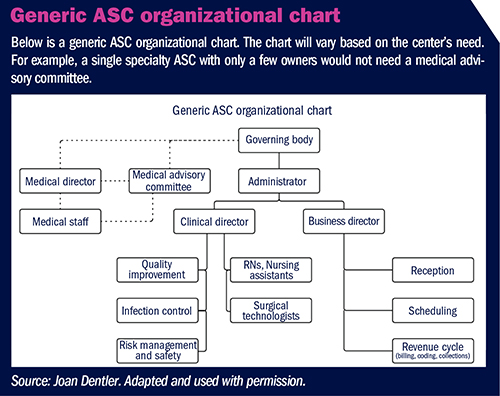
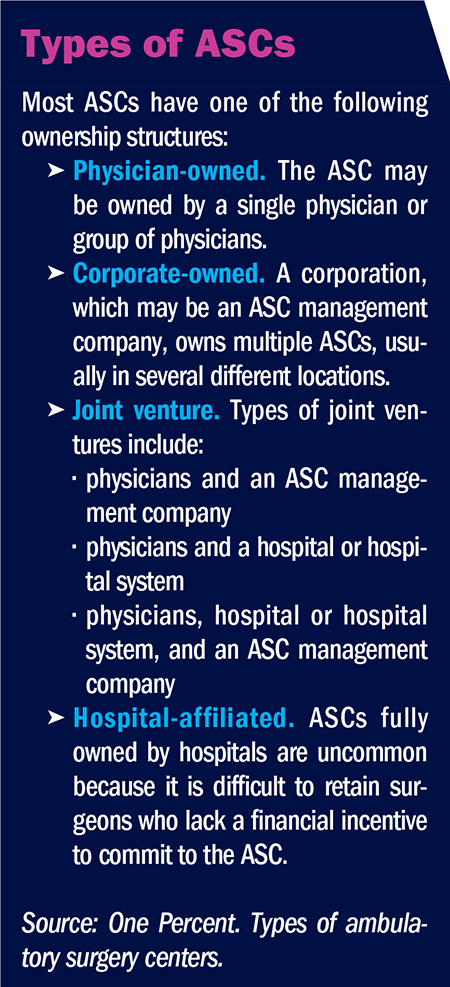 At the top of the ASC structure are the owners (sidebar, Types of ASCs). The key roles under the owners are the governing body, administrator, medical director, clinical director, and business director (specific titles may vary).

Deborah Edelman, MPH
Chosen by the owners, the governing body is the keystone of leadership. “The governing body is responsible for everything that happens in the ASC,” says Deborah Edelman, MPH, senior director, standards compliance and development at the Accreditation Association for Ambulatory Health Care (AAAHC). Those responsibilities include everything from complying with state and federal regulations to the quality of care delivered. The governing body can delegate to the rest of the leadership team to help meet its responsibilities and support daily operations.

Rommie Johnson, MPH, PMP
The governing body selects the ASC’s administrator and defines the authority and responsibilities for the role. The administrator is typically responsible for operational oversight, including adherence to regulations, credentialing of physicians, staffing, patient safety, and infection prevention. A nurse often fills this role, but it is not uncommon for someone with a business degree (who may or may not be a clinician) to be at the helm. However, Rommie Johnson, MPH, PMP, program director for ASCs and office-based surgery at the Accreditation Commission for Health Care (ACHC), says, “In 13 years, I’ve not met one administrator who did not have some sort of clinical background.”
The governing body also selects the medical director, who is “the key part” of the leadership team, Hoeft-Hoffmann says. The physician in this position usually works under a contract and reports to the governing body but may also be a member of the governing body (such as in a small, physician-owned ASC). The person in this role is responsible for medical staff oversight, physician credentialing, and other aspects of ensuring quality care and helps ensure compliance with regulations. The medical director also is responsible for anesthesia services, either serving as its director or overseeing the anesthesiologist or CRNA who fills that role. Anesthesia services are often but not always contracted by ASCs.

Cindy Beauvais, MBA, BSN, RN, CAPA
As the name implies, the clinical director, who reports to the administrator, oversees the day-to-day clinical operations of the ASC. Cindy Beauvais, MBA, BSN, RN, CAPA, an ASC consultant, says the clinical director is often an RN, since the Centers for Medicare and Medicaid Services (CMS) requires an RN to supervise nursing services. For this reason, the clinical director may be called the director of nursing, even though they supervise non-nursing clinical staff as well.
The business director, who often reports to the administrator, is responsible for items such as budgeting, reimbursement, financial forecasting, and revenue cycle management. The business director typically oversees nonclinical staff such as schedulers, coders, and billing personnel. The administrator, clinical, and business directors often attend governing body meetings to provide information and make recommendations, but they usually do not have voting power. “Members of the governing body are the ultimate decision makers,” Beauvais says.
CMS and state regulations dictate some aspects of an ASC’s leadership structure. Hoeft-Hoffmann notes some states require the administrator to be onsite for a specific number of hours a week, while others specify the administrator must be available or on call during the ASC’s operating hours.
Every ASC has articles of incorporation, an operating agreement, or a partnership agreement, which includes who serves on the governing body, bylaws, and key business information such as how shares are sold. Agreements are reviewed periodically and amended as needed. For example, non-compete laws may change.
Size is a major factor in determining leadership structure. “In a small, single specialty ASC the governing body might be made up of two people: the physician and administrator,” Johnson says. Roles often are consolidated, too. For instance, an administrator who is a nurse may also serve as clinical director. On the other hand, larger centers may have an additional layer of nurse managers under the clinical director.
Other than requiring a governing body, “CMS and accreditation bodies aren’t prescriptive about the structure,” Johnson says. This gives ASCs wide latitude. “How you structure your organization is up to you,” Beauvais says. However, the structure should be reflected in bylaws and policies.
Ownership type also influences the leadership structure. In a physician-owned ASC, the governing body will be the physician owners. In a corporate-owned ASC, a corporate board essentially serves as the governing body. A regional ASC director works for the corporation and oversees multiple ASCs, each of which has a local administrator (sidebar, Corporate-owned ASC).

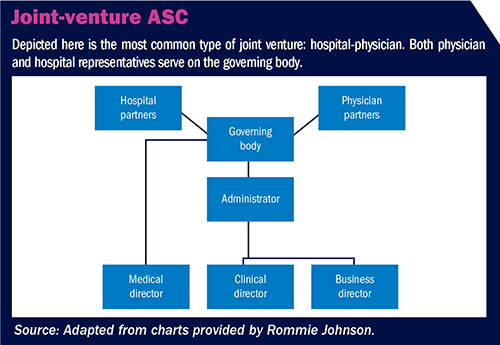
Joint-venture ASCs have a more complex structure (sidebar, Joint-venture ASC). “Typically, the number of seats on the governing body mirrors the equity in the business,” says Joan Dentler, MBA, founder of Avanza Healthcare Strategies. For example, if the hospital owns 60% of the ASC and the physicians own 40%, the governing body might have three hospital members and two physician members. Another factor in governing body make-up is investor class (A, B, or C) because typically there are different rights, responsibilities, and regulations related to each class.

Joan Dentler, MBA
In addition to an administrator, medical director, clinical director and business director, this type of joint venture typically has a medical executive committee, which makes recommendations about clinical operations. “This gives physicians the control they want, even if they don’t own a majority of the ASC,” Dentler says. This committee, which usually reports to the governing body, also makes decisions related to equipment and credentialing. “A medical executive committee can be helpful when you have a large, multispecialty organization,” Beauvais notes. “They can field some issues and even do an initial credentialing review.”
The governing body at Heartland Surgery Center has two hospital members and six physician members. Hoeft-Hoffman and the medical director are ex officio members. The ASC also has a clinical director and OR director. “We need both because of our size,” Hoeft-Hoffman says. The clinical director oversees preoperative and postoperative areas, the scheduler, and the preoperative call nurse (who reviews key information with patients before their scheduled procedure). The OR director supervises OR staff as well as sterile processing, the supply chain coordinator, and the radiology technician.
Whatever the type of ASC, having too many leadership levels is a common mistake. “For example, a small, single specialty organization might have set up a medical executive committee along with their governing body, but this committee isn’t required by CMS and creates one more layer in the decision-making process,” Beauvais says.
An excessive number of committees is another common mistake. Beauvais recalls working with a small ASC that had separate committees for safety, infection control, peer review, and quality. Although one meeting covered all these topics, minutes were written up separately due to the assumption that CMS would require separate committees. However, although CMS requires a quality assessment and performance improvement program, it does not specify “quality committee.” In a smaller facility, all the issues related to quality, such as infection prevention, safety, risk management, and peer review, can be covered by one committee dedicated to that purpose. “People are busy, so you make more work for them and yourself by setting up too many committees,” she says, but adds that some states may require separate minutes.
Requirements for CMS certification are similar for ASCs and hospital outpatient departments (sidebar, From HOPD to ASC). Several organizations offer accreditation for ASCs, including The Joint Commission, AAAHC, and ACHC. Some states require accreditation, and it is a helpful tool for marketing and for negotiating contracts with payers. Requirements typically mirror CMS conditions for coverage, Johnson says. Accrediting bodies such as ACHC and AAAHC, which offer deemed status programs, can conduct a survey of a new ASC far faster than the CMS state surveyors, who, Edelman notes, assign a lower priority to initial certification surveys. Upon receiving the survey results and a recommendation for deemed status, the CMS Regional Office issues the CMS Certification Number (CCN). This speeds the certification process—and allows the ASC to bill Medicare sooner.

While accrediting organizations have specific criteria for what constitutes an accredited ASC, they allow for flexibility when it comes to accomplishing those requirements. “We have flexibility because needs of ASCs differ,” Edelman at AAAHC says. Beauvais adds that many CMS conditions for coverage and accreditation standards “say you have to have a process, but don’t tell you what that process has to be.” Any established process must be applied uniformly.
Whichever accreditation organization is chosen, the leadership team should function as outlined in bylaws and other documents. Johnson and Edelman say that surveyors compare governing body minutes with bylaws and policies to assess alignment. Documentation is essential to avoid discrepancies and to show evidence of communication. A common problem is that “information may have been communicated up or down the hierarchy, but there isn’t any documentation to that effect,” Edelman says. In this case, Johnson says, it appears the ASC is not following its policies. He adds that another common problem is insufficient documentation of the governing body review and approval of credentialing.
In addition, some ASCs develop too many policies that are not relevant to the ASC, making adherence difficult. “Make sure your governing body meeting minutes are very thorough,” Beauvais says. “That tells the story; that shows your governing body is involved in the oversight of the ASC.”
A diverse leadership team promotes the ASC’s success. “I want to have people with perspectives, strengths, and talents different from my own,” Hoeft-Hoffman says, adding that open, honest discussion is important for brainstorming, promoting growth among team members, and holding members accountable. “Our goal every day is to be better,” she says. “We have the mindset that every challenge is an opportunity.”
At Heartland Surgery Center, members of the governing body serve 2-year terms. An ideal governing body is diverse in age. “You don’t want everybody to be within five years of retirement,” Hoeft-Hoffman says. Commitment is also key. “You want members who sincerely care about your center and its growth,” Hoeft-Hoffman says. “Pick people who are committed and want to help ensure the ASC is well run and provides quality care,” Beauvais adds.
Although AAAHC does not have specific standards for governing body membership, Edelman says, “There are benefits to having different experiences and different backgrounds because they are assessing a gamut of factors from financial to administrative to patient care and quality.” She adds that engagement of the governing body is key, including ongoing efforts to improve quality. The AAAHC Institute for Quality Improvement offers tools to help, including benchmarking opportunities.
Once an ASC is established, hectic day-to-day operations can easily crowd out strategic planning, Dentler says. “We get called in because a center that was really busy with surgery and was making money suddenly realizes one of the doctors is getting ready to retire, and they haven’t done any succession planning,” she says. Other examples include new competitors and physicians relocating, taking their patients with them. She recommends scheduling “at least an annual senior leadership and board retreat” to ensure an ASC is prepared for all possibilities.
The bottom line is that setting up a leadership structure based on the center’s needs and following through with ongoing support will lead to long-term ASC success.
—Cynthia Saver, MS, RN, is owner of CLS Development, Columbia, Maryland, which provides editorial services to healthcare publications.
Ambulatory Surgery Center Association. Federal requirements governing ASCs. nd.


