• Failure to understand the complexity of the work performed in the sterile processing department (SPD) can lead to staff shortages, errors, and significant financial loss.
• Strategies for addressing SPD staffing include effective orientation, certification, competency assessment, analyzing staffing needs, and leader visibility.
• SPD schedules should reflect OR workflow patterns, rather than match OR shifts.
Leaders of sterile processing departments (SPDs) face unique challenges compared to their counterparts in other perioperative settings. “The main challenge is a lack of understanding of the actual job requirements, not only by people in other departments but by healthcare as a whole,” says Anthony Bondon, CRCST, CHL, BSM, AAS, SME, LSSYB, central sterile manager at HSHS St. John’s Hospital in Springfield, Illinois. During the pandemic, for example, HR personnel and administrators thought it would be easy to move someone from another department, such as environmental services, to reprocess instruments.

Anthony Bondon, CRCST, CHL, BSM, AAS, SME, LSSYB
This knowledge deficit of the field can hamper SPD leaders. For instance, Bondon says that in a budget crunch, an organization may prioritize a nursing position over an SPD position, even though SPD has the greater need, because, he says, “They don’t understand what we do and the importance of the quality of work that we have to put out.” Bondon, who is president-elect of the Healthcare Sterile Processing Association (HSPA), says executives, administrators, and clinicians outside the SPD need to better understand the complexity of the field.

Joe Hyde, BS, CRCST
Another major challenge for SPD leaders is low pay, says Joe Hyde, BS, CRCST, interim executive director of the sterile processing enterprise for Vanderbilt University Medical Center in Nashville. The enterprise, which includes an offsite SPD, the main campus SPD, and SPDs at ambulatory facilities, processes 20,000 to 24,000 trays monthly. “Pay is the number one frustration on climate surveys,” Hyde says. “That’s been the case everywhere I’ve worked.”

Marjorie Wall, EDBA, MLOS, CRCST, CIS, CHL, CSSBB
Low pay and failure to appreciate what SPD brings to the organization may be why many SPDs are experiencing high turnover and staff shortages. “We have relatively low turnover, but many other organizations are experiencing high turnover,” says Marjorie Wall, EDBA, MLOS, CRCST, CIS, CHL, CSSBB, associate director of sterile processing at Cedars-Sinai in Los Angeles. Dr Wall, who is the immediate past president of HSPA, oversees about 120 employees in two SPDs that are divided by specialty.
For more information related to the pipeline for SPD staff, see Perioperative Workforce 2023: Part 2 (April 2023). Here, the focus is on how SPD leaders can best manage staff and staffing.
It may seem obvious that a scarcity of competent SPD staff will impact surgical operations and ultimately cause lost revenue, but hard data linking SPD staffing to organizational finances is limited. That includes the financial impact of SPD errors, which can be caused by issues such as insufficient staff.
However, SpecialtyCare—which provides SPD, consulting, and education services—and the Wolverine Consulting Group have illuminated how costly SPD errors can be. In 2021, the team analyzed SPD errors that occurred over 1 year at a Midwest hospital. Costs were categorized into three groups: hard costs (associated with OR and SPD staff time required to fix errors), instrument costs (expense of replacing instruments), and soft costs (including customer satisfaction, hospital staff morale, and legal costs related to malpractice suits).
The team found each error cost an average of $6,185, for a total of $1.1 million for the top nine events that accounted for 80% of errors.

Gregg Agoston, BS, MBA, CRCST
That figure is likely an underestimate, says Gregg Agoston, BS, MBA, CRCST, vice president for business development for SPD transformational services at SpecialtyCare. He says most hospitals do not have accurate records for SPD errors. “When we start analyzing their program, we typically see two to three times more errors compared to what they were reporting,” he says.
Agoston notes that preventing errors requires having enough people who are proficient at what they do, the right equipment and supplies, and built-in efficiencies to maximize production. “When you don’t have enough of one or more of those three variables, it really impacts financially,” he says.
How can SPD leaders best address staffing to avoid errors, contribute to the financial health of the organization, and, of course, ensure patient safety? It starts with having a strong leadership team.
SPD leadership teams reflect the needs of each organization, but in general, supervisors, educators, and lead technicians often complement the overall manager (sidebar, Who is on the SPD leadership team?)

In addition to Wall, each of the two main SPDs at Cedars-Sinai has an educator and one supervisor per shift—staff report to a supervisor. The overall leadership team includes an assistant manager to whom supervisors report, a weekend supervisor, and two instrument coordinators. One coordinator manages repairs and purchases, and the other manages vendor loaner trays. The leadership team meets every Wednesday.
At HSHS St. John’s Hospital, where 26 employees support 28 ORs and six GI labs, Bondon has three supervisors—two for day shift and one for evening shift—in addition to a team leader for the night shift. He also has a dedicated SPD educator.
Hyde reports to Vanderbilt’s director of perioperative services. The offsite SPD, which processes 9,000 to 12,000 trays each month, has 31 employees but is budgeted for 43.75. Normally, this SPD also has two managers (one for day shift and one the evening shift), but those positions are currently open. Like Cedar-Sinai, the site has a supervisor for each shift. “Supervisors do troubleshooting and are the first line of defense for team issues,” Hyde says, adding that the supervisors do not have administrative responsibilities.
Hyde likes to develop leaders from staff and to promote continuous leadership development. “We try to grow our leaders to be leaders, not just managers,” he says.
Several factors contribute to ensuring competent staff.
Training. Most SPD staff graduate from a community college program, but others complete only on-the-job training. Community college programs include internship hours, which typically are completed at local hospitals.
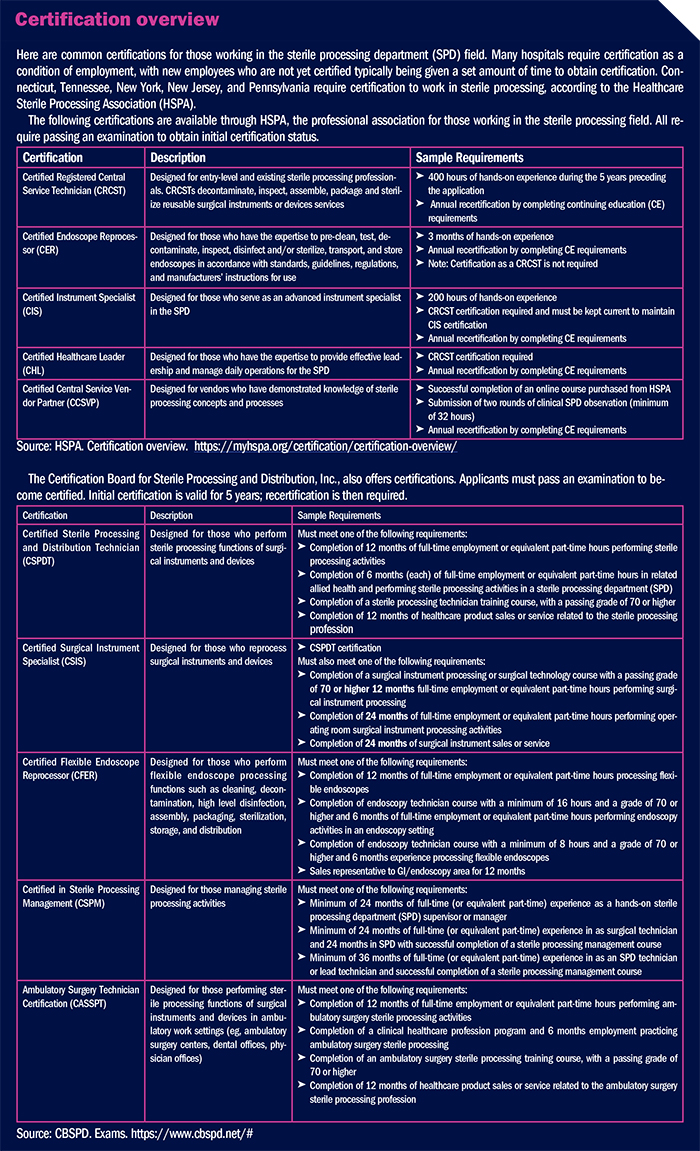
Certification of SPD staff is growing and is required in Connecticut, Tennessee, New York, New Jersey, and Pennsylvania, according to HSPA (see sidebar, Certification overview). Many organizations also require certification on employment or within a set time frame after hire. For example, SPD employees at HSHS St. John’s Hospital have 18 months to obtain the CRCST credential. “We pay for the certification exam fee, so it’s not a financial burden for them,” Bondon says. He and the educator teach a certification preparation course, which is offered weekly for 16 weeks. Employees are paid to attend the course and receive study materials.
“I want my staff to be considered as professionals, and certification is the first part of being a professional,” Bondon says. “To be a truly competent sterile processing professional, you need to combine certification with experience and soft skills.”
Orientation. At Cedars-Sinai, each new employee receives a one-on-one trainer who provides orientation. The educator monitors progress and assesses competencies. Orientation for employees who already have the 400 hours of experience needed for certification typically lasts 6 to 8 weeks. Orientation is longer for those who have fewer than 400 hours when hired.
Bondon finds that employees with no experience require 3 to 4 months of orientation. The first week is mostly didactic, including completion of hospital general education requirements (eg, fire safety) and review of SPD standard operating procedures. Each of the next 6 weeks focuses on a different area—decontamination, manual cleaning, tray assembly, wrapping instrumentation, sterilization, and flexible endoscopes. The remaining weeks are tailored to the individual, addressing areas where the employee needs more assistance in learning. “It’s a heavy investment in the individual,” Bondon says.
Hyde says the company that supplies Vanderbilt with agency staff onboards staff before they start their contract, which is typically 13 to 16 weeks. He requires agency staff to have at least 1 year of SPD experience. The first day on the job is split between hospital orientation and time with SPD educators. At the end of the day, Hyde meets with staff to discuss expectations. “We are constantly trying to increase productivity and efficiency, so I talk to them about how they need to produce,” he says. Staff then dive into their work starting on day 2. “They have to hit the ground running because we’re a large facility,” says Hyde, who also instructs agency staff not to discuss pay with in-house staff and to be team players. Agency staff are included in huddles and are welcomed by in-house staff.
Competencies. Wall says Cedars-Sinai recently expanded use of its instrument tracking system (SPM Surgical Asset Tracking System, Steris) to include competencies. When an employee is working on an instrument with an associated competency, and the employee does not yet have that competency, the system automatically sends a pop-up message asking a supervisor to directly observe the employee as they do the work. The supervisor then validates the work in the computer. After demonstrating the competency, the employee can perform it for 1 year without observation.
At Vanderbilt, SPD staff annual competencies include completing online learning modules and skill demonstrations with educators. Competencies exist at three levels—organizational, perioperative, and SPD.
Size is a major factor in determining whether SPD staff specialize. “In small departments, people are typically cross-trained in many work areas,” Wall says. “As you get into the larger, mega-sized departments, we see a lot more specialization.” Specialization requires investing time to build staff skills to ensure competencies and determining the number of people needed for each specialty to support service lines. In addition, staff should specialize in more than one area to facilitate scheduling.
Education. Maintaining competent staff requires ongoing education. Cedars-Sinai provides a 1-hour inservice every Wednesday at 6 am and 2 pm to facilitate attendance. The program may consist of a presentation by an employee or vendor, or hands-on experience to build skills. “Our staff love it,” Wall says. New trays are made available for a week before implementation (“Show and Tell Inservices”) so staff can ask supervisors any questions before the tray goes into service.
The SPD educator at HSHS St. John’s Hospital is responsible for presenting at least two inservices each month. Bondon promotes additional education outside the hospital through participation in events associated with the local chapter of HSPA. Participation has the added advantage of networking opportunities. He also has some staff members accompany him to HSPA’s annual conference. In addition to education, Bondon says, “Attending the conference gives them a greater perspective on the industry as a whole.”
Bondon often combines education with family activities and likes to include SPD staff from other hospitals. “Our hospitals may be in competition with one another, but SPDs are not in competition,” he says. Most SPD processes are mandated by standards and regulations, and all need to follow manufacturers’ instructions for use, so the work is similar in different settings. At a recent SPD Family Fun Day at a local park, SPD staff and their families in the region enjoyed food, music, and a wave pool. Vendors provided education, and family members could visit a repair van to gain insights into their loved ones’ work. Events like this help build relationships that provide important benefits. “When we encounter problems that we don’t have answers for, we can call other colleagues in the area,” Bondon says.
Although educational needs related to technical skills are easy to identify, Bondon says it is also important for staff to learn soft skills, such as those needed when they communicate with the customers in the many departments with which they interface. Bondon uses role playing to prepare staff for difficult conversations and to learn from ones that have already occurred. “We talk through what happened and what could have been done differently,” he says.
Bondon emphasizes the need to tell the truth. He cites the example of three surgical procedures needing the same instrumentation being scheduled in succession, but because there are only two sets of instruments, the first set will have to be reprocessed before the third procedure can occur. The surgeon or OR staff may demand immediate use sterilization so the case can proceed as scheduled, but that is not safe practice and not what is best for the patient. However, under pressure, staff may say the instruments can be ready in 30 minutes instead of the required 2 hours. Bondon has staff give the correct amount of time and walk the surgeon or OR staff through each step and how long each will take.

Matthew Box, MMHC, CRCST, CHMMC
The SPD staff schedule needs to reflect OR workflow patterns, rather than match OR shifts (sidebar, SPD scheduling pattern.) “What works best is to ramp up throughout the day to meet the instrument volume coming from surgery, with overlap of shifts in the afternoon, then start moving downward in the evening unless you are a large university system that does surgeries all night long,” says Matthew Box, MMHC, CRCST, CHMMC, senior consultant for Sullivan Healthcare Consulting.
Shifts depend on the nature and volume of the work. Cedars-Sinai has three shifts: day (6 am to 2:30 pm), evening (2 pm to 10:30 pm) and night (10 pm to 6:30 am). Wall says starting at 6 am allows staff to miss rush hour and have time to ensure everything is ready for the first case of the day. The evening shift does the bulk of preparing case carts for the next day, but the night shift follows up to add trays that were in processing. The night shift also continues processing trays from the 100 to 150 daily surgical procedures. Staff work every other weekend.

HSHS St. John’s Hospital also has three shifts: 7 am to 3:30 pm, 3 pm to 11:30 pm, and 11 pm to 7:30 am. Night shift staff duties include checking and testing SPD equipment, such as sterilizers, to ensure they are working properly and ready for the next day. Staff serving the main OR work one weekend a month and are on call once a month. Bondon rotates staff members through each work assignment area. In general, staff do not specialize, but two dedicated SPD staff are assigned to the GI lab since processing endoscopes is particularly complex. The two staff who support the ambulatory surgery centers serve as back up for the GI staff; they are on call once a month but do not work weekends or holidays.
At Vanderbilt’s off-site SPD, the standard shifts are: 7 am to 3:30 pm, 2:30 pm to 11 pm, and 10:30 pm to 7 am. The SPD also has a few staggered shifts, such as 9 am to 5:30 pm and 6 am to 2:30 pm. “The overlap helps fill gaps between shifts,” Hyde says. The site is open around the clock during the week, with day shift on the weekends.
Staff members are divided into four teams. “Having teams makes it easier for managers to schedule because there is a set rotation,” Hyde says. Staff know which weekend each month they will need to work. “The predictability improves staff satisfaction,” he adds.
The team approach allows Vanderbilt to publish a 3-month schedule. The first month is final, but the other two also are fairly accurate, which helps staff plan. The final schedule for the next month is released on the 15th of the current month. Once the final schedule is released, managers need to sign off on any schedule changes.
Wall says OR block scheduling facilitates a consistent SPD schedule. The schedule is posted for 2 months at a time, with the next month posted after the first month is completed. For example, June and July schedules are posted; when June is completed, August is posted.
It is important for new SPD leaders to learn how to build a schedule, Wall adds. New managers often give employees either Friday or Monday off, but those are heavy call-out days, so the department can easily become short staffed. Another issue are managers who schedule employees 8 days straight, through the weekend, creating unnecessary stress for staff. “You need to take time to build those schedules,” Wall says. That includes considering factors such as those with modified duties related to short- or long-term disabilities and balancing days off with shift rotation.
An optimal schedule depends on having sufficient staff. Box recommends SPD leaders determine the average number of instrument sets processed during a day and the number of people needed to process those sets. In general, Box says an SPD employee should be able to assemble around four trays in an hour. Instrument tracking systems are valuable so leaders have accurate information. It may be helpful to divide instrument sets into three levels of complexity.
SPD leaders also need to consider how they will factor in individual instrument peel packs; Box says some hospitals count each one as a set, while others have multiple packs count as a set. “You need to determine what your standard will be and not change it so you can do comparisons,” Box says.
Assessing staff needs goes beyond instrument processing. Box says a common mistake SPD leaders make is not considering all the other activities that occur in the department. These include building case carts and ancillary operations such as cleaning medical equipment like IV infusion pumps. “SPD leaders may not realize how these tasks contribute to the department’s volume,” Box says. Another area that may be overlooked is the time to manage loaner sets, especially those that arrive unexpectedly. Leaders also need to consider nonproductive time, such as meetings.
Tracking trends and anticipating future needs, such as the plans for a new surgical services line, are essential to ensure proper staffing, Box says.
Agoston with SpecialtyCare says quality plays an important role in addressing staffing needs. “If you’re not evaluating your quality and you don’t have a good handle on how often errors occur, you won’t have a good handle on if you have enough staff to do the work,” he says. He notes that the three primary goals for every SPD should be to have instruments available, functional, and safe for patient use. Staff will sacrifice safety and functionality for availability, so SPD leaders who are not closely monitoring quality may not be aware of staffing issues.
Unfortunately, Agoston says errors often are not reported by OR staff due to time constraints for room turnover and apathy, which results when incidents are reported but no feedback or correction occurs. He recommends SPD and OR leaders collaborate to ensure accurate and timely error reporting, and for SPD leaders to put quality monitoring processes in place.
A 2019 study by Brooks and colleagues found that SPDs have “low visibility and status” in a hospital’s hierarchy. The findings are surprising given SPD’s important role in supporting surgery. “Without the proper staffing and equipment, the main driver of income for the hospital couldn’t get their job done,” Box says.
“Everyone in the hospital is in some way a customer of SPD,” Bondon says. For example, the SPD processes instruments from procedures done outside the OR, in areas such as the emergency department, medical/surgical units, and labor and delivery. SPD also processes the scopes and ultrasound probes used by respiratory therapy and the imaging department.
Organizations can take action in several areas to strengthen the SPD’s position, including conducting a SWOT analysis (sidebar, SWOT analysis for SPD).

Safety. A study by Nino and colleagues found that those working in the SPD are at risk for musculoskeletal (MSK) disorders due to factors such as awkward positions, prolonged standing, repetitive motions, and handling heavy instrument trays. In addition, mental workload (how much demand a task places on a person’s cognitive function) can worsen posture, further increasing the risk of MSK disorders. SPD workers also are frequently exposed to pathogens such as blood, body fluids, and chemicals used for processing.
Organizations can strive to ensure SPD staff have safe working conditions. In addition to regulations and standards from the Occupational Safety and Health Administration and The Joint Commission, another resource for staff safety—and for staffing in general—are standards from AAMI (sidebar, Staffing guidance). The standard on steam sterilization and sterility assurance also contains recommendations for qualifications of staff and those in supervisory positions.

Communication and visibility. Organizations can show they value SPD employees by being visible through making rounds. At Cedars-Sinai, supervisors are based in the department, and Wall, the assistant manager, educators, or coordinators make rounds throughout the day. They also attend daily huddles in each department at 6 am, 2 pm, and 10 pm.
Visibility is challenging at Vanderbilt’s offsite SPD because it is located 8 miles from the main campus. However, surgeons, department chairs, and residents visit monthly or every other month to view operations. “The staff love it,” Hyde says.
Communicating often and through multiple methods demonstrates the organization values SPD employees. “Everyone takes in information differently, so you have to use different modalities to make sure everyone gets the information,” Wall says. For example, leaders may remind staff about compliance training, or that the number of clamps in a set has been changed during a daily huddle or via a user message that pops up in the SPD tracking system.
In addition to communicating information, Bondon says it is important to communicate caring. “I try to address the whole person and not just the work itself,” he says. “I’ve been able to nurture staff and have seasoned people who understand the why and who we are.” He takes a family-oriented approach, encouraging staff to, for example, participate in their children’s school activities.
Career growth. Organizations are turning to career ladders to promote career growth among SPD staff. Cedars-Sinai staff enter as a level one technician and can advance to levels two and three based on certification, degree of specialization, and years of experience. Level three technicians are responsible for more challenging processing, such as microsurgery trays, eye instruments, robotics, and transplant instrument sets. Wall credits the clinical ladder for the low turnover rate at Cedars-Sinai. “We invest in new employees and develop them,” she says. “They know that they are going to grow with us.”
Box also sees the value of career ladders. “They not only help the organization but give the staff something to come to work for, something to achieve, especially when monetary compensation is tied to different levels,” he says.
Read more about career growth for SPD staff in Perioperative Workforce 2023: Part 2 (OR Manager, April 2023).
Bondon says that promoting sterile processing as a career will help attract and retain staff. “No one grew up saying I want to be an SPD worker,” he says. “It’s a career field that people found, or it found them.” Hyde agrees, noting, “It’s not a well-recognized career.”
Advancing the field depends on filling the knowledge gap mentioned repeatedly by those interviewed for this article. “People outside the SPD don’t understand all that is involved and how it’s grown in complexity,” Hyde says. “A lot of critical thinking is needed for the work.”
Bondon says that it is important to share with those in the community—and others in the healthcare field—the many responsibilities of the SPD.
Examples include:
• reprocessing instruments, which is not, Bondon says, “glorified dishwashing” but instead encompasses disassembly, reassembly, and testing of instrumentation
• proper sterilization and disinfection, which requires using biologicals to check sterilizer efficacy
• proper storage of packs, which requires monitoring air pressure, humidity, and temperature in the storage area.
Hyde feels that certification is helping to advance the field and advocates for more education for SPD leaders, a trend he is already seeing. “More SPD leaders are getting higher education and more degrees to obtain that validation as to what they bring to the table,” he says. Hyde also feels that leadership development should be more ingrained in the field. The payoff for SPD leaders is a staff that meets the organization’s needs. “I have a great team that gets the work done and does it well,” Bondon says.
—Cynthia Saver, MS, RN, is president of CLS Development, Inc, Columbia, Maryland, which provides editorial services to healthcare publications.
Healthcare Sterile Processing Association. Legislative certification issues. nd.
Niño L, Marchak F, Claudio D. Physical and mental workload interactions in a sterile processing department. Int J Ind Ergon. 2020;76.
Sathe P, Agoston G. How your hospital could save millions of dollars each year by improving quality in the SPD. SpecialtyCare. nd.
Sullivan Healthcare Consulting. From staffing to sterilization: The critical aspects of SPD. nd.


