Flipping rooms, or running two ORs back to back, is common in many perioperative services departments. Certain rules of thumb can help ensure efficiency and good outcomes, but sometimes those rules either don’t exist or are unclear.
Does your facility have guidelines for overlapping surgery, and do your surgical teams consistently follow them? It’s a question worth pondering, especially in an era of media coverage that sometimes sends the wrong messages. Negative publicity about overlapping surgery in recent years has led to increased scrutiny and the need for more clearly defined terminology and protocols.
The Boston Globe’s Spotlight team investigation of overlapping surgery in 2015 caused an uproar by suggesting that the practice was tied to an adverse outcome in a surgical case at Massachusetts General Hospital in Boston. Although a jury later found that to be untrue, the fallout from the Globe’s article included a probe by the US Senate Finance Committee of overlapping surgery policies at 20 teaching hospitals around the country.

Diane Skorupski, MS, RN, CNOR, NE-BC
“The article used the words ‘overlapping,’ ‘simultaneous,’ ‘overbooked,’ and ‘concurrent’—and these added confusion to what was really happening in the operating rooms,” explains Diane Skorupski, MS, RN, CNOR, NE-BC, vice president of surgical services at Tampa General Hospital in Tampa, Florida. “Many people were upset at the thought that there was a lack of coherent policy regarding overlapping surgery. It varied from hospital to hospital and state to state. Patients were alarmed—they didn’t know their physician was operating on another patient in another room at the same time as their operation.”
In the wake of this article, the American College of Surgeons (ACS) updated its guidelines, defining the critical portion of surgery as: “Critical or key portions are the parts of the procedure, as determined by the surgeon, when essential technical expertise and surgical judgment are required in order to achieve an optimal patient outcome. The surgeon may leave the operating room for a procedure-related task, during which she/he must be immediately available.” The ACS also stipulates that if the primary attending surgeon is not present or immediately available, another attending surgeon should be assigned as being immediately available.
In December 2016, the Senate Finance Committee issued a report stating that the 20 hospitals had “modified their existing policies or created new hospital-wide policies specific to concurrent and overlapping surgeries, or were in the process of doing so.” But the report also noted that these 20 hospitals are only a portion of the nation’s roughly 4,900 hospitals, and thus the committee still had concerns about patient safety and appropriate payment associated with overlapping surgery.
The correct term for cases in which a surgeon operates on patients in two different rooms is “overlapping,” rather than “simultaneous” surgery, says Ronald Bleday, MD, FACS, FASCRS, associate chief for quality and safety and associate professor, Harvard Medical School; and section chief, division of colorectal surgery, and program director, colorectal fellowship, at Brigham & Women’s Hospital in Boston, a large academic medical center where more than 30,000 cases are performed annually in 43 ORs.
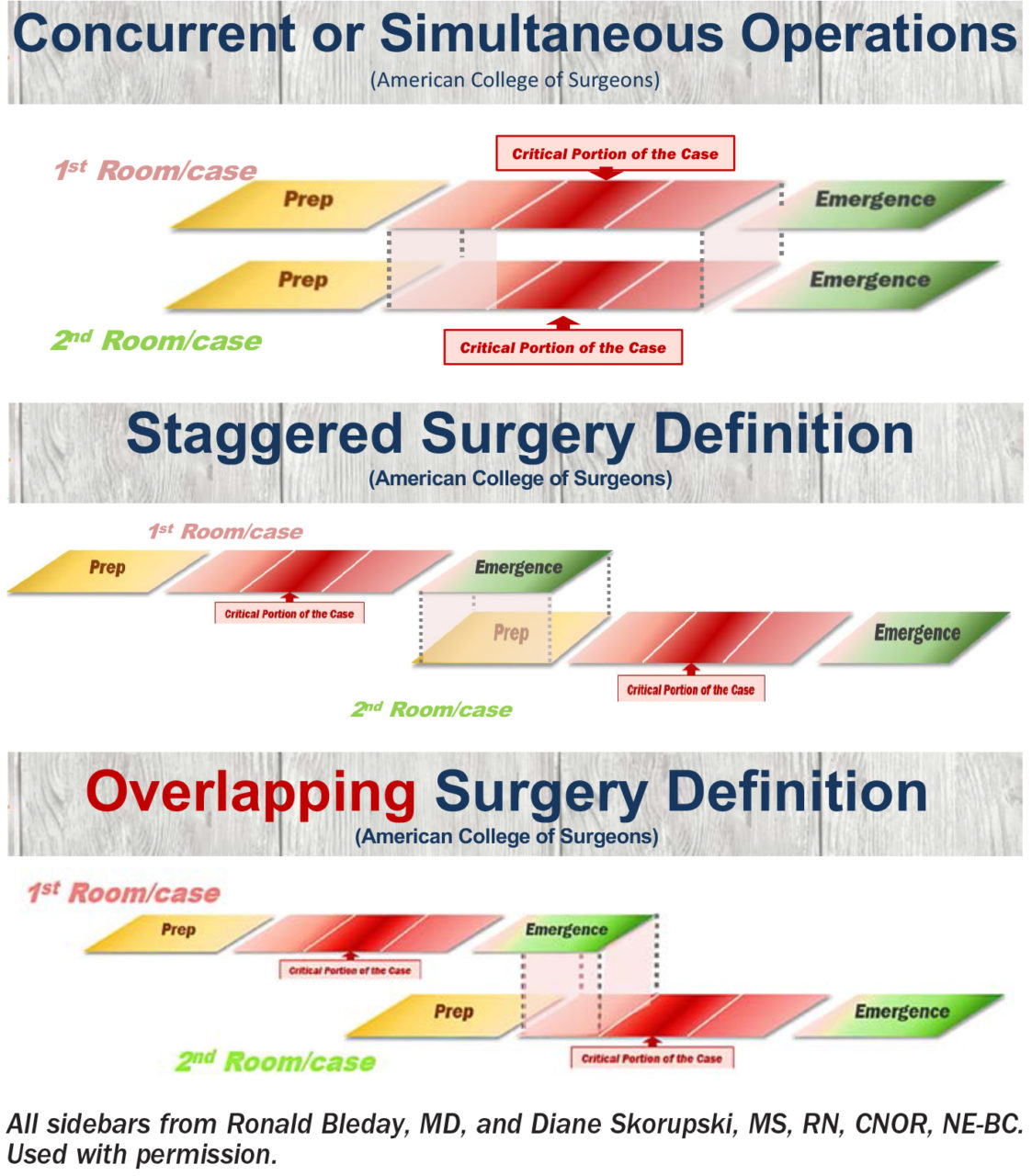 According to the ACS, the primary attending surgeon determines the critical or key portions of the procedure, and it’s inappropriate for that surgeon to be involved in “concurrent or simultaneous surgeries on two different patients in two different rooms.”
Another acceptable term is “staggered” surgery, Dr Bleday says. The ACS defines this as: “the coordination of various procedures for a single surgeon or teams of surgeons throughout the day so that preparation and procedure for one patient begins in one room as the care of another patient finishes in another room. The attending surgeon is present during the key and critical portions of each surgery and oversees all aspects of the team caring for the patient.”
The critical portion of an operation is the time period in which the attending must be in the room. For example, in the case of a gastrointestinal procedure, the non-critical portions would be in the beginning—when the patient arrives in the OR, is prepped, given anesthesia, and positioned—and at the end, after closure, when the patient is put on a stretcher and taken out of the OR, Dr Bleday says. The critical portion is in the middle. “In terms of the surgical time, surgeons can be, but don’t have to be, in the room for non-critical portions of the procedure,” he adds.The differences between simultaneous, staggered, and overlapping surgery are illustrated in the sidebar to the right.
In the case cited by the Boston Globe article, Dr Bleday notes that there was no patient harm caused by the overlap, and the surgeon wasn’t performing critical portions of the procedures at the same time.
Was there inappropriate billing? “We don’t know,” Dr Bleday says, “but that is a comment that gets used by people who feel one shouldn’t be able to bill for overlapping surgery.” He also notes that nonsurgeons may harbor some jealousy about surgeons who can leverage their time for financial gain by performing many cases in a given day.
Since publication of the Boston Globe article, several studies have appeared in various journals—most, though not all, supporting overlapping surgery as a safe practice.
Here are some examples:
• Massachusetts General Hospital did an in-house review of its overlapping surgery policy after the Globe article was published and found no evidence linking overlapping surgery with complication rates.
• A study presented at the American Association for Thoracic Surgery annual meeting found no significant difference between overlapping vs nonoverlapping surgery among more than 1,700 cardiac cases and 1,800 thoracic cases over a 2-year period. The study authors did find, however, that overlapping cardiac cases started an average of 11 minutes later and overlapping thoracic cases ended an average of 20 minutes later than did the nonoverlapping cases.
• A comparison of 3,600 overlapping and nonoverlapping cases over a 3-year period in an ambulatory orthopedic center found no significant differences in operative time or 30-day complication rates.
• A study of more than 1,000 neurosurgical procedures in a 1-year period found no significant difference in rates of overall or serious complications between overlapping and nonoverlapping cases.
However, a 2017 retrospective, population-based cohort study of 960 hip fracture patients (mean age, 66 years) and 1,560 total hip arthroplasty (THA) patients (mean age, 84 years) who had overlapping surgery found an increased risk of complications—notably, infection and early revision. Data came from several health administrative databases in Ontario, Canada. According to this study, the risks for surgical complications from overlapping procedures increased from 6.4% to 10.4% in hip fracture patients and from 1.4% to 2.3% in THA patients.
In a comment on this study, Alan L. Zhang, MD, an orthopedic surgeon at the University of California-San Francisco, said that it seemed to be the first to show an adverse effect from overlapping surgery. Dr Zhang pointed out that because surgeons could not be tracked to determine their presence during critical portions of cases, it’s possible that the increased risk of complications stemmed from more concurrent procedures. “Proper definition of the practice under investigation, whether concurrent or overlapping, is important for interpretation of results,” Dr Zhang said.
Shortly after joining Tampa General, Skorupski was tasked with developing a policy on overlapping surgery. Tampa General, a Level 1 trauma center, is a private, not-for-profit, licensed teaching hospital with 50 ORs and an annual volume of more than 34,000 surgical cases.
 Skorupski turned to some key resources: the ACS guidelines, the Joint Commission, and the Centers for Medicare & Medicaid Services (CMS). Not surprisingly, she found some conflicting information. For example, the ACS says “the patient’s primary attending surgeon should be in the operating suite or should be immediately available for the entire surgical procedure” but also that “there are instances consistent with good patient care that are valid exceptions.”
According to the ACS, the primary attending surgeon should determine the critical or key portions of an operation, and the Joint Commission requires hospitals to follow the ACS guidelines. CMS, however, recommends having a multidisciplinary committee—rather than the attending surgeon—define the critical portion of a procedure.
And just what is the critical portion? Despite the overarching ACS definition, the specifics of “critical portion” tend to vary by procedure and surgeon. The good news, though, is that these professional organizations have sought to define terms and provide guidelines to ensure greater patient safety.
As part of that, greater transparency is important, Skorupski notes. Perioperative services leaders trying to craft policies at their facilities, she says, should focus on:
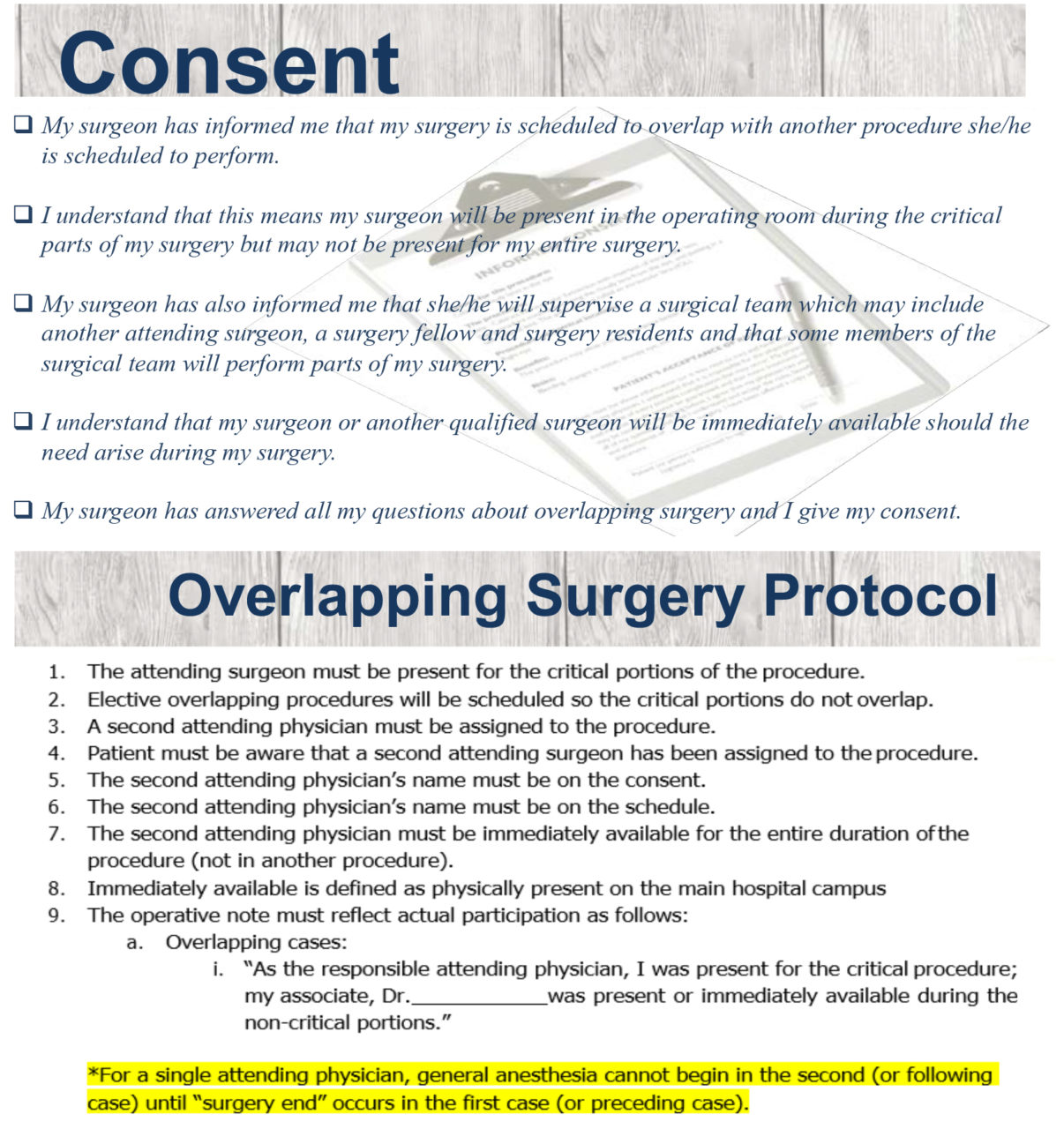
• Full disclosure: Patients should be informed about overlapping surgery schedule practices well in advance of scheduling their procedure. This means telling them about the surgeon’s possible absence during part of the surgery when residents will perform surgical tasks. Patients should also be told they have the right to refuse treatment. A sample consent form is shown in the sidebar on the right.
At Brigham & Women’s, Dr Bleday says, most surgeons who perform overlapping procedures are highly regarded, sought-after physicians.
• Clear definitions: The critical portion of the procedure must be clearly defined so that the patients and the surgical team know that the surgeon may be absent during the beginning and end portions.
• Oversight: Hospital leaders must have a way to ensure that the attending surgeon is indeed present for the critical portion of the procedure, and that he or she is immediately available during the non-critical portions. What does “immediately available” mean? That definition, too, may vary by facility.
“Some hospitals identify the critical portion during the daily huddle and write that on the white board,” Skorupski says. “At Tampa, we also write the name of the surgeon who is readily available.” At Brigham & Women’s, Dr Bleday says, “immediately available” usually means the surgeon is right outside the room catching up on email. The overlapping surgery protocol used at Brigham & Women’s is shown in the sidebar above.
In addition, both the ACS and CMS state that if the primary attending (or teaching) physician is not immediately available, a backup attending surgeon must be available.
Overlapping surgery may seem complicated and full of potential pitfalls—for example, it should be a privilege accorded to experienced surgeons who adhere to policy. And sometimes there are outliers who bend the rules. When that happens, Skorupski says, she enlists the help of her leadership team. “I have a strong surgeon-in-chief and an anesthesia chief,” she says. “They have conversations with the surgeons who are doing this. You must have relationships with physicians and tell them what the implications are—we’re there to protect them.”
When overlapping surgery is well managed, it can be very beneficial. Dr Bleday notes these upsides:
• It allows highly skilled, in-demand surgeons to free up time and perform more specialized operations.
• It enhances training of fellows and residents by giving them more time to work with senior physicians.
• It improves OR utilization by increasing efficiency and reducing overtime.
“At Brigham, there are a couple of orthopedic surgeons and urologists who have mastered overlapping surgery, and their teams know it,” Dr Bleday says. One surgeon can perform as many as six knee procedures in one day, saving the most difficult case for the end to avoid bottlenecks in the schedule.
“It is key for the surgeon to select the right patients,” he notes. “The best patients should be medically stable and undergoing a routine surgical procedure.”
Dr Bleday also cautions that overlapping surgeries are best handled by experienced surgeons because newer surgeons may be overly optimistic about the time needed to complete their procedures.
“When you call the second surgeon needs to be better defined,” he adds. “You have to define ‘critical portion’ beforehand and establish trust.”
Overall, Dr Bleday is enthusiastic about the safety and cost-effectiveness of overlapping surgery. However, he says it is best for short or medium-range cases with high predictability. When used properly, “it can improve the efficiency and safety of the OR environment as well as be a great time saver,” he says. ✥
Bleday R, Skorupski D. Being in two places at once: How to manage one surgeon in two operating rooms. 2018 OR Manager Conference.
Concurrent and Overlapping Surgeries: Additional Measures Warranted. US Senate Finance Committee. December 6, 2016. https://www.finance.senate.gov/imo/media/doc/Concurrent Surgeries Report Final.pdf
Guan J, Karsy M, Brock A A, et al. Overlapping surgery: A review of the controversy, the evidence, and future directions. Clin Neurosurg. 2017;64(1),110-113.
Guan J, Karsy M, Brock A A, et al. Overlapping surgery: 2 years later. Clin Neurosurg. 2017;65(1),55-57.
Ravi B, Pincus D, Wasserstein D, et al. Association of overlapping surgery with increased risk for complications following hip surgery. JAMA Internal Med. 2018;178(1),75-83.
Zhang A L. Overlapping surgery—Perspectives from the other side of the table. JAMA Internal Med. 2018;178(1),83-84.


