The promise of quicker recovery and fewer complications from sedation, anesthesia, and pain management have drawn clinicians and patients alike to procedures performed in ambulatory surgery centers (ASCs) and other outpatient settings. However, sedation, anesthesia, and analgesia add their own risks to those of the procedure itself. Understanding the latest methods and medications in procedural sedation analgesia (PSA) is critical to providing safe and effective care before, during, and after surgical procedures.
The right PSA varies from patient to patient. Factors to consider include the type and duration of the procedure, the expected level of pain, the need for pain control, the patient’s condition, and the patient’s ability to tolerate the procedure. Caretakers also must stay abreast of the latest developments as new drugs evolve and others fall out of favor. Benzoni and Cascella say the most effective PSA regimen should have sedative, analgesic, and amnestic properties with a rapid onset and short duration to enable a safe and quick recovery and discharge.
Sometimes incorrectly referred to as “conscious sedation,” procedural sedation (PS) is “a technique of administering sedatives or dissociative agents with or without analgesics to induce a state that allows the patient to tolerate unpleasant procedures,” according to the American College of Emergency Physicians. PS involves “a continuum of altered levels of consciousness (including minimal, moderate, and deep), and dissociative sedation.”
Further, there is a distinction between sedation, dissociation, and analgesia. Sedation enables the patient to relax and lie still; analgesia is pain management; and dissociation is a state of mind-body separation. PS is not general anesthesia or pain control alone but is an individualized approach for each patient. Because PS is commonly administered by combining sedatives with analgesics to reduce the perception of pain, PS also can serve as PSA.
The Joint Commission outlines three levels of sedation:
• Moderate sedation: Patients can respond purposefully to verbal commands, which may be accompanied by light tactile stimulation. Cardiovascular function and spontaneous ventilation are maintained, and no interventions are needed to maintain a patent airway.
• Deep sedation/analgesia: Patients can respond purposefully to repeated or painful stimulation but cannot be easily aroused. Their ventilatory function may be impaired, and maintaining a patent airway may require intervention. Cardiovascular function is usually not impaired.
• Anesthesia: This includes general anesthesia and spinal anesthesia (spinal, epidural, or a major area of the body), but not local anesthesia. Patients are unable to independently maintain ventilatory function and require interventions such as positive pressure ventilation. Cardiovascular functions may be impacted, and patients cannot be aroused even by painful stimulation.
 The market for sedation agents and analgesics continues to evolve. More effective, safer drugs with quicker onset, shorter recovery, and fewer complications have replaced those older ones.
According to NYSORA, an international educational organization focusing on anesthesiology, ultrasound, regional anesthesia, and pain medicine, propofol is the most frequently administered anesthetic drug for induction and maintenance of anesthesia. With a rapid onset of 15 to 30 seconds and a duration of 1 to 3 minutes, it is widely used for moderate sedation and short-term general anesthesia beyond the OR, whether in the intensive care unit (ICU), the interventional radiology suite, or in an ambulatory setting.
Propofol is an intravenous anesthetic administered as a bolus, an infusion, or some combination of the two. Due to its milky white appearance after dissolving in a lipid emulsion, propofol is also known as “milk of anesthesia.” The drug of choice for general anesthesia in stable obstetric patients, it is also common for sedation in intubated, mechanically ventilated ICU patients. It is safe during pregnancy (although there is a risk of neonatal central nervous system and respiratory depression), as well as in children (maintenance anesthesia for those 2 months and older and general anesthesia for those 3 years and older or with IV access). Off-label uses include treatment of refractory status epilepticus in children and adults and refractory postoperative nausea and vomiting, both common side effects of procedural sedation.

Biraj Patel, MD
In fact, propofol’s antiemetic properties—along with its rapid onset, short duration, and relative safety for a wide range of patients—often leads it to be preferred over other drugs, says Biraj Patel, MD, an anesthesiologist practicing in New York City and founder of PreferredMD. According to literature, although propofol does not have much of an analgesic effect, analgesics such as fentanyl or Toradol can be added to the regimen. Propofol also can be used to reverse some of the effects of local anesthetics, such as seizures. The drug’s quick half-life reduces the risk of overdose in ASC settings, even with a bolus dose. Patients can quickly emerge from procedural sedation with no hallucinations. Propofol’s cost-effectiveness also makes it a drug of choice for many ASCs.
Transient local pain at the injection site is the most common adverse reaction. Dr Patel advises caretakers to monitor patients for airway and hemodynamic status during administration, as high doses could cause decreased cardiac output and arrhythmias. According to Folina et al, potential reactions include airway obstruction and apnea, hypotension, myoclonus, QT interval prolongation on EKG (an irregular heart rhythm that is rarely clinically significant in this context), and discolored urine (a green tint—very rare).
Dr Patel emphasizes that safe, effective administration depends on the skills and training of the practitioners as well as teamwork and communication between the surgeon and anesthesiologist. Appropriately dosing the drug in response to the procedure’s outcome and the patients’ condition is critical, especially in cases warranting a separate local anesthetic or pain medication.

Dr. Patel says he does not anticipate a new anesthetic hitting the market with markedly better properties than and comparable cost-effectiveness to propofol in the near future. However, the quest for the perfect anesthesia drug with a rapid onset and offset, few negative effects on the circulatory and respiratory systems, minimal side effects, and antiemetic or analgesic effects continues. Originally published in June 2022 in the Journal of Clinical Medicine, the graph above (sidebar, Novel hypnotics in development) highlights the new drugs going through various stages of the approval process.
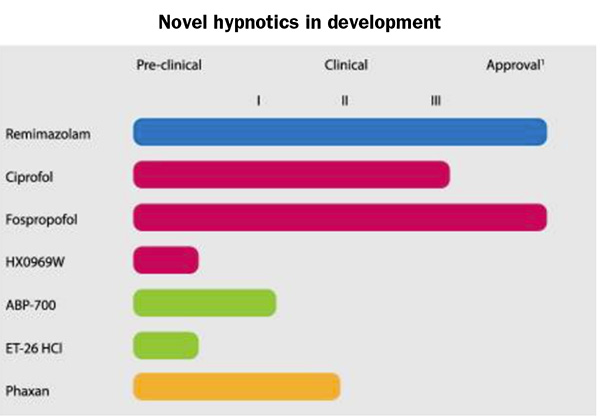
An overview of novel hypnotics and their current status in drug development, originally published June 2022 in the Journal of Clinical Medicine. Blue: Benzodiazepine derivative. Red: Propofol derivatives. Green: Etomidate derivatives. Orange: Steroid.
One of the two examples approved by the FDA is fospropofol, a water-soluble prodrug of propofol with prolonged onset and recovery times. Initially known as GPI 15715, fospropofol was approved as an alternative to propofol to address pain at the injection site, the risk of bacterial contamination, and hypertriglyceridemia with prolonged infusion. It has been shown to be effective and safe for sedation during colonoscopy, bronchoscopy, and minor surgical procedures. Although it is expected to cause less hypotension and less respiratory depression than propofol, these benefits have not been clearly demonstrated. A perineal burning sensation and pruritus are common side effects. Similar to propofol, airway management is essential and should be performed by personnel trained in airway management.
Combining remimazolam—the second FDA-approved drug on this list—with oliceridine is an emerging trend in moderate sedation, says Shawn Craddock, DNP, RN, CNOR, NE-BC, senior consultant at Sullivan Healthcare Consulting in

Shawn Craddock, DNP, RN, CNOR, NE-BC
Alpharetta, Georgia. Pairing a short-active anesthetic (remimazolam) and a potent short-acting opioid (oliceridine) provides effective sedation and analgesia, but with fewer side effects (such as nausea, vomiting, constipation, and respiratory depression) than their relatively older counterparts. Both drugs were approved individually in 2020, and the combination could eventually rival established sedative-analgesic combinations (eg, propofol and fentanyl) for moderate sedation.
More information about the remimazolam and oliceridine combination can be found in an article by Goudra and Mason listed under the References. In clinical trials, remimazolam significantly decreased the incidence of hypotension and respiratory depression and had a faster recovery time compared to propofol. Compared to midazolam, it had a faster time to discharge and to return to neuropsychiatric function. Oliceridine (Olinvyk®) is approximately five times more potent than morphine and has a wider therapeutic window, as well as an onset of 3 to 4 minutes. It also has relatively lower respiratory depressant properties. As an analgesic, it can pair well with benzodiazepines and other intravenous anesthetics, such as propofol, in moderate and deep sedation.
Examples of other common intravenous anesthetics are outlined in the table below, based on articles by Benzoni and Cascella, Ramos-Matos et al, Lingamchetty et al, and NYSORA. The list of IV PSA agents and their characteristics are by no means comprehensive. Practitioners should consult clinical indications, dosage, side effects, and caution for each drug.

Some PSA agents are inhaled rather than administered intravenously. For example, nitrous oxide (N2O) is an analgesic/anxiolytic gas with rapid onset and fast recovery. The drug is delivered with oxygen and has a wide margin of safety. It has little effect on respiratory function, nausea and vomiting are uncommon, and reflex integrity is maintained. Nitrous oxide is contraindicated in:
• chronic obstructive pulmonary disorder
• severe emotional disturbances or drug-related dependencies
• the first trimester of pregnancy
• treatment with bleomycin sulfate
• recent tympanic membrane graft
• methylenetetrahydrofolate reductase deficiency.
Desflurane is an inhalational anesthetic used to induce and maintain anesthesia in adults. It may also be used for the maintenance of anesthesia in pediatric patients following induction with other drugs. Unlike other anesthetics, desflurane is not associated with nephrotoxicity. Although expensive, desflurane has become more popular over the years due to its rapid onset compared to other inhalational anesthetics.
However, every anesthetic has side effects. A potent vasodilator, desflurane has been associated with increased intracranial pressure and, in pediatric populations, the emergence of delirium. The most critical impact of desflurane is its carbon monoxide production. In fact, data from the UK’s National Health Service (NHS) suggest the gas produced by desflurane has a global warming potential 2,500 times greater than carbon dioxide. Scotland became the first country to ban the use of desflurane in 2023, according to Euronews, and NHS England (which leads the NHS in England specifically) appears likely to prohibit it for anything but exceptional circumstances. The European Union plans to ban desflurane use beginning January 1, 2026.
It is tempting to draw a conclusion about which is the “best” PS or PSA. Various practices have yielded effective therapeutic results. Benzoni and Cascella highlight that the combination of fentanyl and midazolam is widely adopted, but other combinations (eg, propofol and fentanyl or propofol and a mixture of propofol and ketamine) are also used with frequency. Combining a short-acting benzodiazepine such as midazolam (sedative, amnestic, and anxiolytic properties but not analgesic effects) with an opioid (eg, fentanyl) is also an option. As described previously, the remimazolam-oliceridine combination has gained attention recently and could grow in moderate and deep sedation practice.
The level of sedation needed depends on the type and duration of the procedure, the patient’s condition, their vital signs, their ability to tolerate the procedure, the expected pain amount, and the need for pain control. Each sedation and analgesic drug has advantages and disadvantages. The selected agent must meet the patient’s needs and profile. Administration of therapeutic agents and patient monitoring must be conducted according to practice standards and the facility’s policies and procedures. Benzoni and Cascella stress that “the ideal agent for PSA purposes should possess sedative, analgesic, and amnestic properties as well as a rapid onset and short duration of action to allow a safe and quick recovery and discharge.”
Craddock says ACSs and practitioners must consider what is best for the patients, balancing between the required therapeutic effects, patient safety, practitioners’ skills and credentials, and cost-effectiveness. When it comes to PSA, this translates to choosing an appropriate level of sedation for the desired outcomes with limited risks and assigning qualified personnel to administer the PSA. For example, moderate sedation could be administered by skilled nonanesthesiologists (subject to state laws).
—Uyen Vo, BSN, MBA, is a freelance writer with more than 20 years of experience in healthcare.
Benzoni T, Cascella M. Procedural Sedation. StatPearls. July 3, 2023.
Folino T B, Muco E, Safadi A O, et al. Propofol. StatPearls. July 24, 2023.
Khan J, Liu M. Desflurane. StatPearls. June 11, 2022.
Lingamchetty T N, Hosseini S A, Saadabadi A. Midazolam. StatPearls. June 5, 2023.
NYSORA. Intravenous Anesthetics. Accessed February 2024.
Ramos-Matos C F, Bistas K G, Lopez-Ojeda W. Fentanyl. StatPearls. May 29, 2023.


