What is the purpose of the top 10 health technology hazards list, released every year by ECRI? “Our number one goal at ECRI is to reduce preventable harm,” stresses Jason Launders, MSC, former director of operations, device evaluation, at ECRI. “We know that every healthcare provider has a lot they keep track of, but they shouldn’t solely rely on the technology they have. We want to help stop serious injury to patients.”
 Understanding these technology hazards is crucial for ensuring patient safety, but Launders urges providers to start at the very beginning. “Let’s be clear on ‘hazard,’” he says. “A hazard increases risk of something going wrong or someone getting hurt. Most importantly, a hazard is something we know of and can do something about.” Medical devices and the systems they use may be invaluable to patient care, but they are not perfect. The first step is to accept that hazards—flaws in the devices or faults in the systems—can innately happen. Harm can come to both patients and staff if hazards are not identified.
Then comes the action. This list consists entirely of items that ECRI can do something about, “whether a fault in the design, misdirection on how a device is used, or miscommunication,” Launders says. He adds that ECRI’s work is meant to help providers understand the risks and put into place actionable plans to mitigate said risks. “ECRI’s recommendations go from alerts to manufacturers on faulty pieces of equipment or instructions for use (IFU) that need rectifying to potential guidelines for providers on improving instructions, training, and adherence to procedures in the healthcare setting.”
At this year’s OR Business Management Conference in Phoenix, Arizona, Launders presented the full list of the top 10 health technology hazards identified by ECRI’s Device Evaluation Lab. The list, which is “grounded in evidence and extensive device testing,” as Launders explains, identifies the high-priority sources of hazards in medical technologies. It emphasizes the need for ongoing vigilance, better reporting mechanisms, and a proactive approach to integrating new technologies safely.
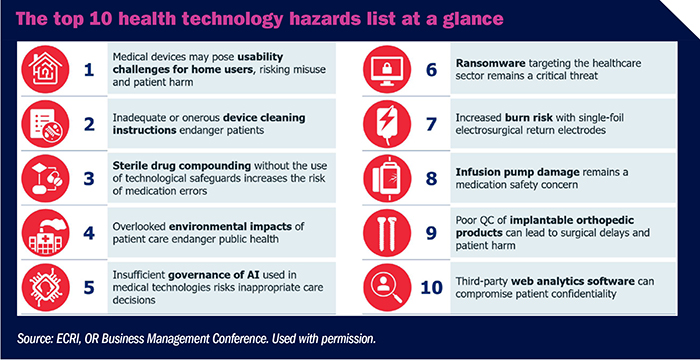
ECRI determined that the following items warrant priority attention in 2024. Each hazard highlighted comes with key recommendations for providers to mitigate risks. Here is what healthcare providers, policy makers, and patients need to know in this year’s list:
1. Medical devices used at home pose usability challenges
As more patients receive care at home, ensuring the safe use of medical devices outside the hospital setting becomes a growing concern. “As soon as you move outside the hospital, you move outside all the controls that we have to ensure the safe use of devices inside the hospital,” says Launders.
Recommendation: ECRI recommends patients and caregivers are assessed so devices well-matched to them are selected. Users at home need to be properly trained, and user support should be readily accessible.
2. Inadequate device cleaning instructions endanger patients
The lack of clear, effective cleaning guidelines and IFU for medical equipment can jeopardize patient safety. In a survey done by APIC last year, 68% of respondents reported that medical equipment IFU lacked clarity about how to appropriately clean the product, Launders says.
Recommendation: ECRI recommends that the reprocessing options for reusable medical devices/items be considered before purchase. ECRI also urges users to consider alternative vendors if validated instructions are not available or not practical in the environment in question.
3. Sterile drug compounding without technological safeguards raises risk of medication errors
Technological solutions can significantly reduce errors in drug compounding, yet adoption rates remain low. Launders speaks of a facility that implemented such a solution, “Once they started using it, they discovered that the [technology] actually pointed out errors in 7.1% of all the compounding they were doing.”
Recommendation: ECRI urges pharmacy personnel to use technological safeguards to minimize opportunities for human error.
4. Overlooked environmental impacts of patient care endanger public health
Healthcare’s environmental footprint, particularly from single-use devices and waste, calls for more sustainable practices. “Healthcare is responsible for over 8% of all greenhouse emissions,” says Launders. “We have to make sure that our patients and our caregivers understand the importance of being conscientious.”
Recommendation: ECRI recommends ways to minimize environmental harm without compromising patient care, such as reducing energy consumption in the imaging suite, anesthetic gas emissions, and the purchase of unnecessary single-use items.
5. Insufficient governance of artificial intelligence (AI) in medical technologies increases risk
The integration of AI in healthcare promises efficiency but raises concerns about oversight and ethical (mis)use. “It gets frightening when a computer is seemingly taking control and making decisions, specifically patient care decisions, without 100% oversight by human beings,” says Launders.
Recommendation: ECRI says an AI governance program should assess risks when considering an AI-powered system; test whether it works with relevant patient populations and care practices; and monitor performance, complications, and maintenance.
6. Ransomware targeting the healthcare sector remains a critical threat
Ransomware attacks target healthcare due to the critical nature of services, with smaller facilities at greater risk due to limited cybersecurity resources. “Hospitals cannot afford to be down on their operations at all; therefore, they are far more likely to pay the ransom,” says Launders.
Recommendation: ECRI urges providers to deploy a framework for identifying and protecting against risks, detecting and responding to threats, and recovering from attacks.
7. Burn risk with single-foil electrosurgical return electrodes is high
Patient burns from electrosurgery are a persistent issue despite the availability of technology that can prevent most burns. “For over 20 years, there have been systems available that should prevent pretty much all burns,” says Launders. “Single-foil, conductive return electrodes should no longer be manufactured, sold, or used for adult patients.”
Recommendation: ECRI recommends using alternatives to single-foil return electrodes.
8. Infusion pump damage remains a medication safety concern
The prevalence of infusion pump issues shows the importance of proper equipment maintenance and reporting. “There have been too many incidents where our investigations revealed that a major part of the pump was missing or damaged,” Launders says.
Recommendation: ECRI says clinicians should not use a pump if damage is visible or any part of the setup seems abnormal, and nurse educators should train staff to identify failure modes observed in the facility and common signs of pump damage.
9. Poor quality control of implantable orthopedic products can lead to surgical delays, poor outcomes
A surprising number of recalls for orthopedic implants signal a need for better quality control and tracking. “Of all FDA recalls, 20% are regarding orthopedic implants,” says Launders. “It could take 20 years before we see the effect [of a faulty implant], and data show that the lifetime of an implant is actually going down.”
Recommendation: ECRI has recommendations for both purchasers and frontline staff, such as establishing a process for clinicians to report defective products and checking for signs of defects before use, respectively.
10. Third-party web analytics software can compromise patient confidentiality
Healthcare providers must navigate the challenges of using web analytics tools without compromising patient privacy or violating HIPAA regulations. “Healthcare providers are being tempted into putting these web analytics tools on their websites, which could and have been in breach of HIPAA,” says Launders.
Recommendation: ECRI urges healthcare facilities to develop policies governing the use of third-party web analytics software for sites containing patient information (eg, patient portals) and audit customer-facing web applications.
The above list is specific to technology-induced hazards, which are faults with the devices themselves. ECRI also compiles and publishes a top 10 Patient Safety Concerns list, which includes process-related issues and management faults that compromise patient safety. OR Manager will also report on the patient safety concerns list after it is released next month.
ECRI’s lists are critical resources that highlight the areas where attention and action are most needed. Healthcare providers are encouraged to use these lists as guides to prioritize safety initiatives and engage in continuous education about potential risks.
An Executive Brief describing these topics is available from ECRI for download on its website at www.ecri.org/2024hazards. The full report—it includes additional resources and step-by-step recommendations beyond what is listed in this article for addressing the hazards—is available to members of ECRI programs. For questions, contact ECRI at (610) 825-6000 or clientservices@ecri.org.
—Tarsilla Moura is senior editor of OR Manager.
Launders J. ECRI’s Top 10 Health Technology Hazards 2024. OR Business Management Conference. February 2024.
Top 10 Health Technology Hazards for 2024 Executive Brief. ECRI. January 2024.


