While demand for OR services can be unpredictable, supply is largely fixed—well below the baseline for many hospitals and health systems. The ability to match supply and demand within perioperative services is critical to efficient ORs, as hospitals and health systems must operate with constrained staffing and anesthesia resources.
On the supply side, along with appropriately skilled staff, equipment like robots, and consumables like sterile supplies, healthcare organizations crucially need anesthesia coverage. On the demand side, OR leaders and their teams must juggle highly variable volume, procedure types of varying complexity, timing, and estimated duration, alongside highly variable anesthesia needs.
Mismatch in this supply and demand in the OR overall exacerbates the special challenges involved in optimizing anesthesia coverage and its reimbursement.
The ability to match anesthesia supply to OR demand has become more critical in the current environment, and more difficult to achieve. Nationwide, the supply of certified practicing anesthesia providers is declining because of many factors, including an aging and retiring workforce, lingering impact of the COVID-19 pandemic, and challenges associated with practice economics.
Meanwhile, demand for surgical services continues to rise, and deploying anesthesia resources day-to-day presents its own challenges. Given emergency surgical procedures, cancellations, and delays, ORs remain extremely unpredictable settings for which anesthesiologists struggle to plan their time and resources accurately.
Beyond this, anesthesia providers must offer coverage to not only surgical patients, but to other procedural units such as interventional radiology, labor and delivery, and cardiac catheterization labs. Practicing anesthesiologists are also often responsible for nonpatient facing work, such as call coverage and serving in medical director roles. Their available supply of time being insufficient to meet demand from hospitals, compounded with the ongoing unpredictability of OR needs, means anesthesiologists struggle to generate enough reimbursement through hospital-based cases, which results in hospitals paying for anesthesia coverage outright.
Reimbursement for anesthesia care is typically calculated by base and time units. Anesthesia providers’ pay is thus patient-treatment based, and often the coverage demanded does not generate enough reimbursement to cover anesthesiology provider salaries, let alone overhead. Reimbursement also depends on payer mix and how efficient or inefficient the ORs actually are day-to-day. As a result, maximizing OR efficiency overall by reducing scheduled downtime is critical. Otherwise, the hospital is paying to be inefficient, and every unused minute of an anesthesia provider’s time is money.
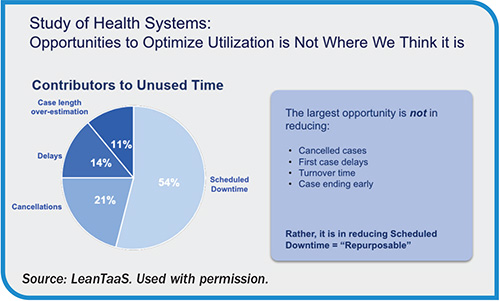
Scheduled downtime accounts for more than half of the opportunity for increasing OR utilization, and thus helping anesthesia providers be productively and efficiently deployed in the OR. An underlying cause is the very definition of that block time.
Despite volatility in demand for OR services, most hospitals use a static block management system to right-size their ORs that assumes some level of “predictability.” This often results in block owners being allocated more block time than they need, leading to downtime when that block is unused (see figure, Contributors to unused time).
To mitigate this outcome, which makes planning anesthesia coverage difficult along with reducing reimbursement for that coverage, perioperative leaders must address three significant challenges:
• Limited access to ORs: Providers are often unaware of first-come first-served time outside of their block, and/or cannot secure this time. Constraints in anesthesia resources also lead to less open time being available, creating a vicious cycle.
• Lack of visibility into OR schedules: Surgeons and their schedulers cannot see where scheduled downtime exists today.
• Lack of accountability for block utilization and block time: Block utilization is an imperfect metric that does not guide stakeholders to support positive operational changes and right-size their ORs. This creates stressors on anesthesia resources when time is over allocated and underutilized, for example.
These challenges involve complex math that cannot be solved through human efforts. ORs need support from high-powered AI and analytics to begin addressing these and creating greater predictability and efficiency.
AI and analytics tools use historical patterns to predict upcoming demand for services and their anesthesia needs. When addressing challenges with decreased scheduled downtime, efforts to maximize utilization, and anesthesia coverage, AI and analytics tools can calculate the best use of existing supply and coverage, eliminate downtime, and support higher anesthesia reimbursement by:
• Providing deeper dive into contextualized metrics for OR and anesthesia utilization: The goal of an effective analytics solution is to elevate visibility and transparency into OR utilization, providing a single source of truth that is relevant to all stakeholders, including anesthesia. This empowers perioperative services to be nimble; make informed operational, strategic, and tactful decisions; and implement course corrections on a day-to-day basis as demand volatility arises, meaning anesthesia coverage will only be requested when it is likely to be gainfully used.
Detailed analytics also play a key role in (re)negotiating anesthesia contracts to match supply to demand and/or justify coverage models built on more than “gut instinct.” A more specific and actionable metric than block time utilization is prime time utilization, which measures how organizations are performing during peak business hours. Similarly, staffed room utilization illustrates how organizations are using rooms they plan to staff. Both of these metrics are invaluable for OR leaders to understand how efficiently their ORs are performing and when is the most opportune time to justify additional anesthesia resources.
AI-powered technology can support the tracking and improvement of prime time and staffed room utilization by providing real-time access to ORs for surgeons and schedulers to book cases in prime business hours, thus optimizing room utilization by “bin-packing” ORs more efficiently. This technology can also optimize OR utilization by providing visibility into current OR performance and push predictive and prescriptive insights—such as case volume and staff predictions—to ensure enough anesthesia resources are available to support the demand, without overusing them.
• Identifying chunks of repurposable time, which is more actionable and surgeon-centric to right-size block assignments for productive use of anesthesia: While block utilization is treated as a universal key performance indicator in ORs, blocks are in fact used in different ways depending on the surgeon, service line, day of the week, and case mix complexity. Being able to identify sufficiently large chunks of truly repurposable time by leveraging case data can visualize block time for physicians and make it easy to see variability on a day-to-day basis. Because gaps between cases are not always repurposable, organizations can set parameters like 3- and 4-hour spans to identify chunks of time that can be used productively (ie, the length of time to complete a case). The goal of this methodology is to promote proactive releases of time so they can be repurposed. This makes physicians and anesthesia partners more successful, and the OR much more efficient.
When AI solutions evaluate historical booking patterns for each physician, they can automatically remind a physician to proactively relinquish OR time if their current bookings are low. Smart, automated reminders sent via email or text message streamlines conversations and processes around scheduling and promotes an outstanding surgeon and scheduler experience. As providers use analytics-built visualizations to understand where their idle time exists within the block schedule, they understand where time can be collected and repurposed to best fit supply and demand, leading to balanced and optimal schedules for anesthesiologists.
• Empowering leaders to use predictive and prescriptive insights to make operational-based changes to better the whole institution, including anesthesia: For ORs that must continue to accommodate staffing and resource constraints, AI and analytics solutions empower end users to reduce staff and anesthesia coverage and close rooms in advance based on knowing which blocks will be unused. Stakeholders can then repurpose staffing based on block fill predictions (eg, reduce the number of travelers/locum staff, adjust afternoon staffing and anesthesia assignments, and flex anesthesia staffing and auxiliary staff).
With AI and analytics-based support, anesthesia supply can be best matched to OR and surgeon demand to optimize performance and decrease costs associated with staffing, supplies, and facility operations. By identifying large chunks of scheduled downtime that are truly repurposable, perioperative and anesthesia leadership can diminish expensive idle time while simultaneously optimizing prime time utilization and/or staffed room utilization that is consistently active and productive for anesthesia providers, as well as provide the most optimal outcome for the institution.
Advanced analytics and superior block management decision support tools have generated an incredible amount of realized opportunity and return on investment in health systems and hospitals nationwide where supply best matches demand.
Imagine cutting scheduled downtime by 30% and confidently refilling unused time through prescriptive analytics at a high degree (eg, 75%). That conversion saves on costs by decreasing idle anesthesia and staff hours as well as overtime and overhead costs from running ORs longer—it can cost $100 or more per OR per minute to simply keep the lights on. It also maximizes prime time utilization and drives revenue growth by allowing other providers to use repurposed time at a high degree.
Finally, such solutions also improve anesthesia providers’ satisfaction, as they lead to less idle time during which cases are not scheduled and maximize anesthesia reimbursement by supporting greater OR efficiency. In today’s ecosystem, where skilled staff and anesthesia resources are at a premium for most hospitals, this type of solution leverages AI and machine learning to best match the supply and demand patterns unique to each institution.
 —Drew Domagalski is senior solutions executive, iQueue for Operating Rooms, at LeanTaaS.


