It is often said that small actions lead to big results. This so happens to be the case with hand hygiene compliance (HHC) in healthcare. Imagine a simple act, like washing hands, cutting infection rates by half—hospital-acquired infections (HAIs) and surgical site infections being reduced simply by improving handwashing behaviors. Now consider how this act is often overlooked by many in critical spaces like the OR.
HHC is essential to infection control, endorsed by both the Centers for Disease Control and Prevention and the World Health Organization (WHO) and directly linked to preventing HAIs and improving patient outcomes. While the WHO’s “Five Moments of Hand Hygiene” is widely recognized as a global framework for hand hygiene practices, its application in perioperative environments has been inconsistent. Compliance remains a challenge, lagging due to systemic and behavioral barriers, particularly among non-scrubbed OR personnel. Traditional approaches have historically focused on those required to scrub for procedures and have left gaps among team members such as anesthesiologists, circulating nurses, and OR assistants.
A quality improvement project at Hospital for Special Surgery, Stamford Hospital, an ortho-spine unit with four ORs, set out to tackle this problem, and the results were transformative. Pre-intervention audits at the hospital showed concerning levels of HHC in situations such as contact with patient surroundings. While scrubbed personnel adhered to established hand antisepsis protocols, non-scrubbed staff frequently missed hand hygiene opportunities, particularly when entering or exiting the surgical suite or after patient contact.
The root causes were multifaceted: lack of awareness and/or education, insufficient access to hand hygiene stations, and behavioral resistance. Addressing these challenges required a tailored, evidence-based approach. This article delves into this 6-month quality improvement project, which used visual cues, education, and increased accessibility to hand hygiene resources to create measurable improvements in HHC, leading to significant compliance improvements.

Example of hand hygiene monitoring and compliance tool. Used with permission.
The WHO defines five critical moments for when healthcare workers should perform hand hygiene to minimize the risk of cross-contamination. Each moment addresses a specific risk point where pathogens can be transferred, making adherence essential for maintaining a sterile environment and upholding patient safety. While originally developed for broader healthcare environments, these five moments can and should be applied to the specialized OR setting.
Here is how each moment is relevant to the perioperative environment:
Perioperative personnel entering the sterile environment of the OR cannot introduce external contaminants. This step involves sanitizing hands after touching non-sterile surfaces outside the OR (eg, door handles, electronic devices) and before crossing the threshold. This is particularly critical for non-scrubbed personnel like the circulating nurses who frequently move in and out of the OR to retrieve supplies or perform other tasks.
Hand hygiene before direct contact with a patient is crucial, particularly during activities involving non-intact skin or mucous membranes, insertion or disruption of invasive devices, and administration of medications. For non-scrubbed OR personnel, this includes tasks like assisting anesthesiologists during intubation, securing patient monitoring equipment, or handling intravenous (IV) lines. Effective hand hygiene during this moment protects patients from pathogens that might otherwise be transferred during a procedure.
This moment involves sanitizing hands immediately after any task that might expose staff to blood, bodily fluids, or other contaminants. In the OR, such exposure can occur during tasks like suctioning, assisting with Foley catheter insertion, or disposing of biohazard materials. This moment is especially relevant for circulating nurses and OR assistants, who are often responsible for handling instruments or waste materials that could be contaminated. Non-compliance at this juncture increases the risk of spreading contaminants to other surfaces or team members.
Hand hygiene after exiting the OR helps perioperative personnel ensure they do not carry contaminants into other areas of the hospital. For example, when a circulating nurse steps out to retrieve supplies or provide updates to family members, they must sanitize their hands to prevent cross-contamination.
Hand hygiene is still needed even when there is no direct patient contact. This moment applies to touching inanimate objects in the patient’s vicinity, such as surgical tables, equipment, or door handles. In the OR, this often involves interactions with monitoring devices, IV pumps, or non-sterile surgical instruments. While this step is well-defined in other healthcare settings, its application in the OR has been less straightforward due to the complex workflows and the constant presence of inanimate objects.
During the initial phase of this HHC project, the above five moments were clarified and reinforced to ensure all non-scrubbed personnel understood their importance. Then through education, visual cues, and increased sanitizer accessibility, compliance at each of the five moments significantly improved.
In a nutshell, the multipronged strategy entailed:
• Education
• Visual cues
• Accessibility
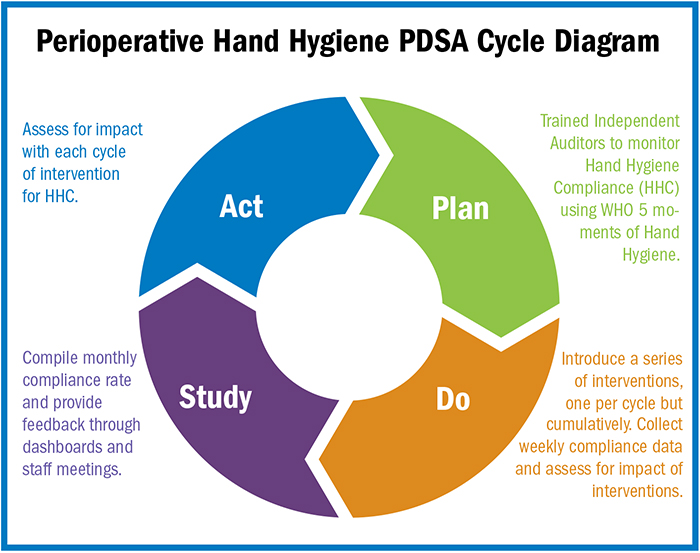
Using the Plan-Do-Study-Act (PDSA) framework, the project systematically evaluated interventions over six months. The inclusion criteria focused on all non-scrubbed personnel in the OR suite, ensuring data validity while excluding vendors and students.
Key steps included:
• Pre-intervention phase. Baseline compliance data were collected for 2 months, revealing low adherence rates among non-scrubbed personnel.
• Intervention cycles. A new intervention per month was introduced over 3 months:
• Data collection and analysis. Trained auditors recorded compliance using an adapted WHO monitoring tool (sidebar, Perioperative hand hygiene monitoring tool). Observations covered all five hand hygiene moments. Data were analyzed biweekly using SAS software. Compliance rates were calculated as percentages and assessed using Chi-square tests and logistic regression models.
The project recorded 179 observations of non-scrubbed personnel, revealing remarkable improvements (sidebar, Compliance rates by role). The most significant impact was observed in the compliance rate at Moment 2 of the WHO’s Five Moments.

Most notably, anesthesia personnel saw the most compliance rate increase of all observed roles in four of the five Moments:
• 90% compliance rate at the end of the project (post-intervention) at Moment 1, up from 10% at the start (baseline)
• improvement from zero to 100% at Moment 2
• 87.5% compliance rate post-intervention at Moment 3, up from 12.5% baseline
• improvement from zero to 100% at Moment 5.
Surgical was the next group to show the most compliance rate increase, beating Anesthesia at Moment 4 with a 90% compliance rate post-intervention, up from 10% baseline.
Also of note:
• Moment 2 showed statistically significant improvement in HHC for all roles.
• Circulating nurses showed the most comparable rates from beginning to end, seeing the least fluctuation in HHC.
• The combined interventions of education and visual cues were particularly effective, with monthly compliance rates showing steady upward trends across all roles.
As with any behavioral change initiative, challenges arose. For instance, initial visual cue reminders featuring “watching eyes” were perceived as threatening. Replacing them with emojis resolved the issue—a result of implementing staff feedback.
While the project achieved short-term gains, toward the end, some staff became less engaged. Sustaining compliance remains a challenge and will require ongoing accountability. To mitigate this, establishing a steering committee as a dedicated task force to monitor compliance, address barriers, implement adjustments, and provide regular feedback is a key recommendation to maintain momentum.
Leadership buy-in proved critical, with infection control specialists, service line chiefs, and frontline managers being vocal advocates and driving the initiative. Alongside the proposed steering committee, stakeholders need to embed hang hygiene into organizational processes, with consistent messaging and role modeling from leaders. Regular, periodic training sessions will also help reinforce best practices and address evolving challenges.
This project demonstrates how small, strategic interventions can yield significant improvements in adhering to safety and infection control protocols. By addressing behavioral and systemic barriers in a single process—HHC—this initiative achieved measurable success and set a foundation for lasting change.
Hand hygiene may seem like a minor detail in the grand scheme of surgical care, but as this project shows, its impact is profound. With sustained leadership support and a culture of accountability, healthcare institutions can turn this simple act into a powerful tool for improving patient outcomes.
 —Fayoke Fatade, DNP, MSN, RN, NEA-BC, is nurse manager periop at Hospital for Special Surgery, Stamford Health.
Croke L. Strategies to improve hand hygiene compliance. AORN Journal. 2022;116(4):4–6.
Lee T. Hand hygiene in the operating room it’s in your hands. The Dissector. 2019;47(1):16–18.
Speth J. Guidelines in Practice: Hand Hygiene. AORN Journal. 2023;118(2):101–108.


