• VA and Navy hospitals are subject to many of the same requirements as their civilian counterparts, including adherence to quality and infection control standards as well as regulations from organizations such as AORN.
• Rank structure plays a significant role in forming and leading OR teams at Navy and Veteran’s Affairs (VA) facilities.
• Nurses are vital leaders in VA and Navy healthcare facilities as specialty surgery experts, coordinators, and instrumentation suppliers.

Melissa Ringlein, RN
In her 28 years as an OR nurse at Ann Arbor VA Medical Center, Melissa Ringlein, RN, has borne witness to amazing technological leaps. Three decades ago, the most complex surgery was a basic laparoscopic cholecystectomy. “Now, we’re doing deep brain stimulation and minimally invasive robotic procedures,” Ringlein says.
Brain stimulators help patients with Parkinson’s disease and reduce shaking symptoms. Ann Arbor was also one of the first facilities to implement a transcatheter aortic valve replacement program. “That’s what I am proud of: Being able to offer very cutting-edge type of programs to patients who need it,” Ringlein says.
The Department of Veterans Affairs (commonly referred to as the VA, or Veterans Administration) is one of the most financially complex agencies in the US. For 2024, the department requested a total budget of $325.1 billion, a 5.4% increase from 2023. On average, funding for the VA has grown annually by $123.7 billion (almost 60%) since 2019.
VA facilities not only offer many of the same, advanced procedures as non-VA facilities, but they also perform them just as well—or sometimes better. In July 2023, the Department of Veterans Affairs reported that 67% of VA hospitals included in the Centers for Medicare & Medicaid Services (CMS) annual Overall Hospital Quality Star Ratings earned either 4 or 5 stars, compared to just 41% of non-VA hospitals.
Military hospitals (which are administered by the Department of Defense rather than the Department of Veterans Affairs) also offer essentially the same experience as their civilian counterparts, at least from a “boots-on-the-ground” perspective. That is according to Brian Dawson, MSN, RN-BC, CNOR, CSSM, a retired Navy captain and OR nurse and a board member at the Colorado Center for Nursing Excellence in Denver. “If you were in the OR of a military hospital, you wouldn’t know it was a military hospital. Everybody’s in scrubs, everybody’s got a name tag on, or a badge,” he says.
Recent interviews with VA and Navy sources shed more light on their experiences, as well as the rigorous leadership structure and protocols they follow to ensure a safe environment for patients.
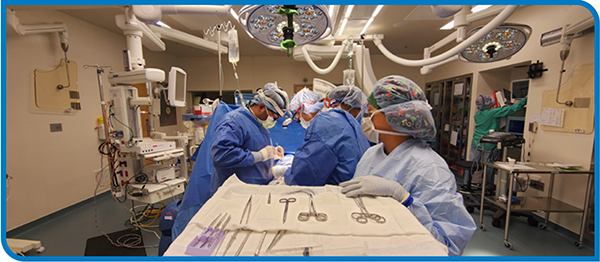
The peripheral vascular team at the LTC Charles S. Kettles VAMC in Ann Arbor, Michigan, operates on a patient in the newly renovated endovascular suite. Used with permission.
Regulatory organizations such as AORN, the American Society for Parenteral and Enteral Nutrition for the postanesthesia care unit (PACU), and the Association for the Advancement of Medical Instrumentation for the sterile processing department (SPD) hold military and VA hospitals to the same standards as other healthcare facilities. And The Joint Commission issues the same types of surveys. Even facilities classified as federal must follow state regulations.
What Dawson loved most about his time in the Navy is all facilities follow the same policies, procedures, and standards, which is not always true for facilities belonging to the same health organization. “We function as a system,” he says. However, most OR nurses and technicians at navy hospitals—and virtually all surgeons—are active-duty service members, he adds. Unlike their civilian counterparts, active-duty personnel have dual assignments: a military hospital (US or overseas) as well as what he calls a “wartime platform.” Examples include warships, the hospital ships Comfort or Mercy, and Marine Corps Medical Battalion Units in combat zones. Most active-duty healthcare providers change duty stations every 3 to 5 years.

Corey L. Sherrill, CDR, NC, USN, MSN, MSHS, RN, CNOR
In the Navy surgical suite, rank structure plays a significant role in team formation and leadership, says Corey L. Sherrill, CDR, NC, USN, MSN, MSHS, RN, CNOR, program director for the perioperative nurse training program, East Coast region at Naval Medical Center Portsmouth in Virginia. Generally, a director of surgical services (DSS) runs the surgery department with an assistant. Under the DSS and DSS assistant are a department head and assistant department head, who typically oversee the Main Operating Room (MOR), preoperative services (preop), PACU, central sterile supply/reprocessing (CSSR/SPD), and business management departments.
“Within the MOR, you may find separate divisions that will cover specific services,” Sherrill says. The bigger military treatment facilities (MTFs) utilize Alpha, Bravo, and Charlie to name its divisions. In the smaller MTFs that run six or less rooms, breaking up divisions in this manner is not necessary, she clarified. The Alpha division encompasses general surgery, pediatric general surgery, gynecology, plastics, and urology. Bravo is all things orthopedics (sports, totals, trauma, hand, foot, pediatric spine, and tumor). Charlie covers specialty services, ear-nose-throat, vascular, oral and maxillofacial surgery, and neurology.
The civilian OR nurses and both military and civilian surgical technologists providing each group of services take orders from a division officer (DIVO). “Leadership is instilled in nurse corps officers from the minute you join the Navy,” notes Sherrill.
OR nurses and lead techs for each service are responsible for pull sheets, equipment, instrument sets, and consumables. Service leads work to build relationships with the surgeons and any other surgical technologists who work in that service. “This model builds a cohesive team that is beneficial to meeting the needs of our patients,” Sherrill says.
Multidisciplinary OR teams utilize TEAMSTEPPs, a system that fosters safer patient care through a teamwork approach, using evidence-based tools to improve outcomes. The Department of Defense and the Agency for Healthcare Research and Quality (AHRQ) developed this program in 2003 to optimize performance of healthcare professional teams by improving quality, safety, and efficiency. The program draws on more than 25 years of research on teams and uses a curriculum available online at no cost (www.ahrq.gov/teamstepps/curriculum-materials.html).
AHRQ in 2023 updated the program to address recent changes in healthcare learning methods and delivery, as well as to more actively involve the patient in their care. Health systems that use TeamSTEPPS have reported increases in the reporting of patient concerns, enabling them to proactively address any such issues.

As a Level 1B complex facility, Ann Arbor VA treats high volumes of patients requiring services ranging from cataract treatment to basic skin cancer removals to riskier open heart and minimally invasive robotic procedures. The hospital also offers bariatrics and gynecology programs.
Each subspecialty has a lead team. General surgery, for example, relies on a nurse and a surgical tech as the go-to subject matter experts. “They maintain the preference cards for the surgeons, and if any special instruments are requested or something needs to be purchased, [they] make sure we have what we need,” Ringlein explains.
However, nurses and techs at Ann Arbor VA are rarely limited to a single discipline. For example, a specialized cardiac surgery team may take care of cardiac cases, but the nurses and techs are required to know all the different services and subspecialties.
All VA clinics employ an RN as the surgical care coordinator. If a veteran seen in the clinic needs surgery, then this nurse usually handles all requests, working with the provider and the surgeon to determine whether the patient needs additional tests.
Ann Arbor’s anesthesia department also has a preop clinic for patients who need additional clearances for health comorbidities. After surgery and initial follow-ups, patients go back to primary care, Ringlein says.
Staff always look at the surgery schedule 2 to 3 days in advance to make sure the OR has all the required instrumentation and disposable items for upcoming surgeries. “This helps us mitigate day-of-surgery cancellations due to equipment issues,” she says.
Like most hospitals, every Navy hospital has infection control and quality management departments. Facilities with smaller infection control departments typically rely heavily on OR nurses “because we are the subject matter experts,” Sherrill says.
Navy facilities report quality metrics to the American College of Surgeons’ National Surgical Quality Improvement Program for both adults and pediatrics. Sherrill is stationed at a Level 2 trauma center that reports trauma registry data to the American College of Surgeons and the Commonwealth of Virginia. It also works with the Leapfrog Group, a nonprofit watchdog that promotes transparency in healthcare.
Daily within her own MOR, Sherrill adds, “we track on-time starts, OR utilization, patient safety reports, traumas, cancellations, add-ons, and bed management for the following day’s cases.” All of these metrics are then reported either internally or to the Defense Health Agency.
As is the case for other hospitals, VA and military ORs have specific temperature and humidity requirements. At Ann Arbor, electronic readers monitor each OR, and automatic email alerts notify personnel if any rooms are outside of the required parameters. “If that happens, then we shut the room down, figure out what the problem is, and have the room cleaned again,” Ringlein says.
Indicative of the nature of the work in the surgical department, for Ringlein and her team, helping patients and sometimes saving their lives is part of the daily job. Ann Arbor has an on-call team available for emergency surgical procedures 24/7, including holidays and weekends. An unexpected problem, such as bleeding, will always call for a quick reaction from the OR team.
If a patient’s anatomy does not allow for a laparoscopic or robotic minimally invasive approach, Ringlein’s team knows how to pivot to an open procedure and do what needs to be done to care for the patient safely in order to mitigate negative outcomes. “I think that those are the cases that really stand out for me and the rest of our team here,” she says.
—Jennifer Lubell is a freelance medical and health policy writer based in Rockville, Maryland.
Budget in brief: FY 2024 budget submission. Department of Veterans Affairs. March 2023.
Team STEPPS Updates. Agency for Healthcare Research and Quality. nd.
London S. OR efficiency, staff satisfaction rise with TeamSTEPPS. OR Manager. 2017;33(9):25–27.
Topic: TeamSTEPPS. Agency for Healthcare Research and Quality. nd.


