Last month, Cedars-Sinai launched its Center for Autonomous Robotic Surgery, “a new initiative bringing surgeons and engineers together to develop the next generation of surgical robots capable of performing certain surgical tasks autonomously while working alongside surgeons in the operating room.” Cedars-Sinai stated that the Center will develop systems “designed to augment a surgeon’s clinical judgment rather than replace it,” with the goal of making surgery “safer, more precise and more available.”
The Center is co-directed by Andrew J. Hung, MD, a urologist and minimally invasive robotic surgery specialist in the Cedars-Sinai Department of Urology, and Michael C. Yip, PhD, who holds a joint faculty appointment at Cedars-Sinai in Urology and Computational Biomedicine. Cedars-Sinai stated that their surgeon-scientist partnership is “designed to bridge the gap between the operating room and the engineering lab.”
Periop Leader Network recently spoke with Dr. Hung about the Center, its goals, and what autonomous robotic surgery might look like in practice.
Periop Leader Network: How do you feel going into this project?
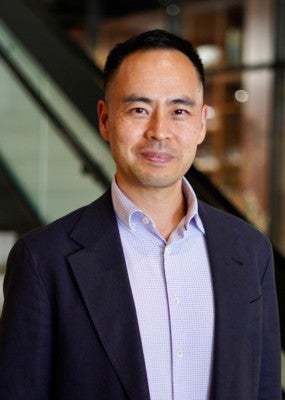
Andrew J. Hung, MD, Co-Director, Center for Autonomous Robotic Surgery, Cedars-Sinai | Photo courtesy of Cedars-Sinai
Dr. Hung: Obviously, very excited. I’m a surgeon and a scientist, and my team’s work has looked at how we understand what good surgery looks like, how it relates to good outcomes. We’ve used artificial intelligence (AI) to analyze a surgeon’s movements and relate it to outcomes, but we haven’t quite yet been able to deliver or translate that knowledge to better patient care.
We know that patient outcomes are not perfect these days. There are irregularities or inconsistencies across different surgeons, different centers. We see autonomous surgery as one area of opportunity where we can make patient outcomes a bit more consistent.
Cedars-Sinai has always been a very strong surgical hospital—we have great outcomes here—but we see an opportunity to bring robotic engineering into the mix, and that’s the really exciting part of this. It’s myself and my team partnering with mechanical engineers to see how far we can take autonomous surgery in a safe, responsible way.
Where are we right now in the timeline of seeing autonomous robotic systems in live ORs?
I think we’re many years away. In the literature, just in the last year or two, we’ve had demonstrations—certainly not in humans but in live animal models—that it is feasible in those instances in very controlled environments. The reality is that the technology, while within reach, still needs to be developed in understanding the surgical field perfectly, executing those movements in a reliable and safe manner. There’s plenty of work to be done there still.
The other aspect that will need much development is defining the roles of the human surgeon and the robot—how those two entities can become one and be responsible for the safety and well-being of our patients.
I should emphasize that the way we are building the Center is that we don’t intend to replace the surgeon. We want to provide a consistent, reliable, accountable partner to the surgeon, perhaps to alleviate some of the workload, perhaps to allow for some repetitive tasks such as suturing to come off the reliance of having the surgeon do it. But we want the surgeon to be in the driver’s seat in terms of selecting the correct patient to operate on, and the appropriate disease to be addressed with surgery. We want to build a robot that can function autonomously, but we want its every action to still be accountable to the surgeon in the room. There’s a lot of substantive work that we intend to tackle.
What does “autonomous” mean in practice, and how does it compare to current robotic platforms?
Great question. In today’s world, robots replicate the exact movements of a surgeon, but in many ways, the benefit is that it miniaturizes a surgeon’s hands, so we are able to manipulate very delicate tissues that maybe are not super-accessible. But these miniature instruments are fully controlled by the surgeon on a surgeon console, maybe a few feet away.
We envision that, to some degree, some of these movements can be done autonomously by a robot—of course with plans that have been approved by the supervising surgeon as to the actions he or she would like to take. In that environment, the robotic instruments wouldn’t need to be dictated by the surgeon for every single maneuver. Given the appropriate scenario in a controlled environment, the robotic instruments would have their own instructions. The robot understands the task. It doesn’t get to decide autonomously, but once it has been given a task to execute those movements, it can do so autonomously.
Is the Center a physical facility? A network of people? Both?
Both. There is going to be a physical space. Cedars-Sinai houses a lot of its research enterprises at the Pacific Design Center, about half a mile north of the main campus in West Hollywood; most of our computational research teams are based there. That will be one of our homes. There is a second home further east that I will probably announce shortly, but there will be at minimum one, if not two, physical homes for the Center.
The reason why there will be multiple spots? One aspect is the hardwares robotics lab we are building. That’s not something that Cedars-Sinai has had in the past. We have recently recruited Professor Michael Yip—a roboticist specializing in surgical robots and autonomy—from the University of California, San Diego, as my co-director, and the two of us are building the Center together. At the offset, our two research labs are merging under the umbrella of the Center. We’re also hiring many staff engineers and clinicians to form the Center.
So there’s the physical space—the equipment, the robotic arms, robotic systems and so forth—and then there’s the people.
You come from a urology background. How will that impact the work of the Center?
Because the Center was an internal investment to me as founding director to establish, it’s fallen into the Department of Urology, but other than that technicality, I am approaching this from a surgical specialty-agnostic standpoint. We want this to be a partnership of many of the surgeons at Cedars-Sinai and beyond who can benefit from the technology we’re building. Perhaps because I am a urologist, some of the early test cases may be within urology, but we’re certainly not bound by one single field. Dr. Yip has partnered with many surgeons of different specialties—general surgery, for example, among others. We’re eyeing solutions that will be translatable or generalizable across surgical fields.
What types of clinicians are you recruiting for the Center?
We want the perspectives of surgeons from different specialties represented in understanding and tackling some of the challenges of the status quo of surgery today—What are our limitations? What are the opportunities to improve our patient outcomes in those spaces? We are also looking for surgeon-scientists who have a specialty or areas of experience in surgeon-human interaction.
Of course, surgeons only make up one piece of that puzzle. The interaction between a surgeon and robot is an underdeveloped field, so we also need perspectives from the engineering side, and to really foster that partnership between surgeons and engineers. We want to make sure we’re addressing real clinical needs, and improve our outcomes. And we need surgeons who can help us develop or best understand how that interaction will be between surgeon and robot.
In autonomous robotic surgery, what is the role of the perioperative team, the nurses, the techs? What new skills might they need to learn? How would their roles change when working with an autonomous robot?
A lot of that is a bit undefined. I’m careful to say that we’re not trying to replace individuals in the operating room, but certain tasks can perhaps be given to automation. For example, instrument exchange currently requires manual intervention by the supporting staff in the operating room. Could something as simple as an automated system to replace or exchange instruments, at least in robotic surgery, happen more seamlessly? That could be an opportunity.
If you look at robotic surgery today—an environment where there is no autonomy—it is a surgeon performing a complex surgery through the aid of a surgical robot. Everybody in the room, the staff included, needs to be well versed in supporting that complex machinery when there’s a malfunction or an error alert notification. Staff in the room need to be trained on how to troubleshoot when these sorts of things happen. As technology gets more complex—and autonomy will be that space where it’s not that it will necessarily fix its own problems—you will need staff in the room beyond the surgeon himself or herself to support that.
I envision that the training will be different. The surgeon who is using autonomy as a partner will need to be trained differently to perform surgery because now he or she is partnering with an entirely new entity that the surgeon will need to be familiar with and comfortable with. Same thing with the rest of the staff in the operating room. They’re going to need to understand its limitations, how to troubleshoot if error messages come up, how to support this likely much more complex piece of technology than even the existing state-of-the-art surgical robot.
Do you envision that autonomous surgery will improve patient access to surgical services?
There is a scalability limitation today. Surgical expertise, typically even in the U.S., congregates in big academic centers and big urban areas that are harder to reach in more rural parts of our country. For existing high-volume practices, the next available time for the surgeon and the hospital is often many weeks away. There are only so many cases I can perform back-to-back in a given day, and having some degree of autonomy can alleviate some of that—perhaps making turnover a bit more efficient, or the process of surgery more efficient. We don’t want to be compromising patient safety, but perhaps it will allow us to scale up our bandwidth, be more efficient, and allow more operations to happen in a timelier fashion.
What would the surgeon be doing during the surgery if the robot’s performing tasks autonomously? Could the surgeon go room to room and supervise two or more surgeries at once?
That is one possibility. I want to be very careful that we will have to emphasize safety above efficiency. We don’t want to create an environment where the surgeon is not supervising something that he or she should be supervising, and allowing room for error. But in the right instances, there can be a scenario where you have more than one surgical system running, and a supervising surgeon who doesn’t necessarily need to be performing every single procedure, but still approving step-at-a-time what is being performed. One of our greatest constrained resources now is that trained surgeon. But if done correctly and safely and ethically, there potentially can be an environment where you could have two patients getting safe, efficient care while still getting the close supervision of a surgeon.
What’s needed to earn the trust of surgeons in this concept?
That’s a great question. I have been in the space of using AI to assess the quality of surgery for over a decade now. In our early work, there was quite a bit of skepticism—I wouldn’t quite say distrust. I think skepticism is a good word to describe it because of the simple unfamiliarity and also, to some degree, lack of experience or imagination of the benefit AI or autonomous surgery could provide.
It does require some proof that one, it can do things that are safe, that are efficient and maybe provide some value. As this field develops, first and foremost, we’re not going to tackle the biggest, most complex problems. We’re going to tackle everyday mundane tasks that can maybe be simplified and done more efficiently—for example, suturing. As we build that experience and as surgeons who experience the technology see that it can be trusted, we can then allow for the stepwise accumulation of more complex tasks. So I would envision a world where we’re starting with very basic maneuvers and then moving upward from there.
How would an autonomous system affect room setup, turnover, sterile processing, length of a case?
I don’t know that I can go into great specifics there, other than to say that currently there’s lots of manual determination and finding the right instruments for the next case; there’s no automation at all. Between where we are today with zero automation to a place where everything is automated, there’s plenty of opportunity in the middle to streamline some tasks—from “what are the anticipated instruments for the next case,” to “do we have them?” and then, of course, if we have them we want to make sure they are sterilized and clean and ready for the next case.
Let’s say we’re short on those instruments—we don’t want to be discovering that during turnover time. We would have wanted to discover that a week before, so the correct instruments or supplies could have been ordered, delivered, processed, and ready for that case, and to alert folks in a timely fashion: “Hey, these instruments need to be cleaned before other sets because the next case is ready to go in this period of time.” All of those are opportunities for streamlining turnover.
I don’t see autonomous surgery as a panacea or a cure-all for all of our challenges of turnover, but there are certainly many opportunities along the pathway to create smart, seamless systems that can ensure that the failure points of why a normal turnover where an hour becomes an hour-and-a-half or two hours can be avoided.
What’s the role of AI in autonomous robotic surgery?
On a high level, we think AI can play different roles. It can play one role in mimicking ideal behavior from surgeons. If we told the model, “This is generally a good ideal action. Can you replicate it?”, and use AI to train that robot to perform that same exact movement, it could probably do it with very high fidelity.
The challenge is that diseases and patients are quite variable across the board—the size of different organs, the extent of cancer or disease, tissue quality for different patients. That can become an immediate challenge for these trained models. So you need some off-the-cuff adaptability, different AI models and technology that would be implemented to allow it to adapt to the variations we inevitably will see from patient to patient.
Do you expect pushback from some patients who might not want to undergo an autonomous robotic surgery?
I can see where there could be hesitation not just from patients, but from surgeons also. First and foremost, we’re not trying to build an autonomous robot that replaces the surgeon. The surgeon is not going anywhere. We want the experience of the surgeon. We want the expertise of the surgeon. We want the supervision of the surgeon. That element will not change any time in the near future.
If we can demonstrate that the safety and reliability of this is not just equivalent to today’s model, but in fact better than the outcomes we have today, I think we can win over patients.
The goal is not to create an environment where the surgeon is a passive approver of actions of the autonomous robot, and it’s doing all the work while the surgeon gets to sit on the side and enjoy his or her latte. That’s certainly not the motivation here. We want that surgeon to be an active player and really to be the gatekeeper of everything that’s being performed. And of course, we need to demonstrate that this technology is going to be safe and reliable.
Who would be responsible if something goes wrong with an autonomous surgery? The surgeon? The hospital or ASC? The manufacturer?
Obviously, this space needs to be defined. I’m not a legal expert, so I cannot predict how the legal landscape around this sort of technology will land, but as a surgeon and as someone who will be a leader in this space, accountability has to be taken on all ends. Perhaps in many ways it won’t be so different than today.
I performed a robotic procedure yesterday afternoon, and I am fully aware that despite having used a surgical robot, I am ultimately responsible for that patient. I don’t see that changing dramatically, because this is going to be surgeon-driven autonomous robotic surgery—not an autonomous robot making its own decisions and movements. Ultimately, I think the surgeon will be responsible. If there’s a malfunction of the robot—if it doesn’t perform as intended, or causes harm or injury to a patient that would certainly not be intended—perhaps the manufacturer of a certified system may need to take some responsibility. I don’t know. But I think there will be some collective responsibility for the safe delivery of this technology.


