There is movement happening in the world of surgical gowns. It is driven in part by the COVID-19 pandemic, which brought new focus to the need for adequate stockpiles of personal protective equipment (PPE)—and for PPE that works as intended. Staff need to know their gowns incorporate the latest technology and provide sufficient protection.
Another driver of this evolution in thinking about gowns is growing awareness of hospital waste—the literal mountain of cast-offs from every surgery. Both for issues of safety and environmental concerns, hospital staff, researchers, and manufacturers are taking a closer look at surgical gowns, including where disposables fall short, and working collaboratively to take surgical gowns to the next level.
Modern surgical gowns require a number of “must have” properties to pass federally required safety tests. These include protective barriers to resist the penetration of blood and bodily fluids; liquid repelling properties; resistance to tears and punctures; suitability for sterilization; fire resistance; capability to maintain user’s desired body temperature; a tight but non-restrictive, ankle-length fit, with capability to close at the back; and soft, flexible, high-quality materials.
The Association of Advancement of Medical Instrumentation (AAMI) ranks all surgical gowns into one of four levels, from least protective (Level 1) to most protective (Level 4). These standards are particularly focused on the “critical zone” (chest to knee and sleeve cuff to elbow) where direct contact with blood and fluids is likely. Different surgical procedures come with different risks of fluid exposure. For example, a colectomy—due to both length and likely fluid exposure—would likely require a gown with AAMI level 4 protection. In contrast, a laparoscopic procedure might require an AAMI level 3 gown.
It is critical, of course, that a surgical gown fits well and does not restrict movement. An ill-fitting gown is much more likely to lead to blood contaminating skin or clothing. To this end, the Centers for Disease Control and Prevention (CDC) recommends that healthcare facilities keep multiple gown types and gown sizes on hand at all times.
Beyond the essential elements, gowns might have numerous differences—neck openings might close by tie, snap, or hook and eye; sleeves may end in elastic cuffs, knit cuffs, or thumb loops. Generally, one choice is far more significant: Reusable or disposable?
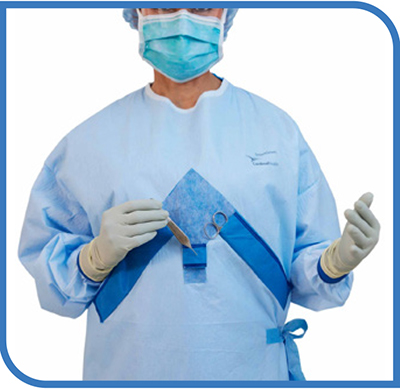
Cardinal Health’s SmartGown EDGE™ Breathable Surgical Gown with ASSIST™ Instrument Pockets is designed for not just protection, but also breathability and easy access to instruments. Used with permission.
The COVID-19 pandemic called attention to the need for ample supplies of PPE. After gloves, hospital gowns are the second most-used form of PPE. In the US, hospitals have evolved away from reusable cotton or polyester gowns and toward disposable options made of nonwoven, synthetic fabrics. As a result of this shift, disposable isolation gowns make up 80% of the market. The disposable medical gown industry is expected to expand from $2.8 billion in 2022 to $14.1 billion in 2032, driven by an increasing number of surgeries and hospital-acquired infections.
However, these disposable gowns come at a cost. When the pandemic caused shortages that sent hospitals scrambling to find more gowns, they soon discovered that not all gowns are created equal.

Meredith McQuerry, PhD
In one recent study in the American Journal of Infection Control, researchers compared commercially available Level 1, 2, and 3 disposable and Level 2 and 3 reusable gowns and found that the reusable gowns outperformed the disposables on nearly every measure. The reusable gowns provided significantly higher water resistance, durability, and resistance to tearing and pilling. They also maintained the same level of durability and protection through 75 washes. In fact, the only advantage for disposables was breathability.
“Despite there being ample availability of reusable medical textiles in the US, more than 90% of healthcare PPE is single use disposable,” says study author Meredith McQuerry, PhD, Carol E. Avery Associate Professor at the Jim Moran College of Entrepreneurship and director of the Textile Testing Laboratory. “This statistic is even more frustrating when you consider the results of our study, given many disposables tested also did not meet the required AAMI standards.”
Safety is not the only potential concern. Disposable surgical gowns carry a significant environmental cost as well.

Ava Yap, MD, MHS
Consider a pilot project undertaken by Ava Yap, MD, MHS, a general surgery trainee at University of California San Francisco. She examined the feasibility of transitioning one hospital within one of the university’s smaller outpatient campuses from disposable to reusable surgical gowns in order to reduce waste and serve as a model for other healthcare systems looking to make similar transitions. The findings appeared in JAMA Network.
Switching from disposable to reusable gowns is a complex process, but it is also essential, Yap says. “The OR is one of most resource-intensive facilities. From ours alone, we produce 30 pounds of trash from each case—and that’s just waste, not energy or carbon emissions from the gas. We thought it was a good first step to focus on linens because it’s tangible. I can see that I’ve accumulated five large garbage bags from a single procedure.”
At a rate 30 to 40 cases per day, this small facility produces 900-1200 pounds of trash daily, Yap says. Her research suggested that more than 30,000 pounds of solid waste would be averted annually from a tertiary medical center if it made the switch to reusable gowns.
The benefits of the transition—significant waste and cost reductions and improved safety for doctors and surgery staff—were clear at the outset. However, practices would have to change. That meant convincing essential staff, particularly perioperative nurses. “Change is hard in general in the OR culture,” Yap says.
She adds that surgeons were generally on board with the change. They recognized the waste associated with each procedure and were open to new ways to address it. But the change in behavior falls on the nursing staff and scrub techs. Unlike disposables, reusable gowns need to be transported to the laundry, and they are responsible for ensuring gowns are available when needed. “Those extra steps take time and change of practice,” Yap says.
For example, even Yap and her research team couldn’t foresee some of the difficulties they would encounter in trying to secure a nearby sterilization facility. They initially had to outsource gown sterilization to a facility in Long Beach—more than 400 miles from San Francisco. Transporting the gowns so far adds significantly to the procedure’s carbon footprint and detracts from the environmental benefits of the transition. “We’re trying to figure out how to bring those services closer to our campuses,” Yap says, adding that implementing these changes will be a multi-year process.

In the meantime, improved designs and features continue to ensure both disposable and reusable surgical gowns meet surgeons’ needs. These advances are needed, as surgical site infections (SSIs) continue to pose a threat to healthcare workers and are the most common type of healthcare infection. The CDC estimates that SSIs cost $11,000 to $35,000 per incident and cost the industry $3 billion to $10 billion each year.
Manufacturers’ first challenge is to design more protective gowns, but they are increasingly focused on functionality as well. One example released in November 2023 is Cardinal Health’s SmartGown EDGE Breathable Surgical Gown with ASSIST Instrument Pockets, designed in collaboration with the Mayo Clinic and co-inventors Joseph Dearani, MD, director of pediatric and adult congenital heart surgery, and Salim Walji, MD, a retired Mayo Clinic cardiothoracic surgeon.

Joel Colyer
As the name suggests, the gown is designed to keep surgeons cool and able to easily access frequently used surgical instruments. Two pockets in the chest and one holster support safety and efficiency by preventing unnecessary hand-offs. It also meets AAMI level 4 requirements for the highest barrier protection against fluids and viruses.
“We are continuously assessing our products and how we can enhance their feature sets,” says Joel Colyer, Global Portfolio Director of Cardinal Health. “We regularly assess how to incorporate advances in materials science and other areas to ensure we are leveraging new technology to manufacture and distribute surgical gowns that deliver the performance that our customers expect in such an important medical device.”
Meeting surgeons’ needs, improving the efficiency and safety of surgical procedures, and addressing the environmental shortcomings of the nation’s operating rooms requires innovation across the board. The COVID-19 pandemic in particular called attention to the need for greater domestic manufacturing of surgical gowns and other PPE and boosted efforts to begin shifting back to reusable gowns. In September 2020, for instance, the Department of Defense signed contracts with five US businesses to manufacture 15 million reusable isolation gowns, committing a total of $136 million to replenish the national stockpile.
“We are aware of movements and support by US Congress, the National Academies, the National Institute for Occupational Safety and Health, and other federal groups who have recognized and cited our work in support of adopting more reusable medical textiles, especially in light of the severe PPE shortage that occurred due to the recent COVID-19 pandemic,” McQuerry says.
Yap echoes this sentiment, noting that supply shortages created by the pandemic ultimately drove her health system to seek alternatives. First, the team stabilized supply by incorporating isolation gowns that required laundering. That opened the idea for a new possibility: If they could do this for isolation gowns, why not surgical gowns as well?
That is how Yap’s investigation was born. “Nonsurgical, nonsterilized solution gowns—we were going through them during COVID, eating up our supplies,” she recalls. “It was interesting to watch how shortages forced us to innovate to have more sustainable, reusable solutions.”
— Brita Belli is an award-winning writer and PR professional with published stories in the New York Times, National Geographic, MSN.com, and Alternet.
Atay Y, Pamuk O, Boyaci B, et al. A new approach to surgical gowns.
Benefit from high-level protection with medical isolation gowns. ICU Production Inc. July 7, 2021.


