The COVID-19 pandemic is having a major impact on all aspects of healthcare delivery worldwide. For children’s hospitals, the crisis has created unique challenges in ensuring patient and provider safety as well as helping to contain the spread of COVID-19 through their communities.
According to the Centers for Disease Control and Prevention (CDC), children account for between 1% and 2% of the population testing positive for the COVID-19 virus. The CDC reports that children tend to be asymptomatic or have mild or different symptoms than adults. Transmission is likely the same as that seen in adults; however, it is also suspected that children may be more predisposed to spread the virus through fecal-oral means.
“We have had a very low incidence of COVID-19-positive patients, averaging around five per day, and very few have been in the ICU,” says Tammy Woolley, MS, MBA, RN, CNOR, CSPM, NEA-BC, director of perioperative services for Children’s Hospital Colorado’s Anschutz (North and South) Medical Campuses. “Most children who are admitted have only stayed in the hospital 2 or 3 days,” she told OR Manager. “At the beginning of the COVID-19 pandemic, when testing results took longer, children with positive results would usually stay in the hospital for 24 hours, but that time has been decreasing,” she says.
 Children’s Hospital Colorado on the Anschutz Medical Campus, a 320-bed facility located in Aurora, continues to run seven of its 17 ORs and nine procedure rooms daily for emergent and urgent cases, averaging 15 to 20 patients per day.
“Because the hospital is a Level I trauma facility, we continue to do urgent and emergent surgical cases that are either inpatient or come through the emergency department,” says Woolley. All elective surgical procedures that had already been booked on the OR schedule were cancelled through April 26.
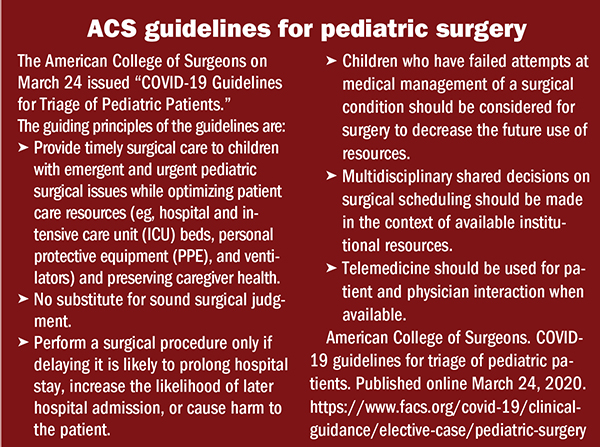
Woolley says they are following the American College of Surgeons’ “COVID-19 Guidelines for Triage of Pediatric Patients” (sidebar at right).
“The surgeon in chief, chair of anesthesia, and I review the scheduled emergent and urgent surgical cases the Friday before the following week. If there are any questionable cases, we contact the providers and ask why the cases need to be done or whether they can be rescheduled,” she says.
Surgeons or nurse practitioners place orders for COVID-19 testing of their pediatric patients up to 48 hours prior to their surgical procedures. An old stand-alone dental clinic has been converted into a drive-through testing center.
If surgical patients are admitted to the hospital without being tested or come through the emergency department (ED), they are tested at the time of admission. In addition, at intubation anesthesia providers are doing a nasal aspirate for a comparative research study.
If test results are not back at the time of surgery, the patient is treated as a patient under investigation (PUI) until the results come back.

Tammy Woolley, MS, MBA, RN, CNOR, CSPM, NEA-BC
“Our dilemma,” says Woolley, “is even though most testing results are back the day before for surgical patients, anesthesia providers believe the tests are only 70% effective, and they still want to wear PAPRs [powered air purifying respirators] or N95 respirators for intubation and extubation on all cases.”
Woolley says because they have a limited number of PAPRs for each department, they had to scramble to get them for the OR and postanesthesia care unit (PACU) as well as for the ED and inpatient units. Perioperative services now has 10 PAPRs, which are used mainly by anesthesia personnel and other providers that cannot be N95 fit tested.
Woolley adds that they have changed their processes multiple times since the onset, and currently anesthesia personnel wear PAPRs or N95s and a face shield for intubation and extubation on all patients.
The hospital has one negative-pressure OR with an anteroom, which is used for COVID-19-positive patients.
All staff wear N95s for COVID-19- positive patients and PUIs and for aerosolizing procedures (eg, bronchoscopy, oropharynx airway cases, dental, ophthalmology).
For COVID-19-negative patients, all staff, including anesthesia providers after intubation, wear standard surgical masks with a face shield.
Woolley says they used to have staff wait outside the room after intubation and extubation for air changes to take place, but because positive patients are all done in a negative pressure room, and all staff are wearing the appropriate PPE, wait times are no longer required except for PUIs. Wait times added about an hour to every case, she says.
Because of the low volume of patients in perioperative services, inpatient surgical units, and the ambulatory clinics, staff have been reassigned to a variety of other jobs such as:
• employee screening
• patient/visitor screening
• donning and doffing observers
• personal protective equipment (PPE) protectors
• reprocessing N95 masks with ultraviolet (UV)-C energy
• cleaning face shields.
All surgery schedulers are working from home, and surgeons are using telemedicine almost exclusively for their clinic and preoperative visits.
Visitors at the hospital are limited to one per patient on the inpatient units. Patients coming in for a surgical procedure can have two visitors. If the patient is admitted after surgery, one visitor is asked to leave.
The hospital has expanded the age limit for patients from 21 to 30 years to help other hospitals in the area with their non-COVID-19 patients. “We are not admitting their COVID-19-positive patients, just their healthy, young adult patients,” says Woolley.
She notes that the hospital has always done follow-up procedures on older patients who had congenital heart defect repairs as infants. However, she says, having multiple older patients is a change for the medical inpatient units.
They have had to develop inclusion and exclusion criteria for these patients and perform safety/risk assessments before admitting them to the medical units.
The units also have had to partner with pharmacy and information technology staff to:
• produce appropriate drug libraries and dosing ranges for adults
• identify nursing competencies for older patients
• coordinate simulation training to identify gaps in caring for children and adults.
The hospital has always had a 14-bed maternal fetal care unit (MFCU) for high-risk infants and low-risk mothers. “This has allowed us to do fetal surgeries, and it allows high-risk babies to be delivered here and go immediately to the cardiac cath lab or have other interventional procedures, such as for teratomas. Also, we have had conjoined twins who needed immediate surgery once they were delivered,” says Woolley.
Currently, the MFCU, neonatal intensive care unit, and one of the surgical inpatient units are taking low-risk mothers from the University of Colorado Hospital (UCH), and the labor and delivery staff from UCH have been helping with the staffing for this additional volume. UCH is also on the Anschutz campus with Children’s Hospital.
“We did this because UCH had to convert one of their inpatient units to a COVID-19-positive unit,” says Woolley.
As of the middle of April, UCH averaged about 100 COVID-19 patients per day, with an average of 45 to 50 patients on ventilators.
The hospital is reprocessing N95 masks according to the protocol that the University of Nebraska developed during the Ebola epidemic (https://www.nebraskamed.com/sites/default/files/documents/covid-19/n-95-decon-process.pdf).
Nebraska put forth a process to validate that N95 masks can be used up to four times, says Woolley.
Key to this process are “PPE protectors.” All N95 face masks are locked up in each unit. A staff member (ie, PPE [personal protective equipment] protector) is designated to check out a mask to a staff member, write it down, and keep track of it.
At the end of the day, each staff member puts his or her mask in a brown paper bag. Staff members write their names, departments, date, and employee IDs on the bags. The bags are dropped off in bins in dirty utility rooms throughout the hospital.
Sterile processing department (SPD) staff pick up the bins and take them to the unit that has had the most COVID-19 patients.
 One of the conference rooms has been converted to a workroom with clotheslines. Masks are removed from the paper bags and hung on the clotheslines with clips on the loop strings to avoid overlapping and to prevent blocking of the UV-C energy to the anterior and distal surfaces (photo at right).
“The masks go through two opposing scrub cycles of Surfacide UV-C, so the light reaches the front and back of the masks,” says Woolley.
After the masks are processed, staff take them off the clotheslines and put them in new white paper bags with each employee’s information on it. The masks are then taken back to each of the units. The next day, staff pick up their reprocessed masks. They mark them with an indelible marker each time the masks are worn. After the fourth time, they are discarded.
“In the beginning, we thought we would need about 20 people each day to reprocess masks, but now we have it down to 4 per shift as the volume is less than expected,” says Woolley.
They continue to reuse N95 masks because, although 3M said their N95 masks used for construction and other non-healthcare jobs were the same quality as the masks used in the hospital, they haven’t yet been approved at the hospital for patient care use.
Woolley says the hospital is considering moving away from this process and using Bioquell hydrogen peroxide vapor because masks can be reprocessed up to 20 times, and more masks can be run each cycle in a pre-built room. This process also requires less labor.
As of the middle of April, all hospital staff are given isolation masks each day, which they must wear in patient care areas. The isolation masks do not have to be worn in administrative areas, but all staff must wear cloth masks or face coverings everywhere in the facility.
Woolley says all hospital staff must be checked in every morning. They do a REDCap survey, have their temperatures taken, are given a sticker that indicates they passed the screening, and then they are issued a new isolation mask.
The REDCap survey is done to collect data for research and to track whether staff have any signs or symptoms of the coronavirus.
Face shields are worn over the isolation masks any time staff are doing direct patient care. OR staff and PACU staff wear regular surgical masks and face shields for COVID-19-negative patients.
The face shields are plastic and cleaned between each patient use. At the end of each shift, they are placed in a dirty utility room to go through a Bioquell hydrogen peroxide vapor cleaning cycle. PAPR hoods also are collected and reprocessed using Biquell.
Though they have not had any shortage of ventilators, Woolley says, Colorado’s governor asked them to take inventory of all their ventilators and anesthesia machines at the beginning of the pandemic.
“We had to submit that inventory to the state, which then could have taken our ventilators and anesthesia machines if they were needed elsewhere, but they haven’t needed to do that,” says Woolley. “We have gone through our surge, and they haven’t been needed.” ✥
American College of Surgeons. COVID-19 guidelines for triage of pediatric patients. Published online March 24, 2020. https://www.facs.org/covid-19/clinical-guidance/elective-case/pediatric-surgery.
Centers for Disease Control and Prevention. Coronavirus Disease 2019 in Children—United States, February 12-April 2, 2020. Morbidity and Mortality Weekly Report (MMWR). 2020:69(14);422-426.
Lowe J J, Paladino K D, Farke J D, et al. N95 filtering facepiece respirator ultraviolet germicidal irradiation (UVGI) process for decontamination and reuse. Updated 4-10-20. https://www.nebraskamed.com/sites/default/files/documents/covid-19/n-95-decon-process.pdf.
Yeo C, Kaushal S, Yeo D. Enteric involvement of coronaviruses: Is fecal-oral transmission of SARS-CoV-2 possible? The Lancet Gastroenterology & Hepatology. 2020:5(4);335-337.


