
Marie Paulson, MS, BSN, RN, CNOR
“A highly reliable organization is an organization that has succeeded in avoiding catastrophes in an environment where normal accidents can be expected due to risk factors and complexity,” says Marie Paulson, MS, BSN, RN, CNOR, regional perioperative director for Kaiser Permanente’s Southern California Patient Care Services in Pasadena.
Paulson and James DeFontes III, MD, assistant executive medical director, patient safety and perioperative services, spoke about their organization’s high reliability journey at the 2014 OR Manager Conference. About 250,000 procedures are performed annually in Kaiser’s 150 main ORs and 55 surgicenters, according to Dr DeFontes.
Cincinnati Children’s Hospital, an academic medical center with around 600 beds, began its high reliability journey about 10 years ago and is regarded as a leader in the movement. However, it’s an ongoing process, notes Stephen E. Muething, MD, associate professor and vice president for safety.
“We do not believe we’re a high reliability organization,” Muething told OR Manager. “We believe we’re on the journey. We’ve dramatically improved on our ability to analyze and learn from events, and we’re very committed from the top to learn from and improve from any serious event.”
Kaiser Permanente is one of many healthcare organizations that have adopted safety practices from the airline industry.
In the early 2000s, Dr DeFontes said, the aviation industry partnered with experts from the University of Texas Center of Excellence for Patient Safety Research and Practice in Houston in an effort to shift from expert individuals to expert teams, break down silos, improve communication, and prevent errors.
“Reliable and timely reporting was the first thing they had to do,” he noted. “They had no reports, so they had to create a blame-free environment to get some reports, and it took 3 to 5 years to get any kind of meaningful information.”

James DeFontes III, MD
Among the key lessons that informed the changes needed at Kaiser, according to Dr DeFontes, were:
• creating checklists and defining roles
• flattening the hierarchy to make everyone an equal member of the team
• using simulation-based education to prepare for emergencies
• creating a failure mode analysis
• hiring for effective leadership.
“We want to be the kind of organization that knows about harm in real time,” says Dr Muething. “If a patient or an employee is harmed in any way—be it a fall, bloodstream infection, pressure ulcer, or a bloodborne pathogen exposure for a staff member—that will be announced to the entire hospital tomorrow.”
Cincinnati Children’s belongs to the Children’s Hospitals Solutions for Patient Safety (SPS) learning network, a partnership between 80 children’s hospitals and the business community to improve quality of care and reduce healthcare costs.
Serious harm, as defined by SPS, includes:
• serious safety events
• surgical site infections
• ventilator-associated pneumonia
• bloodstream infections
• catheter-associated urinary tract infections
• adverse drug events (levels 6-9)
• pressure ulcers (grades 3-4)
• serious falls
• codes outside the ICU
• serious peripheral IV infiltrates.
At Cincinnati Children’s, a Safety Oversight Group composed of family advisors, senior leaders, and the CEO tracks progress toward meeting safety goals, Dr Muething says.
“The Safety Oversight Group comes from the belief in high reliability organizations that safety is owned by senior leadership. Certain things can be delegated, but safety cannot,” he says. The group meets monthly to discuss every serious safety event and report to the board. “If we have a serious safety event, I have to explain to the CEO what happened. He wants to know about it immediately, and he then calls the chairman of our board of trustees immediately and talks about it. That’s how our senior leadership takes responsibility,” Dr Muething explains.

Stephen E. Muething, MD
In 2007, a Safety Coaching Program was launched to reinforce expected safety behaviors. Safety coaches are staff volunteers who are taught to observe their colleagues, give feedback, and complete behavior observation tools, which are part of an electronic log system.
“We laid out a group of very specific behaviors we expect everyone to practice,” Dr Muething says. Coaches give the staff feedback, and their goal is to provide positive feedback five times for every time they give constructive feedback.
Leaders of each clinical area are expected to interact with their safety coaches at least monthly. There’s also a monthly meeting of all safety coaches with positive feedback like “safety coach of the month” awards and discussion of how they can improve as safety coaches, Dr Muething says.
A key safety improvement at Kaiser Permanente has been to incorporate a Safety Attitudinal Questionnaire (SAQ) into the debriefing process. The SAQ was launched in 2002 to link outcomes with briefings, Dr DeFontes says.
Originally designed as a brief questionnaire for the perioperative services department, the SAQ now has about 150 questions and is administered hospital-wide every 2 years, according to Paulson.
Sample questions include:
• Do you feel safe in speaking up?
• Are you encouraged to bring safety issues forward?
• How comfortable are you in speaking up when you identify a safety concern?
The same kind of question is asked in multiple ways, Paulson explains, to discover where hierarchy might be preventing staff from speaking up. For example, physicians have indicated that they feel comfortable discussing a safety concern, whereas nurses have expressed difficulty doing so, and housekeepers have said they don’t feel comfortable at all.
Heirarchical issues are deep in healthcare, Dr Muething notes. “The preprocedural time-out or postprocedural debriefs are very safety critical, and hierarchy is often counterproductive. Often the person who’s lowest on the chain has a piece of crucial information, and if we don’t allow that person to add that information and value it, that can lead to problems.”
At his hospital, he says, team members address one another by their first names, and people are thanked for raising questions, regardless of whether or not they bring up an important point.
Senior and mid-level staff at Kaiser Permanente have benefited from attending the Patient Safety University, a 2.5-day program given at different regional locations in California. Training is provided twice yearly in safety culture, emotional intelligence, and psychological safety, Paulson says.
Attendance is mandatory for positions such as patient safety officers, risk managers, ombudsmen, quality directors, and perioperative services directors, according to Paulson, but even staff who aren’t required to go consider it an honor to be invited.
“We’ve established time-outs and verification processes, and we’ve put together videos and films. Every medical center has a refresher safety training every year,” Paulson says. “We have seen an impact on our hospitals and medical centers in that safety really is a focus every day—sentinel events have decreased.” A notable success story is the Kaiser Permanente West Los Angeles Medical Center, which has gone nearly 1,000 days without a never event (sidebar, p 20).
As a result of the Patient Safety University, one medical center established a policy of saying the words “safety check” as a signal for the OR team to stop talking and listen. “It may be a patient verification, it may be the counts are off, it may be the consent is wrong, it may be a lack of understanding about the medication order—but the point is, the team must stop and listen,” she explains. This practice has now been implemented in all perioperative areas in the southern California hospitals.
Surveys administered to Patient Safety University participants have gotten consistently positive responses, Paulson says. “People find new ways to interact; participants do team activities as equal partners, regardless of whether they are a surgeon, a nurse executive, or staff.”
Kaiser staff also take critical event team training (CETT), which covers topics such as malignant hypothermia, fires, and hemorrhage. A recent CETT taught perioperative staff how to keep themselves and their patients safe during an earthquake. This training was relevant to everyone, Paulson says, and it got high satisfaction ratings on the post-training survey.
Handoff scripts, customized checklists, and trigger films are some of the tools that have proven effective at Kaiser Permanente (sidebar, p 21).
“We’re developing trigger films—simulated scenarios in which things go wrong—and we use these to demonstrate the right way to do things,” Paulson says. “We’re in the midst of filming ophthalmology teams to ensure the right intraocular lens is placed.”
Some of the films used in the Patient Safety University have been edited and repurposed as high reliability orientation films for all new physicians, she adds.
At Kaiser Permanente, 30-minute safety huddles are held every 2 weeks to discuss every serious reportable event since the previous huddle took place and the root cause analysis (RCA) that must be done, according to Dr DeFontes. He then takes the RCA report to the regional chiefs groups and asks them to vet the RCAs.
This RCA process has revealed clusters, or similar events occurring in different parts of the system, including:
• specimen mishandling
• airway fires
• medication errors
• retained foreign objects
• patient falls
• verification errors
• equipment failures.
“When we first started, a lot of people were protecting themselves. We’ve had to teach people how to present an event and how to work in an RCA,” Dr DeFontes says.
Leaders at Kaiser Permanente have increased huddles from once a day to twice a day in an effort to involve more staff and gather more information, Paulson says. “We talk about what happened yesterday and how might we improve, what’s going on today, and how to plan for tomorrow.”
As for errors, a safety algorithm has been created to help reveal the cause of errors, ie, whether they’re the result of factors such as poor education, a system failure, or risky behavior. “As we’re tracking events, we’re planning to use them in our critical event training to demonstrate things that have actually happened and talk about what we might do differently,” Paulson notes.
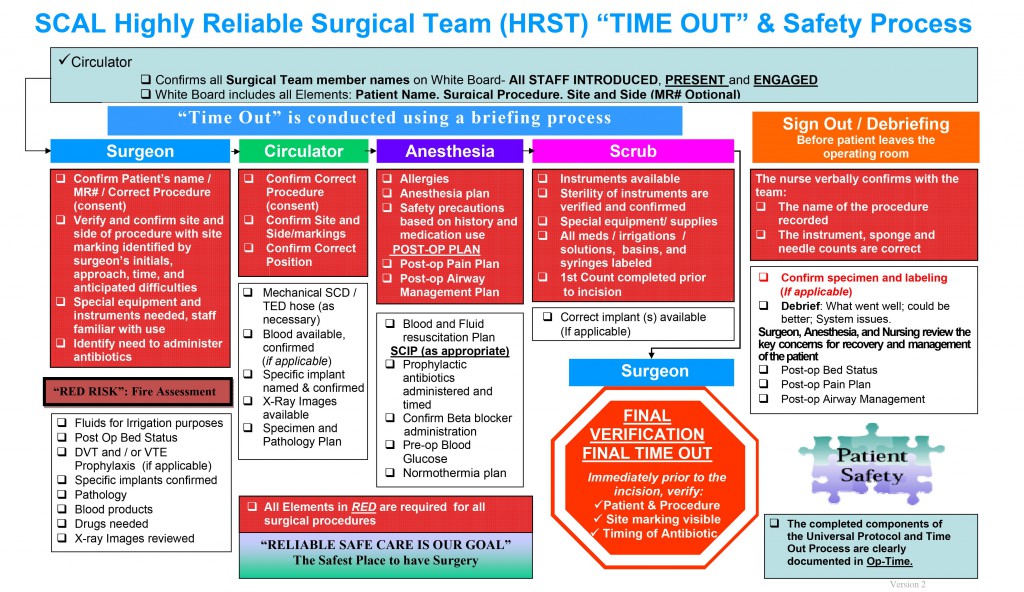
Checklists like this are used in the ORs at Kaiser Permanente and can be customized for different surgical procedures. Reprinted with permission from Kaiser Permanente Southern California Patient Care Services, Pasadena, California.
Becoming a high reliability organization is a journey, not a destination, Paulson says, and it requires ongoing attention. “If you don’t continue to revisit this at least yearly, it goes by the wayside. That constant learning and training and getting groups together is very important,” she adds.
Evolving from a conservative, risk-averse organization to one that embraces rapid and open communication has come about through culture change, Dr Muething says. Over time, staff have learned that safety is everyone’s responsibility.
“You have to build the trust, the belief that leaders care about it, and the systems to communicate the information into the daily workflow, and leaders have to value that information. Changing culture is a ‘forever’ journey; you never stop,” he says. ❖
Perioperative services staff at the Kaiser Permanente West Los Angeles Medical Center are literally counting the days until April, when they expect to hit the 1,000-day mark without a sentinel event.
They have been tracking this metric for about 5 years, and they keep patient safety uppermost in everyone’s minds by displaying a poster with the number of days since the last sentinel event. The poster, located in a main corridor of the perioperative services area, is updated daily.
“There is a saying that ‘what gets measured gets done.’ We wanted to have a simple measure that we could report to staff and surgeons that demonstrates our commitment to safety and teamwork,” Victoria Coon, perioperative director, told OR Manager. “We chose to focus on the number of days since our last never event because it’s an easy and effective metric to track, understand, and communicate to our hospital staff and physicians.”
“Collaboration is an important part of our mission and everyday work,” Coon notes. “Some of the practices that have led to our success in preventing never events have been shared and adopted by other facilities.”
Workplace safety is also a priority, and they post the number of days since the last on-the-job injury experienced by any employee or physician.
“Patient safety requires a multipronged approach,” notes Scott Lisbin, surgical service line leader. Other key elements of the patient safety program that have helped hardwire the behaviors needed to avoid never events, according to Lisbin, include:
• a comprehensive safety orientation for all new employees, physicians, and residents
• a dedicated and enthusiastic safety champion
• understanding and learning from near misses and disseminating what is learned to all surgeons and staff
• recognition of staff who speak out about safety concerns and “stop the line” when they have any safety concerns
• strong briefings and time outs
• providing assertiveness training for staff
• daily reminders in huddles about patient safety opportunities
• daily rounding and observation of practices and behaviors in the OR
• annual human factors training for the entire perioperative staff and physicians
• standardization of language for safety concerns; saying “I need a safety check.”
• Critical event team training.
Outside the OR, the Kaiser Permanente West Los Angeles Medical Center has adopted a reward and recognition program to raise patient safety awareness. Recipients of the “Near Miss/Good Catch” award are recognized among their peers and leadership team as patient safety champions. These individuals receive a special certificate, and several staff from perioperative services and the anesthesia department have also been recognized as part of this program.
A big celebration and lunch are planned to mark day 1,000 without a never event, Lisbin says.
DeFontes J, Paulson M, High Reliability: Our Journey Continues. Presented at the 2014 OR Manager Conference.
http://www.cincinnatichildrens.org/service/j/anderson-center/safety/serious-harm/
Marie Paulson will be a presenter at the OR Manager Conference, October 7-9, in Nashville. Visit www.ormanagerconference.com.


