Recent outbreaks of deadly infections linked to flexible endoscopes have made headlines, and the Food and Drug Administration has issued strict guidelines for reprocessing these devices.
However, cleaning and disinfection may not be effective under the recommended protocols, says Cori L. Ofstead, MSPH, epidemiologist and president and chief executive officer, Ofstead & Associates, Inc, St Paul, Minnesota. Even when adherence to recommended reprocessing guidelines is verified, endoscopes have been found to harbor residual organic material, she says.
A study by Ofstead and colleagues at the University of Minnesota Medical School, Minneapolis, found viable microbes and residual contamination remained on the surfaces of endoscopes used in an ambulatory surgery center after each stage of reprocessing, despite good adherence to reprocessing policies.
“The findings show that current methods of cleaning flexible endoscopes are not sufficient,” Ofstead told OR Manager.
Ofstead and colleagues presented the baseline findings from this study in a poster session at the AORN Surgical Conference & Expo 2016.
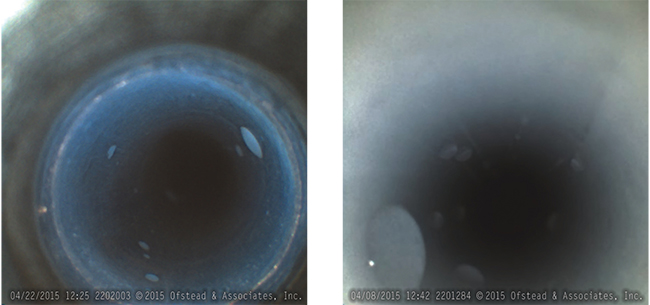
Fluid inside the biopsy port of a gastroscope (left) and fluid inside the suction/biopsy channel of a colonoscope (right). Photos used with permission, Ofstead & Associates, Inc, St Paul, Minnesota.

Cori L.
Ofstead, MSPH
An important point in this study, says Ofstead, is that it was done in an ambulatory surgery center without high-risk surgical patients and without high usage of the endoscopes.
Ofstead and colleagues evaluated 12 colonoscopes and 5 gastroscopes, whose ages ranged from 4 to 28 months (36 to 541 uses). Nine endoscopes had been previously repaired.
Ofstead’s previous research had found high contamination levels on endoscopes, but the research had been done in settings with extremely high usage and difficult cases (two studies were done at the Mayo Clinic, Rochester, Minnesota). Many procedures were long and extended, and the endoscopes had been used a couple thousand times, notes Ofstead.
For the baseline assessment of the present study, two perioperative nurses visually inspected the 17 endoscopes after manual cleaning and high-level disinfection and obtained samples for microbial cultures and residual debris. The research team also used a borescope to examine ports and channels.
“We observed the reprocessing practices and found good adherence by the staff to reprocessing policies, but after manual cleaning, 16 of the 17 endoscopes still had residual contamination,” says Ofstead. Adenosine triphosphate (ATP) and protein exceeded benchmarks for 29% and 47% of endoscopes, respectively.
After high-level disinfection, 29% of the endoscopes still had viable bacteria, says Ofstead. “That means about a third of the time, they’re going through the whole process and still have microbes,” she says.
In addition, borescope examinations identified visible irregularities (discoloration, debris, damage) in suction/biopsy channels.
In one of the colonoscopes, Ofstead says they noticed substantial staining and what appeared to be scratch marks along the top. When they examined it with the borescope, they could see pieces of the lining of the endoscope hanging down. “This was a common observation throughout the study, that the interior lining of the channel was not staying intact,” says Ofstead.
Fluid was often seen in patient-ready channels despite alcohol flushes and air purges done in an automated reprocessing system (see photos above). After reprocessing, the endoscopes were hung vertically in an enclosed cabinet.
“When we checked the endoscopes after they had been hanging for 2 to 4 days, we still saw large droplets of fluid throughout the whole channel,” says Ofstead. “This was an important and troubling finding,” she says, “because we had led ourselves to believe that alcohol, forced air, and gravity would leave us with dry endoscopes.”
Ofstead called this an “aha moment” that explained to her why certain types of bacteria survive in endoscopes and cause outbreaks of infection.
The new AORN Guideline for Processing Flexible Endoscopes recommends special drying cabinets, and “not just hanging the endoscopes and hoping things will work out,” says Ofstead. However, she says she hasn’t seen any published evidence that the drying cabinets work.
After the baseline assessment, the researchers divided the endoscopes into two groups. One group was reprocessed in accordance with the way they had been doing it all along, and the other group received a more rigorous reprocessing.
“We wanted to know what would happen if they ramped up their reprocessing,” she says. “Would their scopes be cleaner?”
The ramped-up reprocessing included all the regular steps like bedside precleaning, leak testing, manual cleaning, and high-level disinfection. In addition, the technicians began to conduct ATP testing to determine if their manual cleaning worked each time they cleaned an endoscope. They swabbed the interior surface of the biopsy port and flushed the suction/biopsy channel with sterile water to test the effluent.
If the biopsy port and effluent from the channel didn’t meet the benchmark for clean, the technician had to manually clean the endoscope again and test it a second time.
Whether or not it passed the second test, the endoscopes in the ramped-up reprocessing group were cleaned again in a new automated endoscope reprocessor (AER) the facility installed. This AER performs a full cleaning cycle, followed by purging the endoscope channels, and then running a disinfectant cycle with peracetic acid. After a final rinse, the system flushed alcohol through the channels and purged them with forced air.
The more rigorous protocol meant all of the endoscopes in this group were cleaned at least twice, and in many cases three or four times.
Their old automated reprocessor would rinse the endoscope, circulate it in glutaraldehyde for a period of time, and then rinse again before flushing alcohol through the channels and purging them with air to assist in drying.
Results showed colonoscopes came clean more often than gastroscopes and that gastroscopes failed the first manual cleaning half the time, and about 30% came clean after the second manual cleaning. The rest of the endoscopes were run through the AER twice, but 11% never came clean even after they’d been manually cleaned two times and cleaned and disinfected twice in the AER.
Ofstead and colleagues presented their interim findings after 2 months of the more rigorous reprocessing in a poster session at the Society of Gastroenterology Nurses and Associates Annual Course, 2016.
“We found that as the study progressed, things got worse, and the endoscopes accumulated more contamination and damage,” she says. By the end of the 7-month study, all of the endoscopes had visible irregularities and most of them required repair. Although the endoscopes in the ramped-up reprocessing group looked better visually, the contamination levels were similar to the endoscopes that had regular reprocessing.
“In the end,” Ofstead says, “we concluded that more needed to be done to ensure the endoscopes are clean before high-level disinfection and dry after high-level disinfection.”
There also should be a schedule for very rigorous inspection of the endoscopes that includes lighted magnification of the outside and the inside.
Presently, she says, there isn’t any guidance to help people know how often they should inspect endoscopes, what they should be looking for, and what they should do about their findings.
The study highlights the need for quality improvement initiatives and more stringent, evidence-based reprocessing guidelines, says Ofstead. ✥
AORN. Guideline for processing flexible endoscopes. 2016 Guidelines for Perioperative Practice. AORN: Denver, 675-758.
Ofstead C L, Eiland J, Amelang M R, et al. Residual contamination found on endoscopes in an ambulatory surgery center. Poster session, AORN Surgical Conference & Expo, 2016. http://www.eventscribe.com/2016/posters/aorn/SplitViewer.asp?PID=Mjc1MDQ3ODAyNQ#)
Ofstead C L, Dirlam Langlay A, Mueller N, et al. Re-evaluating endoscopy-associated infection risk estimates and their implications. Am J Infect Control. 2013;41(8):734-736.
Ofstead C L, Wetzler H P, Amelang M R, et al. Reprocessing effectiveness for gastroscopes and colonoscopes: Longitudinal comparison for two methods. Poster session, Society of Gastroenterology Nurses and Associates Annual Course, 2016. http://www.ofsteadinsights.com//wp-content/uploads/Ofstead_SGNA_Poster_Board_2016_SENT.pdf.
Ofstead C L, Wetzler H P, Doyle E M, et al. Persistant contamination on colonoscopes and gastroscopes detected by biologic cultures and rapid indicators despite reprocessing performed in accordance with guidelines. Am J Infect Control. 2015;43(8):794-801.
Visrodia K H, Ofstead C L, Yellin H L, et al. The use of rapid indicators for the detection of organic residues on clinically used gastrointestinal endoscopes with and without visually apparent debris. Infect Control Hosp Epidemiol. 2014;35(8):987-994.


