Instruments that are still damp or wet after being sterilized cannot be placed in storage. The moisture that remains on or inside of a package can create a pathway for microorganisms to travel from the outside to the inside of the package. Moisture may be in the form of visible dampness, droplets, or puddles of water on or within a pack, and any instruments stored in a damp condition are vulnerable to rust. Any time a wet pack occurs, the instruments are contaminated and need to be reprocessed prior to use.
Some studies have shown that up to 85% of wet packs are the result of human error or clinical practice, so sterile processing staff must be aware and take care to avoid them. Because of the many variables in steam sterilization, it is important to document each occurrence of wet packs and to involve all of the key participants—central sterile personnel, infection preventionists, and staff from surgical services, facilities management, and clinical engineering—in resolving the issues.
During sterilization, as steam hits metal it is immediately cooled when heat transfers to the metal. As this occurs, the steam condenses and forms droplets on the metal. Using lint-free absorbent material helps to absorb the moisture and facilitate drying. If, however, the pack is too dense, the excessive amount of metal may result in the condensation of too much moisture, and a wet pack will occur.
Improper preparation of instrumentation or textile packs can trap water. If instrument sets are consistently wet, they should be reviewed to find out if
• the instrument set is too heavy or dense
• basin sets lack absorbent material to wick moisture in between basins
• textile packs are too dense
• the packages are wrapped too densely or too tightly
• instrumentation is packaged while still wet
• plastic peel pouches are placed inside of a wrapped or containerized instrument set
• multiple-part instruments requiring disassembly are not disassembled
• instruments are placed on concave surfaces that do not allow for drainage
• the sterilization container is prepared incorrectly, eg, using the wrong filters
• trays or instrumentation are not designed to allow proper drainage and drying
• nonabsorbent tray liners are used
• the manufacturer’s packaging instructions for use (IFU) are not being followed
• packaging materials are not held at 68°F to 73°F (20°C to 23°C) for 2 hours before use.
Instrument sets and other packages may be prepared properly but loaded into the sterilizer improperly. The sterilizer operator can cause wet packs if the sterilizer is not loaded properly. Sterilizers should be loaded so that the load configurations provide adequate air removal, steam penetration into each package, and steam evacuation.
Instruments that can hold water, such as solid-bottomed pans, basins, and trays, should be positioned so that they are oriented in the same direction, allowing water condensate or any water to drain easily. Plastic peel pouches should be placed on their sides.
Incorrect sterilizer operation or faulty sterilizer loading and unloading practices can cause wet packs. Specifically, clinical errors include:
• using a dry time less than the medical device manufacturer’s written IFU
• loading that does not allow adequate air elimination and drainage of condensate
• using sterilizer cart liners that are made from nonabsorbent material
• loading solid-bottomed pans, basins, or trays so that they do not drain adequately
• not placing peel pouches on their sides
• having too cool a temperature in the cooling area
• placing textile packs incorrectly (ie, not on their edges)
• unloading warm packages unto a cool surface.
A malfunctioning sterilizer can cause wet packs. A steam sterilizer consists of many components. Its operation depends on the steam generation and distribution system with which it is used, the electrical system, and other mechanical systems unique to the facility. The sterilizer effectiveness can only be verified in the environment in which it will be used. Wet packs can occur from sterilizer or utility reasons such as:
• the boiler is not properly maintained
• steam lines are improperly insulated
• the boiler feedwater contains too many noncondensable gases (such as air)
• steam dryness is not between 97% and 100% (ie, there is too much water in the steam)
• water treatment affects the level of noncondensable gases
• changed (eg, seasonal), unusual, or increased demands are placed on the steam system
• the trap in the steam line malfunctions or is missing
• insulation of steam lines is improper or insufficient
• steam pipework does not allow condensate to flow properly
• the drain check valve malfunctions or is missing
• pressure gauges and controllers are out of calibration
• steam lines are blocked or partially blocked
• condensate accumulates when the sterilizer is not in operation
• the drain screen clogs
• the gasket is not intact.
The manner in which sterile packages are stored can cause them to have moisture, such as when:
• humidity in the storage area is above 70%
• transportation vehicles are damp or wet
• packages are located in areas where high humidity is normal
• packages are transported from air-conditioned environments to non-air-conditioned environments.
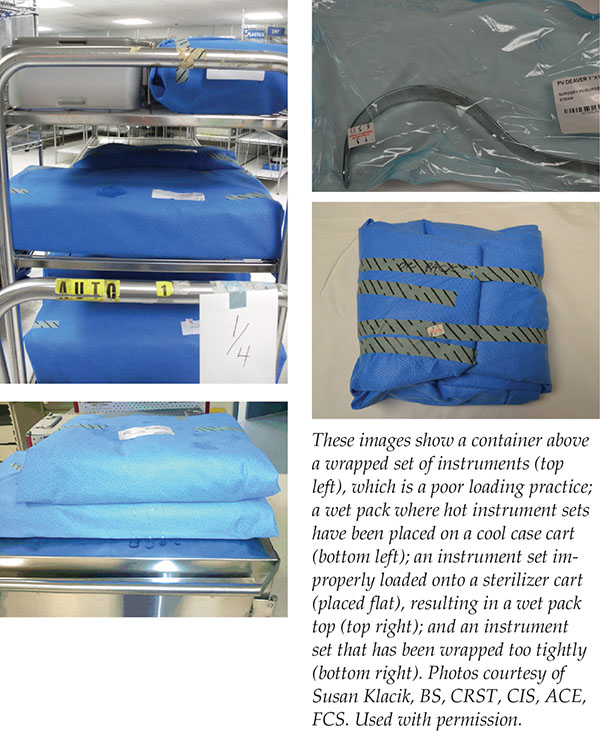
When performing an investigation, analyze the occurrences of wet packs to see if there is a pattern such as the time of day, shift, sterilizer, time of the year, position in the sterilizer, specific instrument set, packaging, association with a specific employee, high humidity, or any other contributing factors. Document the day, time, technical staff, items, packaging, and sterilizer loading and unloading. Evaluate the drying process by means of controlled, random sampling and opening of selected sets at the completion of the drying/cooling time. Once the cause of wet packs is known, the process can be corrected.
Wet packs should not be released. They should be opened for inspection and then repackaged to ensure the wet pack will not recur with new packaging material. Disposable products such as gauze and cotton balls should be discarded. Chemical indicators should be replaced with new ones, and textiles should be removed and replaced with freshly laundered textiles that have not been ironed.
Instrument sets should be prepared in a manner that will ensure adequate steam contact with all surfaces to reduce the potential for wet packs. There are a variety of packaging methods to use when preparing instrumentation, and the preparation and assembly of surgical instrumentation is a complex process. To prevent wet packs, instruments sets should be sterilized in perforated or wire-mesh-bottom trays or in containment devices such as specially designed loaner sets or a rigid sterilization container.
Nonlinting absorbent material may be placed in the tray to facilitate drying. Moisture will dry more readily from absorbent materials than from droplets or pools on solid metal surfaces.
The materials and construction of the packaging used in pack preparation have an impact on the sterilization process. These factors should be evaluated for ease of air removal, steam penetration, and steam evacuation.
Instrumentation should be open and evenly distributed throughout the tray. Instruments with multiple parts should be disassembled for proper steam contact to avoid trapping steam that can condense, resulting in a wet pack. Moisture found inside of a package is typically caused by pack preparation, eg, metal items may be positioned in a way that allows water to pool so as to trap steam that later turns into water.
Temperature and humidity equilibration of packaging material is needed to permit adequate steam penetration and to avoid superheating. Temperature affects relative humidity, so a preconditioning temperature range is also recommended. The current AAMI Standards recommend relative humidity should be controlled between 30% and 60% in all sterile processing areas except the sterile storage area, where the relative humidity should not exceed 70%. The general area temperature should be controlled between 68°F and 73°F. The temperature in sterile storage may be as high as 75°F.
Assembly of basin sets can have an effect on the drying process, resulting in wet packs. Basin sets should be assembled so as to permit air removal, steam penetration, and steam removal during the sterilization and drying process. Basins should be nested within one another. Their size should differ in diameter by at least one inch. Basin sets should be prepared so that all basins are placed in the same direction for moisture to drain with nonlinting absorbent material between them to facilitate drying.
Some instrument sets, such as instrument trays made of plastic and containing plastic, require longer drying cycles. Manufacturers’ IFU for these types of instrument sets should state whether the drying cycle should be lengthened.
Even when all of the preparation and sterilization processes are followed correctly, the environment used to prepare the sterile packages can cause wet packs—as can the environment surrounding the sterilizer and sterile storage area.
A large majority of wet packs are caused by the factors discussed above. The sterilizer and the utilities also play a large role in the sterilization process. Sterilizers should be installed, maintained, inspected, and cleaned according to the manufacturer’s written IFU. A qualified individual to inspect, maintain, and repair the sterilizer should carry out maintenance. Worn and damaged parts such as recording devices (as applicable), filters, steam traps, drain pipes, valves, and door gaskets should be replaced.
Additional information can be obtained from the 2013 edition of the AAMI ST79 Comprehensive guide to steam sterilization and sterility assurance in health care facilities, which has a new annex on wet pack assessment and methods to resolve wet packs. This new annex is title Annex P Moisture assessment. ✥
 Susan Klacik, BS, CRST, CIS, ACE, FCS, is president, Klacik Consulting, in Canfield, Ohio, as well as a CSS consultant and CSS manager at St. Elizabeth Health Center and the IAHCSMM (International Association of Healthcare Central Service Materiel Management) representative to AAMI (Association for the Advancement of Medical Instrumentation).
ANSI/AAMI ST79:2010 & A1:2010 & A2:2011 & A3:2012 & A4:2013 Comprehensive guide to steam sterilization and sterility assurance in health care facilities. www.aami.org.
Lind N. Central Service Technical Manual. 7th ed. Chicago: IAHCSMM; 2007; 250-253, 304-310.


