Even before the pandemic, many OR leaders struggled to maintain adequate staffing. However, COVID-19 has undoubtedly aggravated the situation, with many nurses choosing to exit the profession, leave the hospital setting, or seek higher wages as a per diem traveler. As OR leaders work to fill open positions, they may feel pressured to shorten orientation, not only so new employees start working independently more quickly, but also in response to the need for educators to sometimes function in staff roles.
But giving into these pressures may be shortsighted: A comprehensive, effective orientation program is a key factor in the successful recruitment and retention of OR nurses. “A robust orientation program sets up a nurse for success and helps reduce turnover costs,” says Rebecca Vortman, DNP, RN, CNOR, NEA-BC, clinical assistant professor in the department of population health nursing science at the University of Illinois Chicago in Springfield, Illinois. Vortman previously managed an OR education department.
In this two-part series, OR Manager explores orientation best practices. Part 1 discusses the value of orientation and programs for nurses new to the OR. Part 2 focuses on orientation of experienced and per diem OR nurses, along with social onboarding and program evaluation.
Employees who receive insufficient onboarding are more likely to leave an organization, which is particularly detrimental in the OR. According to a 2021 report from NSI Nursing Solutions Inc, OR nurses are the most difficult specialty to recruit, taking an average of 111 days to fill a position, similar to the 115 days cited in the company’s 2020 report (sidebar, Value of orientation by the numbers).

Despite its importance, orientation programs for OR nurses in the United States lack consistency and have little oversight, according to Jim Stobinski, PhD, RN, CSSM(E), CNOR, CNAMB, who is CEO of the Competency and Credentialing Institute (CCI) in Englewood, Colorado. In addition, many have not been rigorously studied to determine effectiveness. Stobinski points out that for accreditation, The Joint Commission and DNV verify that staff have completed orientation, but there is no mechanism to assess the quality of that education, and no state or national requirements specific to the perioperative nurse title exist. “The employer defines who is a perioperative nurse,” he says.
Adding to the orientation challenge for OR leaders is the fact that most schools of nursing offer students only minimal exposure to the OR. “It’s up to the healthcare facility to provide new OR nurses with what almost amounts to a college course,” Vortman says.
Employers, therefore, have to develop the best programs possible to meet the orientation needs for four groups: new graduate nurses, practicing nurses without OR experience, nurses with OR experience, and per diem nurses. Each group has its special needs, but commonalities also exist.
Vortman says an effective orientation program includes didactic presentations, practice in a simulation or skills lab, and clinical experience (circulating and scrubbing) with a preceptor. Clinical experience usually includes rotating through multiple specialty service lines.
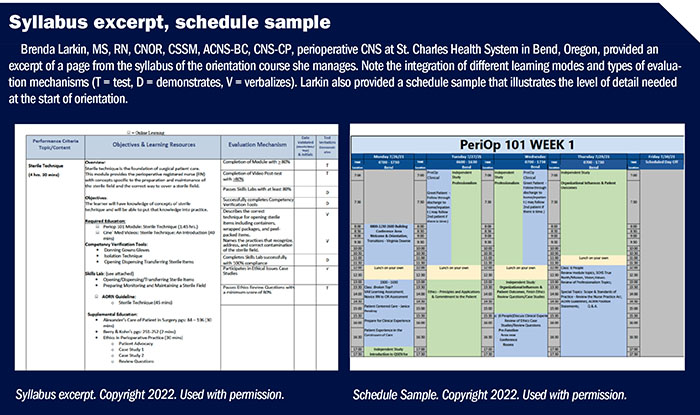
A syllabus provides an outline that educators and orientees can use to ensure essential information is covered (sidebar, Syllabus excerpt, schedule sample). The syllabus includes topics, objectives, and evaluation parameters. Information is based on AORN’s 2018 position statement on the orientation of RNs and surgical technologists, which outlines content in the following areas: safety, physiological responses, infection prevention and control, behavioral responses, and health systems.
While many topics are obvious (for example, fire safety), the list can help identify those that an organization might not think to include, such as ethics. Most facilities also incorporate two classic perioperative texts:
• Berry and Kohn’s Operating room technique, 14th edition
• Alexander’s Care of the patient in Surgery, 16th edition.
Organizations may use commercial resources such as AORN’s Periop 101: A Core Curriculum or Nurse in Surgery Essentials (NISE™) to standardize orientation, ensuring that nurses receive what they need to provide optimal care to patients (sidebar, Overview of Nurse in Surgery Essentials).

Vortman notes that these programs save educators’ time by reducing the need to frequently update didactic materials when information changes. “When you invest in these programs, you know you are getting up-to-date information,” she says.
Standardized programs may also help improve retention. For instance, when Vortman implemented Periop 101 in the 500-bed medical center where she worked, 1-year retention rates improved from 59% to 87% and 2-year rates improved from 37% to 70%. (Learn more about Periop 101 at https://www.aorn.org/education/facility-solutions/periop-101/or.)
Even when standard programs are used, however, educators need to include specific hospital policies and may add content they feel is essential. For instance, Brenda Larkin, MS, RN, CNOR, CSSM, ACNS-BC, CNS-CP, perioperative CNS at St. Charles Health System in Bend, Oregon, incorporates information about social determinants of health and the work environment.
Participants receive a copy of the syllabus and a schedule of what is planned for each day. The schedule includes times for in-person class, skills lab, independent study, and clinical, including when orientees will be with their preceptors. The nurses are tightly scheduled initially, but as orientation progresses, more time is delegated to preceptors and independent study.
Within the basics, educators structure orientation to meet the needs of each type of orientee. For those new to the OR, the average orientation time is 6 to 12 months. Experienced OR nurses typically can be oriented in 3 months or less. The most variation is among agency nurses, with orientation ranging from 3 days to 1 week.
Here is a closer look at programs for nurses new to the OR. Those for experienced and per diem nurses are discussed in Part 2.
Nurse residency programs can ease the transition from school to practice. Organizations may use commercial products such as the Versant Nurse Residency program or create their own. The programs address not only technical skills but skills that nurses new to the profession may need help with, such as interprofessional communication.
An OR residency program may be part of a hospital’s general residency program or independent from it. Donna Ceschini, MSN-Ed, RN, CNOR, an OR nursing professional development specialist at Penn State Health Milton S. Hershey Medical Center, a level 1 trauma center in Hershey, Pennsylvania, launched a 9-month course for new graduate nurses in 2005. The course starts with 8 weeks of didactic and clinical experience that includes time with a preceptor, followed by a 7-month rotation through various specialties. Participants also spend a week in the sterile processing department and a half-day each in the preoperative department and postanesthesia care unit. “This helps them understand those areas and build relationships,” Ceschini says.
Ceschini notes that it is important to repeat information and to use different means to reach all types of learners: visual, auditory, and hands on. She cites patient positioning as an example: “Participants read about positioning, have discussions via a PowerPoint presentation, and watch a video,” she says. “Then I take them into the OR to show them available products and have them practice by using simulation.”
The hospital, which has 36 ORs and four procedure rooms, now runs four courses a year, with 10 nurses in each course. Usually, 25% of participants are nurses from other specialties who are new to the OR. The course, which costs about $70,000 to run, averages a 2-year retention rate of around 90%.
Screening helps ensure participants are truly committed to working in the OR. Ceschini has candidates shadow an OR nurse for 3 to 4 hours before she and the OR managers interview them. (During part of the pandemic, this was replaced with a digital presentation, in which she and her manager described what it is like to work in the OR.) “We can then talk with them about the experience and their perceptions about the OR,” Ceschini says.
Nurses from other specialties typically require as much orientation as nurses new to the profession and the OR. Some organizations have created nurse fellowship programs, which are essentially residency programs for nurses transitioning from another specialty into the OR. Both nurse residency and nurse fellowship programs can be accredited through the Practice Transition Accreditation Program (PTAP) offered by the American Nurses Credentialing Center (sidebar, Practice Transition Accreditation Program).

Larkin says St. Charles Health System started its OR paid fellowship program in May 2021, It consists of 12 weeks didactic instruction with clinical experience, followed by 8 to 12 weeks of clinical in different specialty areas. Larkin recently added a requirement for fellows to complete an evidence-based project; topics might include pressure injury prevention or smoke evacuation. A medical librarian helps support the nurses in this work.
Mosaic Life Care in St. Joseph, Missouri, has a more accelerated timeline, with the bulk of information coming in the first 2 to 3 weeks. “We do lots of hands-on training via videos, simulations, and didactic education in a classroom or OR setting,” says Mary Jo Hutchcraft, MSN, RN, CNOR, nurse education specialist for surgical services. “It’s intense.”
The nurses then work with a preceptor circulator for the next 6 months. Orientees may have the opportunity to scrub, but more commonly, that experience comes later in their employment, if at all. The hospital has 14 ORs and completes about 35 to 50 cases a day.
Moving from a position where the nurses felt comfortable with their knowledge to a new specialty can be daunting. “It’s challenging to go from being an expert to being a novice again,” Hutchcraft says. “It can be hard on their confidence.” Part of the challenge is how different the OR is from a nursing unit. Hutchcraft tells nurses they will still use some of their skills, such as assessment, as they learn new ones. “I try to be empathetic and give them the tools and resources they need to learn and improve their self-confidence,” she says. That might include recommending a YouTube video about the next day’s surgery, sharing articles, holding interactive discussions, or providing hands-on opportunities.
Anita Wilson, MSN, RN, CNOR, the OR nursing professional development specialist at Akron Children’s Hospital in Akron, Ohio, finds it helpful to set expectations from the start. “I tell them that they are going to learn totally new things and that they are going back to being a novice at each phase of orientation,” she says. “I also tell them it’s OK if they decide the OR is not for them, but to give themselves time to check it out.” For those who are struggling with whether the fit is the right one, Wilson says, “I give nurses the support they need to make a decision.” For example, she provides opportunities for nurses to express their feelings and explores ways to tailor orientation that might be helpful. Wilson also keeps the manager informed of the situation.
To help avoid a poor fit, Wilson recommends assessing a person’s motivation before the transition, if possible, or early in orientation. “On the first day, I ask, ‘why did you come to the OR?’” she says. Red flags include responses such as “the hours are better” or “I don’t know.”
Ceschini at Milton S. Hershey Medical Center also asks nurses why they are moving to the OR. “You want to find out if they have a passion for it,” she says. In some cases, faculty still tell those interested in the OR that they need 1 year of med/surg experience, so the person is simply fulfilling a desire they had when they graduated. For those with many years of experience, it may be the opportunity to try something different. To ensure those nurses know just how different the OR is, Hershey offers them the same shadowing experience in the OR as it does for new graduate nurses.
Many of those interviewed for this article find new graduate nurses easier than nurses with experience in another specialty to train. “The experienced nurse has to go through all this turmoil of feeling like ‘I’m an expert but now I’m not,’” Larkin says. “New graduates don’t have that baggage.”
An effective orientation program depends on an effective partnership between the educator and the manager. Ceschini has found it helpful for the two to meet on a monthly basis to anticipate what training might be needed in the future based on potential retirements and other upcoming needs.
Larkin adds that it is important for managers to meet with new nurses at the start and towards the end of orientation. “It helps the manager understand their needs and to see what they have an affinity for,” she says.
—Cynthia Saver, MS, RN, is president of CLS Development, Inc, Columbia, Maryland, which provides editorial
services to healthcare publications.
AORN. AORN position statement on orientation of the registered nurse and surgical technologist to the perioperative setting. AORN J. 2018;108(1):59-63.
AORN. AORN position statement on orientation of perioperative registered nurse residency programs. AORN J. 2019;110(1):86-87.
NSI Nursing Solutions. NSI national health care retention & RN staffing report. 2021.
Thew J. Want to keep nurses at the bedside? Here’s how. Health Leaders. March 27, 2019.
Vortman R, McPherson S. The state of the perioperative nursing specialty workforce: A concern for executive nurse leaders. Nurse Leader. 2021;19(3):281-288.
Vortman R, Dewey Bergren M, Baur K, Floyd V. Nurse retention in the operating room after perioperative core curriculum completion. ORNAC J. 2019;37(3):13-19.


