During the COVID-19 pandemic, healthcare workers nationwide have experienced patient deaths on a scale like never before. Whether from COVID-19 or other complications, surgical services staff sometimes lose patients despite their best efforts, and these failures to rescue can leave lasting psychological or emotional scars.
Many healthcare facilities have ramped up efforts to support healthcare workers struggling amid the myriad challenges of COVID-19 (“Support programs multiply as pandemic strains health systems,” OR Manager, March 2021, pp 1, 6-11). Even before the pandemic, however, leaders at the Mayo Clinic in Rochester, Minnesota, had recognized the need to help staff in the wake of critical events.
Responses to surveys administered to anesthesia staff in 2016 and to surgical services staff in 2018 revealed a high percentage of people who felt they needed greater support in these circumstances. As a result, leaders there launched a critical event debrief that has been conducted several times, providing staff with the tools and resources needed to recover from the loss of a patient.

Brenda Bearden, DHA, MSN, RN
“Debriefings have been shown to be a best practice,” says Brenda Bearden, DHA, MSN, RN, nurse manager, surgical services. She cites the Joint Commission’s Quick Safety Advisory 39, issued in January 2018, which called for the development of support for second victims. “This emphasized a just culture for learning from system defects and communicating any lessons learned, ensuring that all team members are engaged in a debriefing process, and that lessons learned are shared,” she says. Noting that critical event debriefings are used by firefighters, emergency medical services (EMS), and law enforcement, she says it was a natural step to develop them for surgical services staff.
“We cultivate a culture of mutual trust and safety for everyone, regardless of their role,” Bearden says. “The health and well-being of every colleague is valued.”
There is a vast body of literature on the “second victim” phenomenon, whereby healthcare workers experience emotional distress after adverse events, and many programs have been developed to help them cope. For example, Johns Hopkins Hospital in Baltimore implemented a RISE (Resilience in Stressful Events) program, starting with a pilot in 2011 and expanding that hospital-wide by 2016, after polling of staff indicated a need for greater support.
Before the pilot was launched, a multidisciplinary program development team was created, and a survey was administered at a Johns Hopkins Patient Safety Summit. Two-thirds of the survey respondents said they had experienced emotional distress after an unanticipated adverse event, and more than half had sought support from a peer or colleague.
Respondents endorsed the need for a hospital-sponsored peer support program to help second victims.
Similarly, surveys informed the need for second victim support at Mayo. Fully 90% of anesthesia staff who responded to a survey in 2016 said they wanted a support program. Of those, 65% did not feel support was adequate after an adverse event, Bearden says.
And in a 2018 survey that was administered to surgical services staff, 8 of 10 respondents said they had been involved in a traumatic case, and less than a third of them had a chance to talk to anyone about it. There were 225 total responses, for a 51% response rate.
Survey questions and answers were as follows:
Have you been directly or indirectly involved in a surgical case that you considered traumatic?
Yes:81%
No: 19%
Have you been involved directly or indirectly in a surgical case involving death?
Yes: 69%
No: 31%
Were you offered the opportunity to discuss the outcomes?
Yes: 28%
No: 51%
Of those who answered “yes,” they typically discussed the incident with a coworker, charge RN, manager, or supervisor, and 67% said the discussion took place immediately after the event.
Was discussion beneficial?
Yes: 43%
No: 1%
N/A: 56%
Would it have been beneficial to have had an opportunity to discuss the incident?
Yes: 44%
No: 56%
Was there any follow-up from managers?
Yes: 14%
No: 61%
If there was discussion with a supervisor, was it beneficial?
Yes: 23%
No: 2.8%
N/A: 73%
Are you aware that Mayo Clinic has resources available?
Yes: 50%
No: 50%
Those who were aware of available resources commonly sought help from the chaplain, a coworker, the Employee Assistance Program (EAP), or a supervisor—or they searched for information on the internet.
Having a debrief/team meeting was cited as an additional resource that they would find helpful, along with follow-up from a manager and time to process and discuss the incident. In addition, they noted the need for leadership support and understanding, avoidance of blame, and closure.

Jamie Mathison, RN
“Critical events can cause feelings of incompetence, inadequacy, or guilt,” says Jamie Mathison, RN, resource nurse specialist, surgical services. Symptoms of second victims include difficulty sleeping, burnout, depression, anxiety, impaired judgment, and memory issues. The survey results showed a critical event debrief was needed.
“To prepare for this initiative, we reviewed the literature and got research approval,” Bearden says. “Leadership support was imperative, and we got a physician champion. We developed and sent a survey to staff and met with experts in team debriefings. Using literature and resources, we developed a standardized tool that rolled out to staff, and we put out an educational video to show them the process.”
She also notes that Mayo got help from Adam Cheng, MD, a pediatric emergency medicine physician based in Calgary, Canada, who is an expert in debriefing, simulation-based education, and peer coaching. They also drew from Critical Incident Stress Management training, which is used in law enforcement and EMS to debrief critical events in the field, Bearden explains. “We conducted simulation training and empowered our chaplaincy to help with compassion and caring development,” she adds.
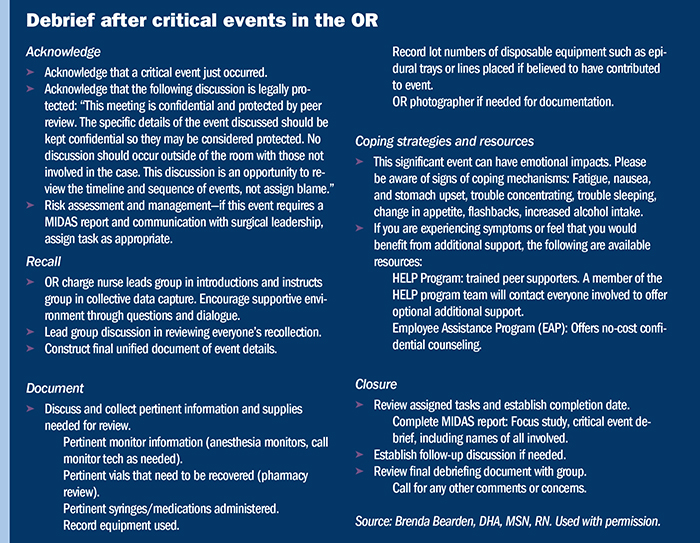
The debriefing process, which was developed through a multidisciplinary effort, involves 5 phases:
• Acknowledge: Schedule the debrief as soon as possible after an intraoperative event. At Mayo, the charge nurse initiates the debrief, Bearden says, although anyone on the team may request it.
• Recall: This is a group discussion of the details of the event that takes place in a neutral environment.
• Document: Details about any systems or equipment failures are entered into MIDAS+, a database reporting system that allows for additional follow-up.
• Coping resources: Peer support is offered in the immediate aftermath of the incident and later on, along with referral to the EAP or the HELP program, a peer-supported program available to healthcare professionals who may experience emotional or physiological impact after an adverse event, medical error, unexpected outcome, or any stressful clinical event.
• Closure: Staff are offered follow-up as needed.
Specific steps for each phase are described in the sidebar, “Debrief after critical events in the OR.”
Staff receive training on the process during a quarterly quality conference attended by all surgeons and surgical staff, anesthesia providers, RN circulators, scrub nurses, and other OR staff. In addition, the debriefing tool and companion procedure are provided in a manual that is attached to all ventilators and is available online.
The charge nurse brings together all team members for a confidential discussion that is not shared with any staff not involved in the case. That’s because the charge nurses are present for all shifts in all ORs, and therefore they are an integral part of helping to coordinate the debrief process.
“It’s an opportunity to review the timeline and sequence of events, not to assign blame in any way,” Bearden says. “We ask a team member to take notes and record participants’ names, and this information is entered into the MIDAS database along with any suggestions.”
At the beginning of the debrief, all team members introduce themselves, and then take turns describing what they saw or heard as events occurred. At the end, team members are thanked for participating in the debrief and encouraged to seek support if needed.
“We want to reinforce to staff that we don’t always achieve the outcomes we strive for, and it’s important to acknowledge the impact of what has just occurred in a healthy, protected environment,” Bearden says. She notes that the purpose of the critical event debrief is to focus on the emotional needs of the team in the immediate aftermath.
“The work doesn’t stop after the debrief,” Mathison says. “Information is entered into our MIDAS system for tracking and notification to our HELP program.”
Peer supporters receive training in 4-hour workshops to learn how to manage medication errors, unanticipated outcomes, trauma, or an unanticipated patient death. They confidentially receive names of staff and reach out to help colleagues who have been involved in such events return to a pre-event level of performance.
Some staff tend to welcome such help right away, whereas others may reject help initially but seek it later.
Since implementation of the critical event debrief in July 2018, Bearden says, some 17 debriefings have been held that were formally entered into the MIDAS database, but informal debriefings also have taken place.
In addition, some staff have sought follow-up support from the HELP program, Mathison says, notably after a ruptured abdominal aortic aneurysm—which was the first patient death experience for one certified surgical technologist—and after an organ donation for a pediatric patient—which had an impact on staff with young children of the same age as the patient.
“We’ve found debriefing to be applicable to the OR and also to code situations, trauma, and organ donation,” Bearden says. The tool has helped to create open dialogue that enhances teamwork and collaboration, she adds.
“These debriefings may not happen often, but it’s important to make sure all disciplines have this information and know this process is available,” Bearden says. “We’re here to support each other, and we want everyone to be healthy. The focus is on emotional support and what we could have done to make things go more smoothly. We want to ensure a balance between providing emotional support and analysis of equipment or system failures.” ✥
Bearden B, Mathison J. Calling all team members: Time for a critical event debrief. OR Manager Conference. September 30, 2020.
Edrees H, Connors C, Paine L, et al. Implementing the RISE second victim support programme at the Johns Hopkins Hospital: A case study. BMJ Open. 2016;6:e011708. https://bmjopen.bmj.com/content/bmjopen/6/9/e011708.full.pdf.


