Any process improvement project is far more likely to succeed with backing from leadership. The familiar phrase, “the buck stops here,” reflects a mindset that applies to OR managers who take ownership of what happens to their patients and their staffs every day. But what if they could say, “the buck starts here?”

Chris Bejil, DNP, MSN, RN, CNOR, CSSM, CENP, NE-BC
That’s the position Chris Bejil, DNP, MSN, RN, CNOR, CSSM, CENP, NE-BC, found himself in when leaders at Midland Memorial Hospital (MMH) in Midland, Texas, agreed to use bonuses as incentives for improving productivity. Bejil is director of perioperative services at Midland, a Level III, 13-OR facility that performs 8,000 cases annually.
When Bejil joined MMH in 2016, he inherited chronic turnover among OR leadership, a high proportion of traveling nurses, and virtually no accountability among surgeons or staff—all of which added up to gross inefficiencies and low morale. With the support of executive and surgeon leadership and an investment of just over $200,000 in incentive payments, dramatic improvements were made in a year’s time.
A few years before Bejil came to MMH, work had begun to develop a culture of ownership across the hospital. Leaders had recognized the need to improve attitudes, empower staff, and engage them. Bob Dent, senior vice president, chief operating officer, and chief nursing officer, had partnered with Joe Tye, chief executive officer (CEO) and head coach at Values Coach, Inc, to launch several initiatives designed to change the workplace culture. (For details about the entire program, see OR Manager, March 2018, pp 19-21, 27; April 2018, pp 19-22; and May 2018, pp 25-27).
That work eventually produced some positive changes, but they had not yet taken hold in the OR when Bejil took on management of perioperative services.
“In the 2 years before I arrived, there were five different directors,” Bejil says. “Staff had to learn to be self-sufficient and work around the system.” Workarounds meant that rules weren’t enforced, and surgeons had free reign over block times. Furthermore, surgeons were highly selective about which OR staff they were willing to work with, and this preferential treatment left some staff feeling entitled and free from any repercussions from management.
Cases started late not only because surgeons were not accountable, but also because many staff belonged to “the breakfast club,” Bejil says. “Staff would arrive and make sure the room was generally okay for a 7:30 am start time, but then they would leave for breakfast, returning around 7:25 am to open the room and get everything ready.”
Before Bejil’s tenure, 18 nurses had been hired, and only six were permanent staff. “We had a huge vacancy rate and a huge traveler utilization,” he says.
Thanks to the success of the oil industry, the population in the Midland area had nearly tripled within a few years, which increased surgical case volumes. Traveler contract rates reached $95 per hour because the nursing staff was stretched so thin. And that, in turn, meant that the staff also expected higher wages.
“There was a 75% RN vacancy rate, and I lost one of my best charge nurses because he left to work for the oil industry,” Bejil notes. “I couldn’t compete with that in a county hospital—he became a millionaire.”
Initially, Bejil says, as director, he was overseeing six departments, and the OR had no management. The average room turnover time was 38 minutes, and just 65% of first cases started on time. Furthermore, although the last case of the day was supposed to start by 4 pm, the last case out average start time was nearly 6:30 pm.
The first glimmer of light at the end of the tunnel came from Dent and Wes Barnt, VP operations, who committed to finding solutions to these problems, Bejil says. “For the first time in a long time, OR leadership was invited to speak with the key stakeholders—we got a seat at the table with the surgeons and the executive staff.” Out of these interactions, a dyad leadership model was born between nursing administration and surgeon leadership. The group met weekly to discuss possible solutions.
Starting in August 2018, sign-on bonuses of $20,000 were offered for any nurse with more than 2 years of experience. A similar tactic is used at some other healthcare organizations, but Bejil notes that such an incentive can backfire. “Out of the six nurses who were hired with sign-on bonuses, four are gone,” he says.
Other options that were considered but not adopted:
• buying lifetime memberships to different associations
• offering specialty pay for the OR group
• the “nuclear solution”—blowing everything up and asking everyone to reapply for their jobs and be interviewed
• implementing a physician-led employee recognition program whereby staff received small tokens of appreciation for a job well done.
Ultimately, it was decided that if monetary rewards were going to be used as a solution, the team would need to work to earn them. No one wanted to pay more money to staff who continued to perform poorly.
“We came up with the OR incentives program through which employees can earn up to 10% of their monthly income,” Bejil says.
The theoretical basis for the program was Gittel’s Relational Coordination Theory, which essentially states that by providing goals and the knowledge and support to achieve them, an environment of mutual respect is created that makes things better for everyone. It promotes teamwork and lessens stress.
 Both target goals and stretch goals were set for each performance metric, and all full-time employees as well as travelers were eligible to participate (sidebar, “Performance metric goals”). Efforts to reach these goals started in November 2018, and progress was tracked on a monthly basis. Managers posted performance metrics in common areas.
“A lot of things happened at the same time that year,” Bejil acknowledges. “We got new management staff, which had a huge impact on operations and quality management. We got an educator to help with onboarding education. We had a staff meeting led by senior leadership—the CEO, physician leaders, vice presidents, and the chief nursing officer. Expectations for behavior were clearly communicated and made an impression on staff.”
Success was seen in every performance metric, and Bejil attributes much of that success to the collaboration between administration and physician leadership.
The staff were able to appreciate the determination of the physician leadership. Surgeons supported the hospital’s decision to sever ties with staff who had poor attitudes or behaved badly, regardless of their clinical ability or relationship with physicians.
Although surgeons had been perceived as a primary barrier to on-time case starts, Bejil says the physician bylaws stated that a 15-minute leeway was allowed for case start times.
“The surgeon-led surgical control committee requested a change to hospital policy and the incentive metric to allow a 15-minute delay as acceptable—as long as surgeons were rounding or in a meeting. That’s because ultimately such a delay wasn’t really disruptive to the rest of the schedule,” he says.
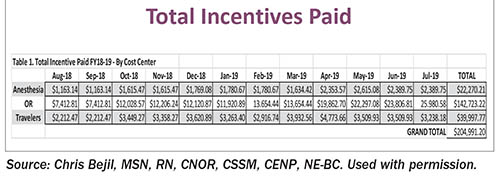 “We paid out a total of $204,991 for the incentive program in the first year,” he says (sidebar, “Total Incentives Paid”). That payout yielded big benefits to the facility, however; total surgery minutes increased by 59,731 minutes from fiscal year (FY) 2018 to FY 2019.
“The potential revenue was calculated at $102 per minute, which increased the bottom line to more than $6 million,” Bejil adds. “Our RN vacancy rate is now zero, and our traveler rate has been reduced from 60% to 20%.”
The cost of the incentive program was more than offset by the productivity gains, Bejil says. He calculates cost savings in terms of revenue that was protected as a result of improved efficiencies:
• $795,600 related to improved on-time starts (a savings of 30 minutes per day)
• $5,304,000 related to improved turnover times (estimate based on a 20-case daily average)
• $102,900 related to reduced premium pay/overtime (a 10% reduction).
In addition, two surgeons who had left to work at outpatient centers ended up returning to the hospital after experiencing the improved efficiency, he notes.
After some revenue losses in FY 2018, Bejil says, the hospital achieved profits in FY 2019 that made it possible to reward all employees hospital-wide with a 7% Christmas bonus.
Despite the overall success of the incentives program, Bejil says its future is uncertain—perhaps in part because when it was launched, no one thought to define the pathway for improvement. “We hit the 1-year mark and didn’t know what to do next: Change the metrics? Stop? Cut it off?”
In 2020, he says, the program has been expanded to preadmission testing, the preoperative area, and the postanesthesia care unit, and now includes metrics around patient readiness and tighter, more meaningful goals for turnover and on-time starts. The future of the program will be determined by a biannual reevaluation at the executive level.
In addition to establishing the length of the program, Bejil advises anyone undertaking this to:
• Set achievable goals that mean something to your organization.
• Proceed only with full support from administration and physicians.
• Consider whether to include other departments such as the preoperative and postoperative areas.
• Anticipate your data aggregation needs. “We recently switched to a new electronic medical record, and our reporting system doesn’t allow us to collect rich data as of yet,” he says.
• Monitor infection rates; make sure quality isn’t compromised by faster turnover.
• Define the payout for employees under corrective action. “This is something we didn’t think about until someone was on a ‘final warning,’” Bejil admits.
“This program could not have been started without the attention and dedication of our physician and administrative team. Their support was instrumental to our ability to create change,” Bejil says.
He also credits the frontline staff and their leadership team for having been so responsive to making changes for the better. “All of the successes of the program are a direct reflection of the resolve and tenacity of the MMH OR staff who can now proudly say that teamwork truly does make the dream work!” he adds. ✥
Bejil C. Show me the money: Incentivizing productivity. OR Business Management Conference, 2020.


