During a procedure in the OR, a medication is retrieved from the automated supply station and introduced onto the sterile field. The sterile field is then, unknowingly and unintentionally, contaminated by an unsterile medication.
This example could happen in any operating room setting. In this case, the circulating nurse spoke up and brought the situation to the attention of the manager, providing a learning opportunity for herself and her peers. An immediate survey within the department revealed that the majority of nurses would not have questioned if the contents of a medication or solution from the supply station could possibly be nonsterile. Often, the packaging with this information is removed before a medication is placed in the machine.
This incident illustrates how a “Just Culture” practice environment, in which an organization’s leadership embraces a systems approach to error reporting, results in safer patient care. Research demonstrates that the root causes of most errors in health care systems are organizational issues. Still, it is common for management to blame individuals when errors occur. This blaming approach leads to missed opportunities to learn from the error, to better educate clinicians about their practice and situational awareness, and to improve systems and processes to help prevent future errors. As Lucian Leape, MD, a leader in the prevention of health care errors, states, “The single greatest impediment to error prevention is that we punish people for making mistakes.”
In recent years, perioperative services in the Southcoast Hospitals Group has evolved into a Just Culture. Southcoast has adopted a definition of Just Culture based on the description by David Marx, JD, the safety engineer who developed the concept: “Our culture is an environment that encourages reporting and puts a high value on open communication—where risks are openly discussed between managers and staff. We create an environment where staff members feel safe and supported in voicing concerns, while also holding them accountable for behaviors and practice. We learn from mistakes and strive to improve processes, recognizing that good outcomes are a result of a shared accountability for both good system design and personal responsibility.”
With the change in leadership structure and the addition of a new nursing director 5 years ago came a leadership philosophy of open communication and transparency regarding the reporting of both errors and near misses. It was a new concept for the OR staff. Unlike many other organizations, errors didn’t often surface because of a lack of reporting by members of the care team.
To introduce the Just Culture approach and hardwire it throughout perioperative services, the perioperative director adopted a hands-on strategy with her leadership team. When an unsafe incident occurred, the director closely mentored managers throughout the process of reporting and resolving the issue. As a guide, they use the Unsafe Acts Algorithm as a consistent framework to explore each occurrence. The algorithm, adapted from James Reason’s research on errors in complex, high-risk areas, provides an objective tool that embeds the following elements:
• intent to harm
• incapacity
• foresight
• the “substitution test.”
The substitution test involves substituting the individual(s) involved in the incident with a peer from the same clinical domain with similar experience and skills and asking how the peer would deal with the situation. This test was useful in the example involving the automated supply station because it showed that someone else faced with the same situation clearly could have done the same thing. Using the substitution test helps to identify whether there are deficiencies in the system or staff education.
The algorithm is part of the standard approach to error management at Southcoast. There is a formal electronic reporting system, which staff members use to document any safety concern they observe or in which they are involved. The incident reporting system allows the person completing the report to forward the message to appropriate managers or directors, including physician leadership, who are needed to complete the investigation. It is an interactive system that fosters communication and collaboration around the event. The risk management department views all incidents in the system. In addition, staff can and often do talk directly with their manager. The manager then uses the algorithm to explore the incident, the root cause, and possible courses of action that may be needed.
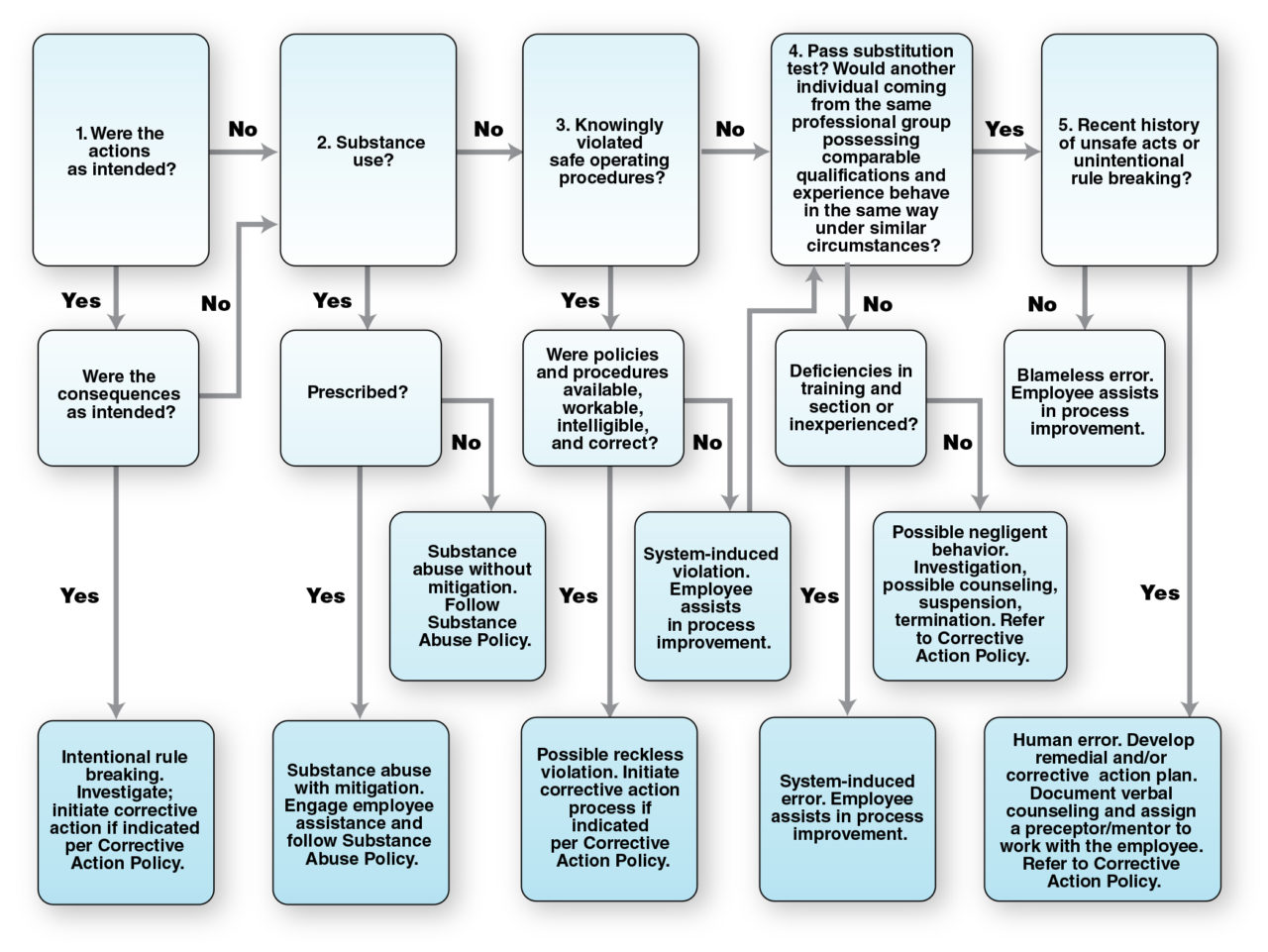
Reprinted with permission from Reason J. Managing the Risks of Organizational Accidents. Farnham UK: Ashgate, 1997, and Roesler R, Ward D, Short M. Supporting staff recovery and reintegration after a critical incident resulting in infant death. Adv Neonatal Care. 2009;9:163-171.
New managers are coached by the director until the manager is skilled and comfortable with the error-reporting process. This includes co-managing investigations and following through all of the steps. This process facilitates navigating the investigation through possible contributing factors such as human error, at-risk behavior, or reckless behavior. Outcomes of this process range from consoling the staff member to coaching or reprimand.
Managers continue to consult with their director and peers when incidents occur to gain insights and to learn from one another. When talking with staff, managers use an empathetic and blameless communication style and avoid a potentially punitive tone. Often, the staff members who are involved are encouraged to develop their own collaborative solutions and improvements, which are then shared (anonymously, if warranted) with the entire team.
The Southcoast Hospital Group’s perioperative leadership team meets monthly as a group, and the agenda always includes a discussion about incidents that have occurred throughout the system. This allows for broad-based learning from team members, another facet of the open and transparent culture that has emerged over time.
Just Culture doesn’t replace individual accountability for safe practice; rather, it encourages management to focus on system and organizational contributions to patient safety incidents. Integral to the success of this approach is the support of leadership, the human resources department, and the medical staff. The outcomes of the Just Culture include stronger teamwork, increased reporting, a change in culture, and ultimately a safer practice environment.
For more about Just Culture, visit the Just Culture Community at www.justculture.org.
Marx D. Patient Safety and the “Just Culture”: A Primer for Health Care Executives. New York: Columbia University, 2001.
Marx D, Comden S C, Sexhus Z. Our inaugural issue—in recognition of a growing community. Just Culture Community News and Views. November/December. 2005;1:1.
Meadows S, Baker K, Butler J. Incident decision tree: Guidelines for action following patient safety incidents. Advances in Patient Safety: From Research to Implementation, Vol 4, pp 387-399. Washington, DC: Agency for Healthcare Research and Quality, 2005. www.ncbi.nlm.nih.gov/books/NBK20446/?redirect-on-error=__HOME__
Reason J. Managing the Risks of Organizational Accidents. Farnham UK: Ashgate, 1997.


