The OR is the financial motor of a hospital. As such, inefficiencies in this space adversely impact patient safety as well as the financial stability of the hospital and/or healthcare system. The first case on-time starts (FCOTS) metric is one of the primary benchmarks for assessing OR efficiency. The following study focused on strategies to improve FCOTS to increase OR utilization.
This study was conducted in Spring 2021 at a learning children’s hospital that is part of a larger medical complex in an academic medical center (AMC). The surgical department consisted of eight theaters, of which seven were in constant use and the eighth was reserved as a negative pressure room for COVID-positive cases. Six rooms had elective cases scheduled, and the seventh was for emergent trauma and add-on cases.
Start times were recorded during this study for the six rooms with scheduled cases. FCOTS were monitored on elective OR days (Monday through Friday, non-holidays) with an on-time start considered for same-day surgery as patient in the room at 7:30 am on Monday, Tuesday, Thursday, and Friday, and at 8:30 am on Wednesdays. Cases in which the patients came from the ICU, the attached adult hospital, or when the anesthesiologist had two first cases had a scheduled start time of 7:45 am or 8:45 am, respectively.
Typically, four of the six elective ORs are scheduled to start at 7:30 am (8:30 am on Wednesdays), and two are scheduled to start at 7:45 am (8:45 am on Wednesdays). If all cases start on time, then FCOTS are 100% and minutes lost before first case are 30 minutes. Delays in start times increase late starts and time lost before first case.
For example, if three cases scheduled for 7:30 started at 7:40, and the 7:45 cases started on time, then FCOTS are only 50% and minutes lost are 60. Also, if two surgeons with elective cases move their starts to 8:00 am, with the other two scheduled at 7:30 and two at 7:45, if all started on time, then FCOTS ostensibly appear to be 100%, yet the minutes lost before first case are 90.
A chargeable OR minute in this OR suite ranges from $130 to $250. As such, minutes lost before a first case can become an expensive form of waste, especially if they accumulate on a daily basis.
In 2021, the Surgical and Procedural Operations Council (SPOC) set a system-wide goal to improve FCOTS to 80% around a uniform start time. To meet this goal at the children’s hospital, a quality improvement (QI) project using small tests of change was initiated.
The aims included:
Secondary outcomes included:
The QI project was supported by the Perioperative Nurse Leadership Cooperative (PNLC), a collaborative partnership between a perioperative education and credentialing organization, the Children’s Hospital, and a Midwestern school of nursing (sidebar, Perioperative Nurse Leadership Cooperative). The project lead was a Doctor of Nursing practice student from the school of nursing.

An interdisciplinary FCOTS team was formed, and it included the project lead, a physician champion, the director of surgical services, manager of perioperative services, OR manager, a data analyst, perioperative clinical nurse specialist, graduate program faculty advisor, and the perioperative department RNs. After clarifying the current state and project goals, barriers to FCOTS were identified.
Direct observations of the perioperative and OR workflows were conducted from March 2021 to May 2021. The project lead developed a “fishbone diagram” identifying potential root causes contributing to delayed FCOTS (Figure 1). Surgeon and anesthesiologist arrival times, incomplete perioperative documentation, and large case set-ups emerged as primary contributors to delayed FCOTS. These findings were consistent with the literature and provided targets for interventions.
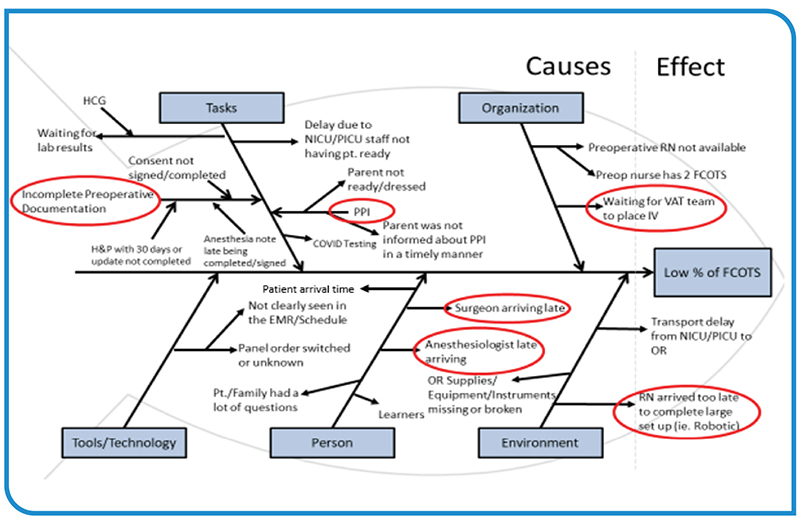
Figure 1: Fishbone diagram showing causes of delayed first case starts
Small tests of change were implemented through the FOCUS-Plan-Do-Check-Act (PDCA) framework.

Figure 2: Preoperative timeline
The “Plan-Do” included five tests of change:

Figure 3: Project interventions, 2021–2022
The evaluation of strategies (“check stage”) included distributing a daily report of the FCOTS percentages and delay code reasons to the surgical leadership team. Additionally, the surgical services nursing team completed a daily huddle to discuss any related delay codes. The project lead also asked for continuous feedback from the service line surgeons. Data was analyzed at daily, weekly, and monthly intervals and presented at monthly OR Committee meetings.
The “act stage” of the project included continuous evaluation of the impact of each test of change on the FCOTS rate and delay minutes. It was also determined if each test of change should be adapted, adopted, or abandoned.
All but the fourth PDCA cycle tests of change were adopted for implementation. Adjusting the arrival time of the patient and parent was abandoned, as data showed that it did not impact FCOTS. The team worked with Information Technology Services and the OR Committee to implement push notifications for three specific points as the patient moved through the OR: patient in preop, patient in OR, and patient in postop.
At the end of the push notification test of change, general surgery FCOTS percentage improved. In February 2022, the general surgery FCOTS percentage increased to 67%, which met the organization’s red-line goal of 65%. Data continued to be collected for an additional 4 weeks. Although FCOTS percentage decreased to 57%, there were fewer delay codes related to surgeon arrival time compared to previous months.
Preimplementation, the average daily minutes lost prior to first case from November 2020 to June 2021 was 94.1 minutes. Postimplementation, from August 2021 to March 2022, the average daily delay minutes prior to first case was 80.9 minutes, a 14% reduction in delay minutes. There was initially a positive correlation between higher FCOTS percentage and fewer minutes lost prior to first case (Figure 4).

Figure 4: Average wasted ‘am’ minutes per day vs FCOTS%
The overall FCOTS percentage had a positive trend postimplementation period, but by 8 months, FCOTS average was lower than the preimplementation 8-month average (Figure 5). This result was impacted somewhat by the COVID-19 pandemic. However, the average minutes lost prior to first case was durably reduced by 350 minutes per month in the postimplementation period. These first case delay minutes come from improving FCOTS as well as increasing the number of cases scheduled to start at 7:30 am. To see if this change was statistically significant, a T-test was performed comparing the pre- and postintervention periods. The resulting p-value was 0.013, indicating that the difference in average minutes lost prior to first case was statistically significant between the intervention periods.

Figure 5: Monthly FCOTS%
When comparing the same two periods, average monthly chargeable “In-OR” minutes increased by 1,330 postimplementation: a 26% increase. The increase in collected hospital billing charges for these In-OR minutes was approximately $17,300 per month, or $138,000 over the 8-month postimplementation period. The data indicate that reducing minutes lost prior to first case improved OR utilization and collectable charges.
This project had many strengths and limitations that may be transferable to other benchmark improvement initiatives.
Strengths:
Limitations:
The FOCUS-PDCA framework identified and overcame barriers to small tests of change through rapid cycles to increase chargeable In-OR minutes. Department culture and staff buy-in were initial obstacles. Support from SPOC and the OR Committee allowed for continuous buy-in and improvement. Transparency of data and overall awareness of process improvement contributed to conversation shifts regarding FCOTS and, ultimately, a change in culture. Maintaining a culture that embraces and adapts to change will be critical for both sustainability and further improvements. As with this project, new initiatives will incorporate the FOCUS-PDCA framework as a standard approach.
While the project did not durably increase FCOTS percentage, it did reduce average minutes lost prior to first case. The momentum from this project across the health system continues to drive continuous system-wide process improvement in FCOTS percentages and minutes lost prior to first case. ORM
—The main authors of this study are Katrina M. Schuh, DNP, RN; Quinn Mullikin, PhD, RN; Peter Nichol, MD, PhD; and Susan L. Jones, MBA.
Acknowledgements
The project lead would like to extend her sincere thanks and gratitude to the following people who have contributed to the QI project:
I am extremely grateful to the PNLC and appreciate their support throughout the duration of the project. To my preceptors and mentors, Laura Ahola, MSN, RN, and Bethany A. Steindl, MSN, RN, CPN, I express my deepest appreciation. Thank you for your guidance. I would also like to acknowledge the assistance of Aimee Muchie, MSN, RN; Dennis Stanford, MBA, BSN, RN; and Alexandra York, MSN, RN, CAPA, for their contributions.


