 It’s common for physicians to order 2 units of blood. But with growing awareness of the hazards of transfusions, hospitals are adopting stricter measures to manage their blood supplies, including developing guidelines for transfusions and making sure physicians are compliant.
Over the past 5 years, research has shown that transfusions during surgery carry risks of higher mortality, surgical site infections, and other complications.
A federal panel on use of blood products found too many patients are receiving blood transfusions they don’t need, putting them at risk, wasting limited blood resources, and raising costs.
The Health and Human Services Advisory Committee on Blood Safety and Availability issued findings and recommendations in June 2011 (sidebar).
One finding was that blood management programs have shown a significant reduction in blood use without patient harm.
Also in June, the Joint Commission issued its final Patient Blood Management Performance Measures, which provide metrics hospitals can use to gauge how they are meeting blood management goals (sidebar).
“What really accelerated the interest in blood management was evidence coming out of the critical care literature, including the 2009 clinical practice guideline on transfusions from the Society of Critical Care Medicine and Eastern Association for the Surgery of Trauma,” Joseph Thomas, BSN, RN, told OR Manager.
This was the first formal practice guideline to recommend single-unit transfusions rather than 2 units for nonhemorrhaging patients, says Thomas, vice president of program services for the Strategic Healthcare Group, LLC, a blood management consulting firm (www.bloodmanagement.com).
The first prospective randomized controlled clinical study on blood transfusions, Transfusion Requirements in Critical Care (TRICC), was not published until 1999. The study compared outcomes in patients transfused with red cells when hemoglobin concentrations dropped below 7 g/dL (restrictive group) and those transfused when hemoglobin concentrations dropped below 10 g/dL (liberal group).
The restrictive group had lower overall 30-day mortality (18.7% vs 23.3%) and lower in-hospital mortality (22.2% vs 28.1%).
“The TRICC study showed that a hemoglobin trigger of 7 was not only as effective but superior to a trigger of 10,” says Thomas, adding that “the hemoglobin trigger of 10 is antiquated and not based on any evidence.” It dates to 1942 when a prominent anesthesiologist from the Mayo Clinic promoted the idea that patients would have a better recovery if their hemoglobin levels were maintained above 10 g/dL.
The TRICC study is still viewed as the one having the greatest impact on transfusion practice, says Thomas. Prior to this study, practitioners based transfusion decisions on retrospective studies that found patients had adverse effects due to anemia.
“Everyone had just assumed that if anemia has some risk, they should prevent an adverse event from potentially happening by giving blood to correct the anemia. No one ever asked whether patient outcomes improved when they were transfused,” he says.
Over the past 5 years, the number of studies has grown (sidebar).
A study, published online December 14, 2011, in The New England Journal of Medicine, provides new evidence that a more restrictive transfusion threshold is appropriate, including in elderly patients with cardiovascular risks. The study also helps confirm that the findings of the TRICC trial apply to patients outside the ICU.
In the trial, rates of death or inability to walk without human assistance at 60-day follow-up were similar in patients randomized to a liberal transfusion threshold (hemoglobin 10 g/dL) and to a more restrictive transfusion strategy (hemoglobin <8 g/dL or symptoms of anemia). Differences were not significant in rates of in-hospital acute myocardial infarction, unstable angina, or death. Rates of other complications also were similar.
Besides patient safety and quality, cost is another driving factor for managing blood transfusions. Blood is expensive, easily ranging from $1 million to $10 million per year for acquisition alone, notes Thomas.
“Blood is a limited resource. It is a waste of blood and dollars to continue ordering and transfusing 2 units of blood when 1 will do,” Nicole Brocato, MSN, MBA, RN, told OR Manager. She is executive director of quality improvement and clinical research at John Muir Health.
Brocato explains that it costs $200 to $300 to acquire a unit of blood and $650 to administer it. John Muir Health, a 2-hospital health system in Concord and Walnut Creek, California, had an escalating blood budget of $6 million a year.
Over 3 years from 2007 to 2009, John Muir saved more than $2.9 million by implementing a blood management program that focused on:
• a new hospital policy of physicians ordering 1 unit of blood at a time instead of 2 units
• lowering the transfusion trigger of hemoglobin concentrations of 10 g/dL to 7 g/dL. Presently, the physicians are using a trigger of between 8 g/dL and 7 g/dL.
More than $900,000 was saved the first year, more than $1 million was saved the second year, and the savings have been sustained.
The savings don’t include the reductions in labor, supplies, testing, or adverse events but simply the amount paid to the local blood provider, says Thomas, who worked with John Muir on the project.
John Muir started its blood management program for its cardiac surgery service in 2007 after exceeding the Society of Thoracic Surgeons blood transfusion benchmark.
The program is now systemwide. The cost savings have been a secondary but welcomed outcome.
Thomas says his firm consistently achieves 20% to 40% reductions in blood use in hospitals they work with.

An eye-catching poster reminds clinicians to get on board with single-unit blood transfusions.
Many physicians have become more comfortable in the hemoglobin 8 g/dL range, but most have not reached the 7 g/dL range except for critical care physicians, says Thomas, noting that 8 g/dL is still an improvement. The bigger challenge has been convincing physicians to order 1 unit of blood instead of 2.
“It’s not because of a lack of information. It’s just such an engrained habit,” says Thomas.
At John Muir, the change began by having round-table discussions with the physicians and showing them the data. He emphasized that every unit of blood increases a patient’s complication rates, and each unit is a different liquid tissue transplant that should be treated with respect.
Autologous blood collected a week or two before surgery is not completely safe either, he says. Any biological substance stored in a refrigerator changes its properties. Every day blood is stored there is a buildup of cytokines, plasma-free hemoglobin, potassium, and cellular debris, which promotes inflammation. Red cells stored over time become sticky and inflexible and less able to perfuse the capillaries.
Thomas says he also points out to physicians that the 2 units of blood they automatically order and give are not just 1 large unit split in half; each unit is completely different. He advises them that they can as easily give 1 unit and reassess the patient before giving a second.
“It’s not about avoiding transfusion; it’s about minimizing exposure to a potentially harmful substance,” he says.
As part of raising awareness, Thomas uses creative reminders, such as screen savers that say, “Why give 2 when 1 will do?” and posters showing animals entering Noah’s Ark 2-by-2. At the end of the line is a single unit of blood saying, “Two-by-two was good for Noah, but not for blood transfusions. Get on board with single-unit transfusions; don’t flood your patient.”
Integral to John Muir’s success was the formation of a transfusion committee. The committee appointed a transfusion safety officer, identified a physician champion, and developed an education plan and new transfusion order form.
Three core people are needed to make a blood management program work, Brocato notes:
• an executive director with links to senior administration
• a transfusion safety officer with links to nursing and ancillary staff
• a medical director (physician champion) with links to medical staff.
At John Muir, Brocato is the program’s executive director. The safety officer is an RN who performs monthly audits of criteria for transfusion and nursing documentation, works closely with nursing, blood bank staff, and the medical director and reports to the executive director.
The medical director is a respected trauma surgeon who is recognized as a conservative blood product user. He is willing to accept controversy and engage the medical staff in a paradigm shift, Brocato says.
She advises that a successful transfusion committee must be multidisciplinary, multispecialty, and action-oriented. Steps she recommends:
• Gather baseline data on how much blood the hospital is using. The blood bank will have total volumes by product type.
• Find out what the organization’s hemoglobin triggers are for transfusion compared to the evidence. Then look at the quality department’s compliance data for how often the triggers are met. A trigger may be 10 g/dL, but physicians may transfuse at 12 g/dL.
• Establish new triggers using data from the literature and physician input.
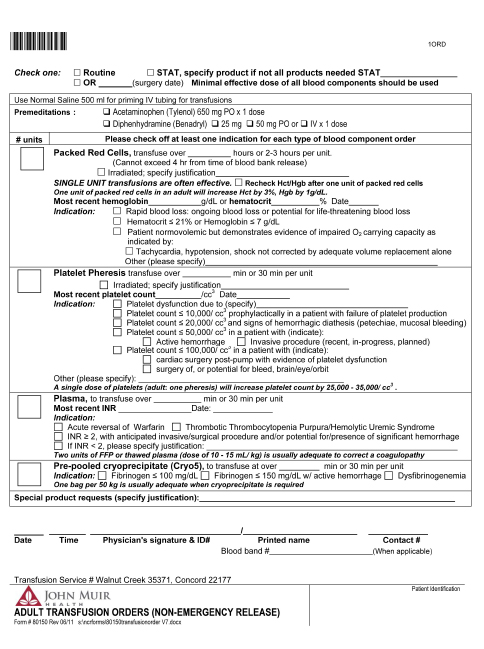
• Develop a transfusion order form with the new triggers and educate the users (chart, p 11).
John Muir’s transfusion committee had the transfusion order form approved by the medical executive committee, and the medical director presented the form at all medical staff department meetings. The committee also wrote newsletter articles about the form, presented in-service programs, and sent a letter with the order form to all the physician offices.
Use of the transfusion order form is mandatory for John Muir physicians. They can order only 1 unit of blood at a time.
Physicians must recheck the patient’s hematocrit and hemoglobin after the first unit and before a second unit can be ordered. If the physician orders 2 units, only 1 is delivered.
The form is used for all elective transfusions. Anesthesiologists are not required to use the order form during surgery if blood is needed. Use of the form is not required in emergencies, such as the care of trauma patients.
The blood bank must be engaged in this process, advises Brocato. “They have to be willing to take the heat when they refuse to fill an order for 2 units.”
As of July 1, 2011, the blood bank no longer completes any blood orders that are not on the order form. Previously, it filled handwritten orders and sent a reminder to use the form, but that is no longer done.
Some of the steps take time, Brocato notes. The physicians were given a year and a half to become used to the order form. Because of that, she has not heard complaints since the July 1 transition.
Blood management is a win-win, says Brocato. “It is the poster child for saving money and improving outcomes and patient safety.” ❖
Bennett-Guerrero E, Zhao Y, O’Brien S M, et al. Variation in use of blood transfusion in coronary artery bypass graft surgery. JAMA. 2010;304:1568-1575.
Bernard A C, Davenport D L, Chang P K, et al. Intraoperative transfusion of 1 U to 2 U packed red blood cells is associated with increased 30-day mortality, surgical-site infection, pneumonia, and sepsis in general surgery patients. J Am Coll Surg. 2009;208:931-937.
Carson J L, Terrin M L, Noveck H, et al. Liberal or restrictive transfusion in high-risk patients after hip surgery. N Engl J Med. Published online first, Dec 14, 2011. https://www.nejm.org
Hajjar L A, Vincent J L, Galas F R, et al. Transfusion requirements after cardiac surgery: The TRACS randomized controlled trial. JAMA. 2010;304:1559-1567.
Health and Human Services Advisory Committee on Blood Safety and Availability (ACBSA). Meeting, June 7-8, 2011, Bethesda, Maryland. https://www.hhs.gov/ash/bloodsafety/advisorycommittee/recommendations/recommendations_201106.pdf
Hebert P C, Wells G, Blajchman M A, et al. A multicenter, randomized, controlled clinical trial of transfusion requirement in critical care (TRICC). N Engl J Med. 1999;340:409-417.
Joint Commission Blood Management Performance Measures, 2011. http://www.jointcommission.org/patient_blood_management_performance_measures_project/
Napolitano L M, Kurek S, Luchette F A, et al. Clinical practice guideline: Red blood cell transfusion in adult trauma and critical care. Crit Care Med. 2009;37:3124-3157.


