Certain perioperative leaders stand out for their ability to inspire teams, drive innovation, and maintain excellence in patient care. Amid continued staffing shortages, technological change, and evolving patient needs, the recipients of the 2024 OR Manager Awards exemplify all these qualities and more.
Nominated by their peers and recognized in October at the OR Manager Conference in Las Vegas, this year’s honorees are:
• OR Manager of the Year: Lindsay Meade, MBA, BSN, RN, CNOR, director of perioperative services, Texas Children›s Hospital
• Ambulatory Nurse Leader of the Year: Rebecca Rayburn, MS, RN, CAPA, perianesthesia nurse manager, Sawgrass Surgical Center, University of Rochester Medical Center
• PACU Leader of the Year: Jeanne Arthur, MSN, RN, nursing director pre-procedure evaluation, preop, PACU, and day surgery, MGB Newton Wellesley Hospital.
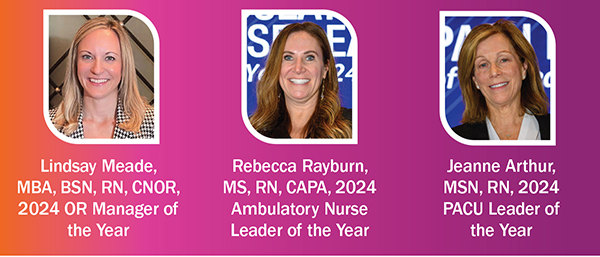
Among other topics, we discussed their leadership philosophies, how they have overcome obstacles, their strategies for adapting to change, their goals for the future, and what they have learned while guiding their teams to success. Here is what they had to say (edited for length).
Meade: A combination of clinical expertise and strategic management skills, but also the emotional intelligence to effectively lead your teams. In the perioperative world, we have to be forward-thinking—able to understand challenges that may be coming. At Texas Children’s, quality and safety is also a really big focus, and so the ability of a leader to understand how to effectively operationalize any of those identified opportunities for improvement is critical to ensure that we’re continuously improving the care for our patients and our patient outcomes.
Rayburn: It’s a blend of three qualities: strong clinical expertise; the ability to foster meaningful relationships with the surgical team; and a steadfast commitment to advocate for both staff and patient safety. Clinical expertise is so crucial. It’s difficult for a team to really trust a leader who doesn’t know what’s going on or doesn’t understand their needs. Building strong collaborative relationships is equally important. A successful team depends on trust and mutual respect to resolve issues. Focus on solutions rather than placing the blame on anybody. Learning from every interaction has helped lead me to where I am today.
Arthur: Having clinical expertise in the area you’re managing really is of value. [Staff] have faith that I understand the process as nursing director. Communication is key because everyone responds differently to change. Some people like the chaos of change—I like change, but I’ve noticed throughout my career and as a leader that not everybody feels the same way. So you really do have to make sure you communicate the message. Listen to all sides, but also give people a chance to adjust.
Meade: The pandemic is likely what comes to mind for many leaders, and that is certainly the case for me. Navigating the staffing challenges that we faced during that time, as well as the operational changes that we had to make, was something I had never experienced as a leader. We had to consider things differently and listen to the voices of our front line teams while keeping the patient front and center. The ability to pivot was critical and is what got us through that time period. I grew and learned a great deal in my leadership during this time—including my confidence in decision making, appropriate delegation, and building and maintaining team culture.
Rayburn: Supporting staff with their concerns and making them feel heard. Staff safety is a huge priority of mine. I think patients after COVID have been a little on the angry side for whatever reason. It’s really challenging to strike a balance with supporting staff, maintaining patient boundaries, and making sure that you don’t escalate the situation—you never want to tell a patient they’re wrong, yet you want to support your staff. Equally important is debriefing with staff after an incident and letting them know you have their back. My door is always open.
Arthur: I loved being a staff nurse. I had never thought about leadership. And then, when I got my Master’s degree, I started to think, ‘Well, maybe.’” So I arrived in my position, then COVID hit, and I really had to trust myself. That’s when I realized that, being part of this clinical workflow for so many years, I really did have the knowledge to set up different workflows and make sure staff felt supported. I had to trust myself to be OK with making decisions and, if they didn’t go as expected, to be honest about that and pivot to something that works.
Meade: Leadership is not just about the surgery, it’s not just about preop, and it’s not just about PACU. It’s the collective efforts of all of our teams and all of the people throughout the hospital who have an impact on our patients. While the patient remains front and center, we also have to consider the team, our physician partners, an all of the other departments across the hospital. That’s really something that has shifted in my mind since growing into a leadership role.
Rayburn: Sometimes your words can come out wrong, so it’s important to have difficult conversations when the moment is right, and to really think things through before you have that conversation. Learning your people and what their preferences are and how they like feedback is also super important. Some people need preparation, but some people hate that, because then they’re going to stress over it all night.
Arthur: You can’t make everybody happy and do what everybody wants. I can’t make everybody’s schedules perfect, but I can do my best to meet the needs of the unit with consideration to what the employees want. Scheduling that works for everybody translates to happier employees and better patient care.
Meade: Allowing myself that time to recharge. I have to often force myself to do it, but then once I do it, I really see the value in it. When I allow myself the time to take off and be with the people I care about and really be present, I come back more energized and more excited about the work and I’m able to give it 110%.
Rayburn: When I need to leave, I set an alarm on my phone to half an hour before I need to leave so I can wrap up. I never shut off my phone so I’m always available, so it can be difficult. But if I’m working really late one day, I try to pay myself back the next.
Arthur: I work out a lot, and I try to set some boundaries. I could work 24/7, and I would still have more work to do. You can only be effective at work if you take some time away. I work on that all the time, and also being able to delegate more and giving people the chance to perform.
Meade: I want to continue to expand my impact on patient care and patient outcomes. I also look forward to cultivating future leaders. It’s sometimes hard to find a perioperative leader who is passionate about it and strong in what they do, so investing the time in their development is really important and something that I personally want to focus on. At Texas Children’s, we do a really good job at focusing on quality and safety, and I look forward to continuing to drive those initiatives forward.
Rayburn: I’m excited to do some more impactful projects—time studies and that sort of thing—to increase our efficiency. For example, we had orthopedics here at the surgery center, which were typically healthy athletes and sports medicine patients, but all of those cases have moved to a newly built location. The population that’s left generally take longer to preop and recover. Trying to figure out a way to justify FTEs [full-time equivalent hours] for the amount of time that it takes to get a patient ready—that’s what I want to focus on next, and trying to figure out the best data to get what I need.
Arthur: I’m excited about finishing my DNP [Doctor of Nursing Practice]. It’s very relevant to what I do here, and it makes me think differently about things. If a higher position in leadership came up, I wouldn’t say no to that if it was the right position. I would want to stay in perioperative nursing because I think that’s where I can have an impact. Right now, I’m happy in my role—there’s still more work to be done.
—Matt Danford is managing editor of OR Manager.


