A protocol using color-coded zones has yielded a more thorough, efficient cleaning process for one 17-room OR.
The OR leaders knew they had to step up cleaning as part of an effort to reduce surgical site infection (SSI) rates and to accomplish between-case cleaning more systematically.
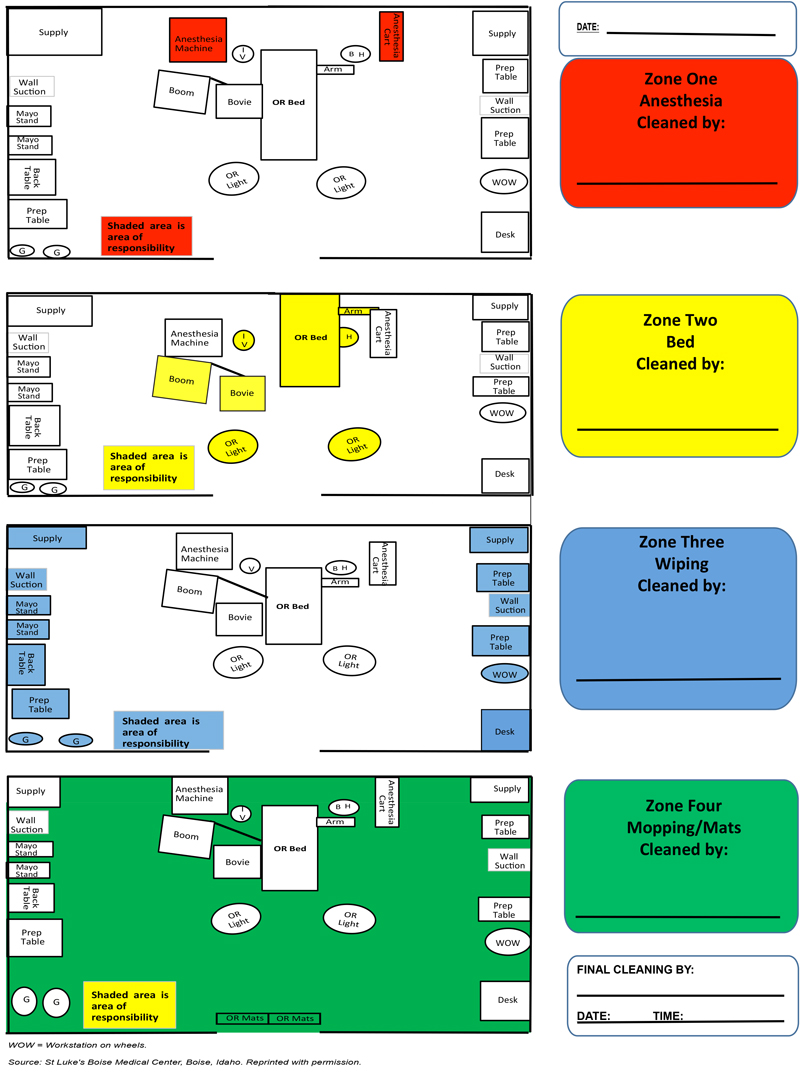
The answer: Divide each OR into 4 zones and have each member of the cleaning team sign up to clean a zone (illustration).
Designating zones alone isn’t sufficient, cautions Melissa Clapp, BSN, RN, CNOR, nurse manager for the ORs at St Luke’s Boise Medical Center in Idaho.
The OR also needs a standardized process, clear expectations, and thorough training for both environmental services (EVS) and OR staff.
Though St Luke’s had tried a zone system previously, without proper training, it quickly fell apart, she notes.
The zone system was revived during a project to improve turnover time. The effort was led by Clapp, the EVS director, and the clinical educator.
• Red zone: Anesthesia area
• Green zone: Floor
• Blue zone: Horizontal surfaces
• Yellow zone: OR bed, lights, IV poles, patient warming device, cords, and related items.
Each room has a laminated map showing the zones with spaces for the staff to sign up.
“When you come in to clean the room, you sign up for a zone,” Clapp explains. “Then you’re responsible for that zone, and you clean all of those components.”
The EVS staff is primarily responsible for OR cleaning. Five to six EVS staff are available on weekdays from 7 am to 3 pm.
If EVS staff is not available for a case turnover, they stage the room with a mop and other supplies. That indicates to the OR staff that they will need to do the cleaning.
At the end of the day, the person who performs terminal cleaning of an OR signs a wall chart with the date and time.
“In the morning, we can reference the wall chart to see who performed the cleaning and what time and date cleaning was completed,” she says. “If we see anything has been missed, we know who to talk to.”
Clapp estimates that it took about 6 months for the process to be hard wired.
She stresses the importance of having clear, standardized policies and procedures for all staff. In addition, translating all training material to overcome language barriers is especially important.
“The biggest barrier we have had is language,” she says. “Before, we just brought in our EVS staff and had one interpreter convey the instructions, but there was no return demonstration.” That wasn’t effective.
Here’s her advice for ORs that want to introduce a zone system:
• Plan for education and training. Spend time upfront developing tools and training correctly.
• Have a checklist for the correct process.
• Translate all training materials into the appropriate languages.
• Conduct rounds, audit, and be visible to sustain the effort.
For validation of cleaning, St Luke’s uses a fluorescent marking gel. The gel is applied to high-touch surfaces where cleaning is to be validated. After cleaning, a black light is shined on the surface to determine if the gel has been removed.
The audits are conducted by the EVS department or members of the hospital’s Project Zero infection prevention team.
If gaps are found, education is reinforced.
Cleaning is most likely to be effective if the EVS staff feel like a part of the team. “One reason the zone system works is because we have really engaged the EVS staff,” Clapp says.
“We have welcomed them, made them feel important, and had luncheons so they know the value of the work they’re doing. I think they are proud of the work they do.”
With a more systematic and thorough cleaning protocol as well as Project Zero’s other efforts, SSI rates have come down, as have turnover times and cleaning times.
“The zone system makes cleaning a more efficient process,” Clapp says. “We want to be thorough, touch all surfaces, and do that in a short period of time.” ❖


