Most OR leaders today are concerned about the growing problem of diabetes in surgical care. More than 30 million people in the US now have diabetes mellitus, and many studies have demonstrated its adverse impact on surgical outcomes.
The challenge is translating this research into practice. Managing diabetes is always difficult, and the physiological stress of surgery can make glucose control even more complicated. How do you implement complex diabetes management protocols in a fast-paced perioperative environment?
At Advocate Lutheran General Hospital in Park Ridge, Illinois, OR leaders have been developing and refining a perioperative diabetes management program for nearly a decade. We believe our experience could be useful for other large ORs that are trying to develop effective diabetes protocols.
Recent research on diabetes and surgery has highlighted two themes. First, hyperglycemia is clearly linked with poorer surgical outcomes. One study of coronary artery surgery patients with diabetes found that postoperative hyperglycemia is associated with an increased risk of developing surgical site infection (SSI), pneumonia, and urinary tract infection.
Conversely, another study of diabetic patients undergoing cardiac surgery found that blood glucose (BG) <200 mg/dL was associated with a survival advantage, shorter length of stay, and a lower SSI rate.
Second, hypoglycemia is also associated with bad surgical outcomes. The findings, however, are complex.
The Van den Berghe study of ICU patients compared a regimen of strict glucose control (80 to 100 mg/dL) to conventional glucose management (180 to 200 mg/dL). The data showed that strict glucose control reduced mortality, bloodstream infections, acute renal failure, ventilator days, and ICU days. On the other hand, the incidence of severe hypoglycemia (<40 mg/dL) for patients in the strict glucose group was 5.1%—more than six times higher than the conventional group.
Subsequently, the NICE-SUGAR study examined intensive versus conventional glucose control (81 to 108 mg/dL vs ≤180 mg/dL) in critically ill patients. This large international trial found that severe hypoglycemia was significantly more common in the intensive glucose management group and associated with excess mortality.
Although there is no clear evidence for specific BG targets in perioperative care, the research plainly shows the importance of carefully steering between hypo- and hyperglycemia.
We had several reasons for focusing on diabetes management in perioperative care. First, we knew that diabetes was prevalent within our surgical population. Estimates suggested that 20% of the patients who came through our ORs had diabetes mellitus. Second, we wanted to improve our performance on Surgical Care Improvement Project (SCIP) metrics—including SCIP-Inf-4, which measures postoperative glucose control for cardiac patients. This measure was also a pay-for-performance target for our health system.
Most of all, diabetes management was a significant source of confusion for patients and staff alike. Patients with diabetes frequently arrived for surgery with conflicting instructions from their primary care physician, their surgeon, and their anesthesiologist. Patients did not know which instructions to follow, and nurses were confused about how to manage this population.
Our first step was to create a multidisciplinary team to study the issues and devise evidence-based protocols for perioperative diabetes management. The team consisted of representatives from anesthesiology, nursing, endocrinology, pharmacy, and diabetes education. This leadership group began by reviewing all the available literature on diabetes management in surgical and critical care populations.
Using this evidence, we developed a perioperative diabetes management program that included target BG levels for surgery patients, perioperative insulin algorithms, and nursing protocols for managing patients with diabetes. We validated our assumptions by consulting with outside experts, notably Susan Braithwaite, MD, one of the nation’s leading diabetologists. The program rolled out in 2007 with an extensive education effort for nurses and anesthesiologists.
Under our diabetes management program, the target perioperative BG range for adult surgery patients is 100 to 140 mg/dL. (The literature suggested an upper threshold of 180 mg/dL for critical care patients; we set our perioperative target a little lower because the stress of surgery can increase blood sugar rapidly.)
The program includes several sets of algorithms:
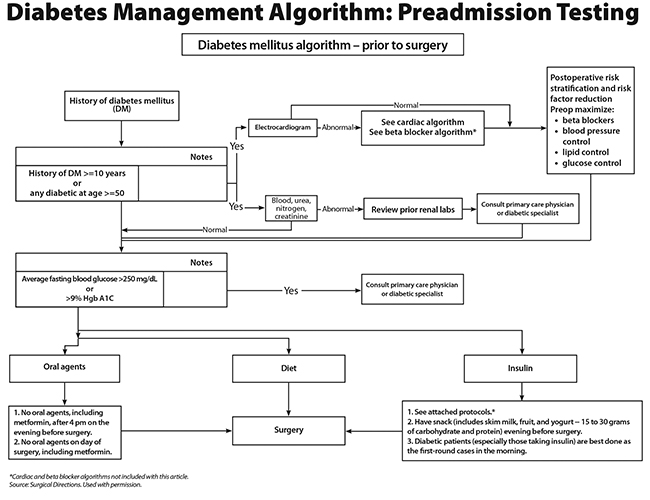
• Preadmission testing (PAT). The preadmission algorithm specifies both electrocardiogram (ECG) and BUN (blood urea nitrogen)/creatinine testing for all surgery patients with diabetes mellitus who are over age 50 or who have been diagnosed for more than 10 years (sidebar, p 22). Patients with abnormal results are referred for further consultation. PAT staff work with these patients to reduce select risk factors. In addition, patients with average fasting BG >250 mg/dL or Glycated hemoglobin (HbA1c) >9% are referred for a primary care or endocrinologist consult.
• Day before surgery. Our prior-day algorithm focuses on managing blood sugar while guarding against hypoglycemia. Patients are directed to stop all oral agents, including metformin, at 4 pm on the day before surgery and to eat one 30 g snack that evening. Special insulin dosing instructions provide details about which medications to hold and/or reduce on the day before and day of surgery.
• Day of surgery. The OR leadership team makes an effort to schedule all diabetic patients during the first round of morning cases. Preoperative nursing staff measure patient BG upon arrival and every 2 hours afterward. (Point-of-care testing is essential to this algorithm, so the OR may need to invest in glucometers.)
Nursing then orders an insulin regimen, depending on the patient’s BG reading and surgical risk score. We chose to use the 5-point Pasternak score because we wanted a more granular breakdown of surgical risk.
Patients undergoing a Pasternak 1-3 procedure (minor- to intermediate-risk surgery) receive a single bolus of insulin.
Patients undergoing a Pasternak 4-5 procedure (major surgery, including all bowel procedures) are put on one of four different insulin infusion regimens, depending on BG reading and any symptoms.
All order sets include the option of a reduced dosing scale for cachexic, elderly, and insulin-sensitive patients. (Download order sets from the OR Manager Toolbox at ormanager.com/or-toolbox.)
After rolling out our diabetes management program, we monitored outcomes to validate our protocols and identify areas for improvement. Attention was focused on two goals:
• Control of hyperglycemia. We tracked the percentage of patients with BG <180 mg/dL upon admission to the postanesthesia care unit (PACU). In 2008, shortly after the protocols were introduced, this measure was 80.3%. This was an improvement over preprogram performance, but it still fell short of our goals. As the program became hardwired into our organization, however, our ability to control hyperglycemia improved. PACU glucose control improved to 85.0% in 2012 and to 91.0% in 2013.
• Control of hypoglycemia. Low blood sugars proved more difficult to manage. In 2012, about 15% of our diabetic patients arrived in preoperative care with BG <70 mg/dL. In that same year, the percentage of patients with BG <70 mg/dL during the total perioperative period was 33%.
We responded to this issue in September 2012 by implementing our reduced insulin dosing scale. Then in February 2013, we added the evening snack. Total perioperative hypoglycemia remained high through 2014 (42%), but preoperative hypoglycemia dropped to 13% that year.
By 2015, the preoperative hypoglycemia rate was down to 7%, and the total perioperative hypoglycemia rate had been reduced to 26%.
Based on our experience designing, implementing, and refining our perioperative diabetes management program, five lessons stand out:
After the multidisciplinary team developed our diabetic protocols in 2007, we planned to hold a few in-service training sessions and then deploy the program. The director of preoperative nursing helped us understand that a program of this scale and complexity required a significant education effort, so we worked with others to develop more comprehensive education before rolling out the program. A detailed resource manual was created for nursing staff that explains all protocols, order sets, and patient management guidelines. It includes photo tutorials on how to administer push and infusion insulin.
When developing a diabetes management program, roll out a pilot protocol and then track performance to understand what needs to be fine-tuned. We tracked key measures from the beginning. After 1 year, our data clearly showed that poor compliance with diabetic protocols translated directly into worse blood sugar control. That helped us realize that targeted follow-up education was needed to make our program a success.
When we launched the diabetes protocol, we incorporated key BG information into the paper handoff tool used by preoperative nursing. This included communicating to OR nurses when the next BG reading was due.
Later, when the department switched to an electronic medical record (EMR), we moved “next BG due” to the EMR. Our goal was to streamline the handoff tool. In reality, the BG reminder became “out of sight, out of mind” for OR staff. The solution was to return this element to the paper handoff sheet.
Every failure is an opportunity to learn and improve. Whenever a surgery patient ranges outside of our target BG range, a manager examines the case and identifies any variations in care. If provider compliance is the problem, someone coaches the nurse or physician to correct course.
The drill-down process can also uncover system problems. For example, consistent drill-downs on low morning BG readings helped us realize we needed to implement the evening snack.
Clearly, any effort to improve diabetes management requires the cooperation of patients. At Advocate Lutheran, a PAT nurse contacts all patients at least 2 weeks before their procedure. The nurse explains the patient’s insulin plan and helps decide what snack to have on hand. One key question is, “Are you insulin-sensitive?” This helps us identify many patients who need a reduced-dose order set.
The PAT nurse also calls the evening before surgery to reinforce instructions. Although we have worked to disseminate our diabetes algorithms to referring physicians, some patients still enter our system with conflicting instructions from their doctors. In these cases, nurses need to explain our protocol tactfully to help improve patient education and ensure compliance.
There are a lot of unanswered questions in perioperative diabetes management. What is the optimal BG range for surgery patients? How does HbA1c fit into the picture? Does it make sense to screen for “stealth diabetes” in PAT?
To answer these questions, we need more well-designed and carefully monitored diabetes management programs. By pooling our experience, OR leaders have the opportunity to improve surgical care for a significant portion of their patient population. ✥
 David Young, MD, is medical director of preadmission testing at Advocate Lutheran General Hospital in Park Ridge, Illinois. He is also medical director of Surgical Directions (www.surgicaldirections.com), a specialty healthcare consulting firm that helps hospitals optimize perioperative performance.
 Lynn Nolan, RN, CAPA, CPAN, is assistant manager of perianesthesia services at Advocate Lutheran General Hospital.
Endara M, Masden D, Goldstein J, et al. The role of chronic and perioperative glucose management in high-risk surgical closures: A case for tighter glycemic control. PlastReconstr Surg. 2013;132(4):996-1004.
Finfer S, Chittock D, Su S Y S, et al. Intensive versus conventional glucose control in critically ill patients. N Engl J Med. 2009;360(13):1283-1297.
Golden S H, Peart-Vigilance C, Kao W H, et al. Perioperative glycemic control and the risk of infectious complications in a cohort of adults with diabetes. Diabetes Care.1999;22(9):1408-1414.
King J T, Goulet J L, Perkal M F, et al. Glycemic control and infections in patients with diabetes undergoing noncardiac surgery. Ann Surg. 2011;253(1):158-165.
Kwon S, Thompson R, Dellinger P, et al. Importance of perioperative glycemic control in general surgery: A report from the Surgical Care and Outcomes Assessment Program. Ann Surg. 2013;257(1):8-14.
Lipshutz A K M, Gropper M A. Perioperative glycemic control: An evidence-based review. Anesthesiology. 2009;110(2), 408-421.
Quattara A, Lecomte P, LeManach Y, et al. Poor intraoperative blood glucose control is associated with a worsened hospital outcome after cardiac surgery in diabetic patients. Anesthesiology. 2005;103(4):687-694.
Van den Berghe G, Woulters P, Weekers F, et al. Intensive insulin therapy in the medical ICU. N Engl J Med. 2006;354(5):449-461.


