An effective handoff helps ensure care transitions are safe and efficient, but achieving the ideal handoff can be challenging. Part 1 of this two-part series provided an overview of the role of handoffs in the perioperative setting (OR Manager, January 2020, 22-23, 25). This article offers best practices for successful handoffs.
Many of these practices are touched on in the Joint Commission’s Sentinel Event Alert, AORN recommendations, and the 2019 document, “Consensus recommendations for the conduct, training, implementation, and research of perioperative handoffs,” developed as part of a Delphi process presented at the 2017 Anesthesia Patient Safety Foundation Stoelting Conference.

Lisa Spruce, DNP, RN, ACNP, CNOR, CNS-CP, ACNS, FAAN
“Leaders should establish an interdisciplinary team at the facility level to develop a standardized handoff process,” says Lisa Spruce, DNP, RN, ACNP, CNOR, CNS-CP, ACNS, FAAN, director of evidence-based perioperative practice for AORN. The team should include perioperative nurses, perianesthesia nurses, nurses from receiving patient care units, surgeons, anesthesia providers, licensed independent practitioners (nurse practitioners and physician assistants), allied healthcare providers, and support personnel. “Research shows that handoffs should be designed by personnel who will be using the process and to fit the context in which it will take place,” Spruce says.
“Handoffs need to match the workflows of the people involved in them,” says Meghan Lane-Fall, MD, MSHP, FCCM, assistant director, Penn Center for Healthcare Improvement and Patient Safety; codirector, Penn Center for Perioperative Outcomes Research and Transformation at the University of Pennsylvania in Philadelphia; and assistant professor of anesthesiology and critical care at the Perelman School of Medicine, University of Pennsylvania. The team should keep in mind the limitations of current handoff research. “They have to have some degree of skepticism about how what has been published applies to their own situation,” Dr Lane-Fall says.
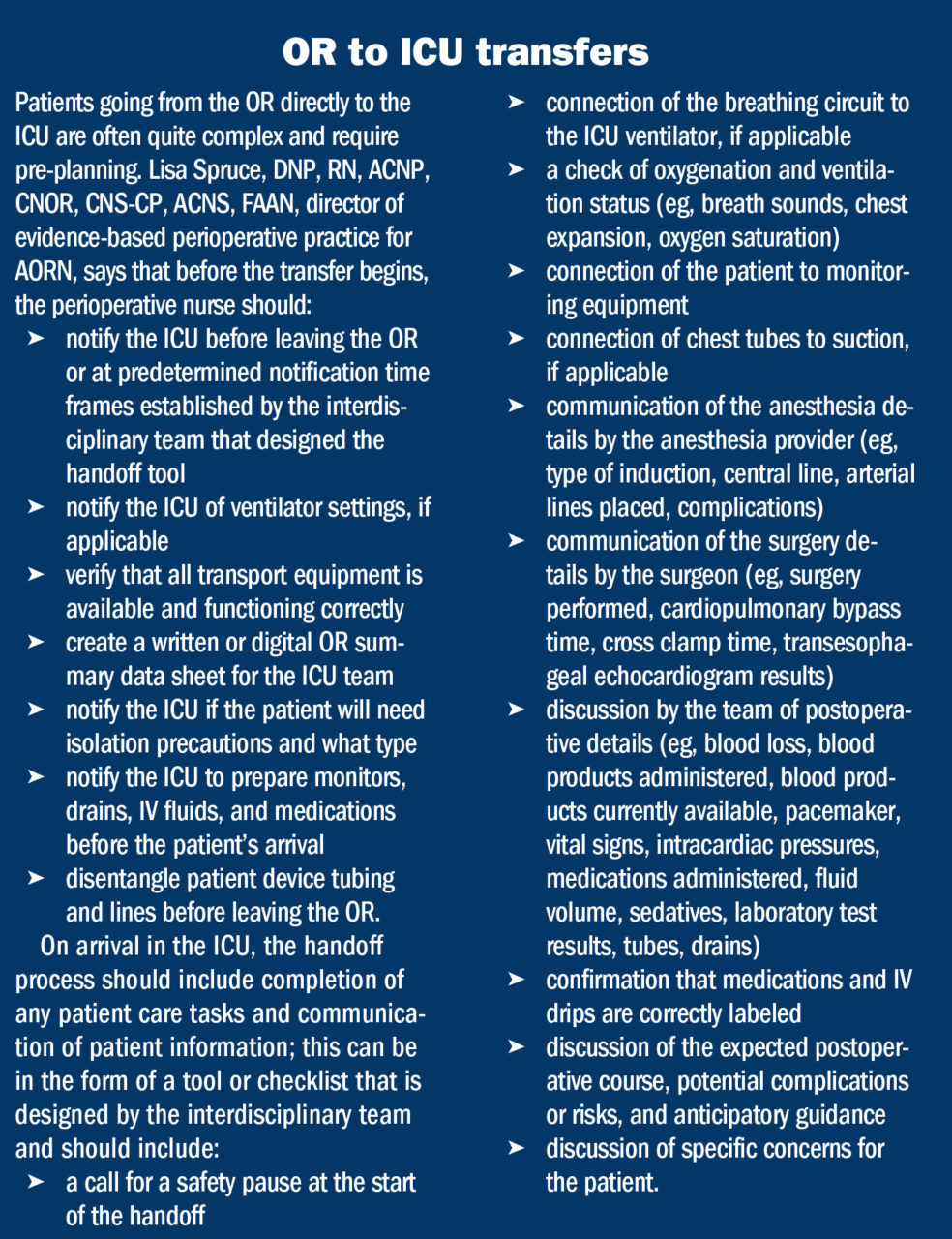 What works in one facility might not work in another. For example, at Vanderbilt University Medical Center in Nashville, Tennessee, the OR circulator, anesthesia provider, and perioperative nurse conduct a face-to-face handoff in the preoperative area. In addition, the circulator accompanies the patient for a transfer from the OR to ICU. Those processes might not be feasible for a smaller organization.
“We had a multidisciplinary work group figure out who should be present [at the preoperative to OR handoff],” says Amanda Lorinc, MD, assistant professor in the division of pediatric anesthesiology at Monroe Carell Jr Children’s Hospital at Vanderbilt University Medical Center. “We all thought that it would cause too much of a delay for the surgeons to be there because they might go into another room to do a case while we were bringing that patient down to the OR.”

Amanda Lorinc, MD
For the transfer from the neonatal ICU to the OR, the team decided it was important to have a neonatology representative (attending, nurse practitioner or fellow), anesthesia representative (anesthesiologist or certified registered nurse anesthetist [CRNA]), the OR circulator, and a respiratory therapist if the patient is on respiratory support. All of those representatives were also present when making decisions about the process, which gave them ownership.
Dr Lane-Fall notes that handoff processes must take into account daily demands. “We understand the need to take reliable care of the patient, and that high reliability is something we strive for, but in any given moment in a work day, what’s driving you is the need to get your work done in an efficient fashion,” she says. “We’re not thinking of what’s the right thing to do for the patient, we’re thinking, how do I get my work done?” Handoff processes need to account for that.

Meghan Lane-Fall, MD, MSHP, FCCM
Face-to-face communication is the gold standard for handoffs. “You should be talking in person,” Dr Lane-Fall says. “That’s really hard to do sometimes, but you transmit so much more effectively when you’re looking at someone and having a face-to-face conversation.” Tone of voice, speed of speech, gestures, and facial expressions all transmit useful information that’s missed without any in-person interaction. “Just as we can misinterpret what an email means, we can misinterpret a checklist,” she says.
Dr Lane-Fall acknowledges that face-to-face interaction isn’t always possible, given OR schedules. The next best option is a phone call (some organizations have clinicians leave a voicemail), followed by a written report.
Even face-to-face reports may be enhanced by supplemental tools. “Standardized tools, protocols, and checklists have been shown to improve the quality of information transfer and decrease communication breakdowns during handoffs,” Spruce says. Two commonly used tools are checklists and mnemonics.
“I’m a fan of checklists, but they have some serious limitations,” says Dr Lane-Fall. Checklists address only one aspect of the seven handoff functions—information exchange. Dr Lane-Fall outlines other limitations:
• Checklists don’t provide anticipatory guidance about what to consider or actions to take if the patient’s course doesn’t unfold as expected, and they don’t cover unusual events.
• Checklists don’t help in encouraging clinicians to gather everything they know about a patient into a bigger overview. For example, during a handoff, a clinician might state that the patient’s blood pressure is low because more fluid is needed, and in the process of sharing that information, the clinician realizes that it also might be because of sepsis. “Having the conversation with someone else helps you come to a different conclusion based on telling it,” Dr Lane-Fall says.
To create an effective checklist, she recommends tailoring it to the workflow of the clinicians on the front lines, and then having them pilot test it.
It’s also important to consider when a checklist is (or is not) needed. “You have to weigh the benefits of checklists with the burdens of having additional forms,” Dr Lane-Fall says.
 Spruce at AORN says a handoff tool related to meal breaks and shift changes might include the following information, but the precise data may vary:
• correct patient and procedure
• correct operative side/site
• special considerations or precautions
• intraoperative imaging
• type of incision and dressing needed
• postoperative plan of care
• medications or other solutions on the sterile field
• blood products given or available
• current blood loss
• urine output
• presence of drains
• implants needed
• instruments needed and location of the instruments
• specimen management
• type and location of grafts
• status of counts
• location of counted items (for example, body cavities, off the sterile field)
• status of documentation
• plan for communicating with the patient’s significant other.
Here are examples of mnemonics that can be used to structure handoffs:
• SWITCH—Surgical procedure, Wet, Instruments, Tissue, Counts, and “Have you any questions?” (https://www.ormanagement.net/Clinical-News/Article/08-17/Perfecting-Art-of-the-Handoff-With-the-SWITCH-Tool/46689)
• SBAR—Situation, Background, Assessment, Recommendation (https://www.ahrq.gov/teamstepps/instructor/essentials/pocketguide.html#sbar)
• IPASS—Illness severity, Patient summary, Action items, Situation awareness and contingency planning, Synthesis by receiver (http://www.ipassstudygroup.com).
Dr Lane-Fall notes that clinicians need to know what they are expected to provide for each section of the mnemonic. A 2017 study of the use of SBAR for intraoperative handoffs found that on average, each handoff addressed only 67% of the four components, with the frequency of SBAR components used differing by role type.
Spruce recommends that OR leaders ensure that the handoff process includes the following:
• assigning the roles and responsibilities of team members
• individualizing the handoff for the specific patient population (eg, child, adult) and level of acuity (eg, severity of symptoms, complexity of surgery, comorbid conditions)
• notifying the receiving team member that the patient is being transferred and citing the potential equipment needs before the patient’s arrival
• completing urgent tasks before starting the handoff
• limiting the handoff conversation to patient-specific discussions
• allowing only one person to speak at a time
• keeping distractions and interruptions (such as personal conversations) to a minimum, with only urgent clinical interruptions allowed
• using supporting documentation such as laboratory test results
• providing an opportunity for participants to voice concerns and ask questions.
Putting good handoff practices in place helps OR leaders meet regulatory requirements and can improve the bottom line by bolstering efficiency. But the most important purpose of the handoff is at the heart of what leaders, physicians, and staff alike want to achieve—quality patient care. ✥
Cynthia Saver, MS, RN, is president of CLS Development, Inc, Columbia, Maryland, which provides editorial services to healthcare publications.
Agarwala A, Lane-Fall M, Greilich P E, et al. Consensus recommendations for the conduct, training, implementation, and research of perioperative handoffs. Anesth Analg. 2019;128(5):e71-e78.
Agarwala A, Lane-Fall M. The evidence base for optimal conduct of handoffs. Anesthesia Patient Safety Foundation Newsletter. 2017;32(2):36-39.
Chatterjee S, Shake J G, Arora R C, et al. Handoffs from the operating room to the intensive care unit after cardiothoracic surgery: From the Society of Thoracic Surgeons Workforce on Critical Care. Ann Thorac Surg. 2019;107(2):619-630.
Hawthorne H, Cohen T, Common W. Assessing SBAR during intraoperative handoff. Periop Care Operating Room Manag. 2017;6:7-10.
Joint Commission. Sentinel Event Alert: Inadequate hand-off communication. 2017. https://www.jointcommission.org/assets/1/18/SEA_58_Hand_off_Comms_9_6_17_FINAL_(1).pdf.
Patterson E S, Roth E M, Woods D D, et al. Handoff strategies in settings with high consequences for failure: Lessons for health care operations. Int J Qual Health Care. 2004;16:125-132.
Terekhov M A, Ehrenfeld J M, Dutton R P, et al. Intraoperative care transitions are not associated with postoperative adverse outcomes. Anesthesiology. 2016;125(4):690-699.


