Accurate OR case scheduling is a key performance indicator that is challenging to manage. The published literature often focuses on scheduling algorithms using historical data, the surgeon’s own estimate, or a mix of similar procedures. This mathematical approach neglects the cultural, economic, behavioral, and process challenges that impact attempts to better predict the duration of cases, defined as patient in the room to patient exit.
Although the symptoms of inaccurate case scheduling are often similar (eg, rooms running past the scheduled end time), the root causes are not. If the reason for the scheduling inaccuracy is diagnosed incorrectly, a management intervention may be used that causes more problems than it intends to solve.
The more accurate the schedule and the earlier the schedule is finalized, the easier it is to plan resources accordingly.
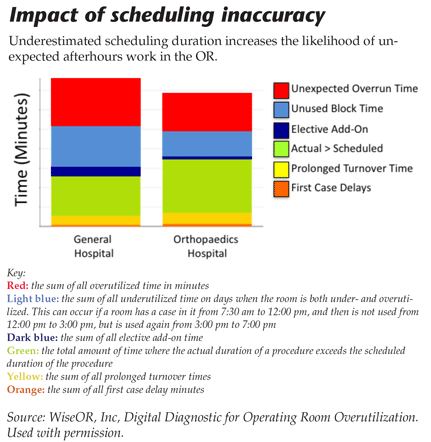 The scheduling accuracy workup
Scheduling accuracy is necessary for optimal matching of workload and staffing (sidebar right). The assumption that if a room starts late it will always finish late is false.
First-case delays may be a contributing factor to cases running over later in the day, but there are other potential causes such as prolonged turnover time, actual surgical duration, add-on procedures, or a room that is not used until the end of the day.
We have developed the START approach as a systematic way to assess the current state of scheduling accuracy, investigate potential causes for scheduling incongruence, and develop solutions (sidebar below). START includes a scheduled procedure analysis, time stamp assessment, actual procedure analysis, review of algorithm, and timely feedback and continuous improvement.

The first step is to conduct a gap analysis between what procedures surgeons think they are booking and what is actually being booked. It is best to use a combination of CPT codes and ICD 9/10 codes that together can function as a unique identifier to properly describe both the procedure and condition of the patient.
Some facilities have implemented their own custom coding taxonomy for procedure scheduling and surgeon preference cards. If so, they should use these tools to conduct their analysis.
Taking a deep dive to understand these codes and have them appropriately mapped to the procedure the surgeon wants scheduled is critical. Otherwise, there may be a breakdown in communication between what surgeons think they are scheduling and what is actually being used as the basis for scheduling the procedure.
For example, an orthopedist may be planning a simple removal and replacement of a screw in a foot, which is a 30-minute procedure. The surgeon tells his coordinator to book the case, noting some special tools that he prefers. The coordinator then books the following to account for the special circumstances: metatarsophalangeal joint plantar plate repair, arthrodesis; hardware removal; toe fusion; transfer foot hardware, which has a computed surgical duration of 180 minutes.
When gaps like this exist, it’s important to reconcile the gap between what surgeons want to schedule and what is actually being scheduled for them.
Providing adequate training to the office assistant who is calling to book cases is often useful, especially for new hires, because it will better align what the surgeon is planning to do and what is booked.
If this correct procedure scheduling step is not resolved, all further efforts will not succeed. Even if the surgeon suggests a time, it may be difficult to implement because the surgeon’s suggestion may only incorporate surgical duration and may exclude induction, positioning, preparation, and emergence.
The second step is to ensure that the correct time stamps are being used for procedure duration estimates. It’s important to clearly define which time stamps should be used, and ensure that all stakeholders understand what they mean and the rationale for using these time stamps. For example, some OR management systems may provide skin incision to skin closure historical time estimates instead of room-in to room-out times.
It is ideal to use room-in to room-out time stamps to capture the entire workload required to perform the case, and this information needs to be verified, not assumed to be correct.
If skin incision to skin closure time stamps are being used as the basis for estimates of case duration, the amount of time scheduled will be less than what is needed.
If time stamps are unreliable or not reported at all, workflows need to be changed to ensure that the data collected are comprehensive and sufficiently reliable to serve as a basis for estimating future procedures.
If the booked procedure is not performed, the time duration should be assigned to the procedure performed—not what was booked.
After the surgical case is closed, review the actual procedures performed during the case. A procedure descriptor should be precise and comprehensive enough to accurately describe the surgery performed. Corrections must be made to any procedure descriptors that may have been created before the actual surgery.
If the actual procedure performed differs from the scheduled procedure, and that discrepancy is not corrected in the descriptor, case scheduling for any subsequent surgeries will be based on faulty data.
For example, a procedure may be booked as “cystoscopy with bladder biopsy plus ureteroscopy/cystoscopy with retrograde pyelogram,” but only the first portion is completed. There should be a retroactive process that adjusts the recorded descriptor for the surgery that was actually completed, not what was originally scheduled.
If there is no set process for assigning the time duration to the case performed vs the case scheduled, one must be created. Having a workflow to collect this information is important to ensure not only good scheduling data but also accurate classification of procedures for billing purposes. Once this is achieved, future case durations will be based on validated, accurate data.
Some facilities use software that produces estimates through scheduling algorithms. These algorithms base their predictions on various sample sizes to produce numbers based on rolling averages, medians, linear regressions, advanced mathematical programming, or more sophisticated machine-learning methods.
Others find value in scheduling prediction models weighted by patient characteristics, procedure type, surgeon, or other OR personnel. Each method has its plusses and minuses.
OR leaders at facilities with computer-based scheduling that compiles historical case times in its database should review the algorithm used to predict case duration. It’s important to ensure that the inputs to the algorithm are precise and comprehensive.
As a start, review definitions of inputs, and make sure the input data are valid and consistent. The process should not be reviewed until the gap between the scheduled procedure description and actual procedure description is resolved.
To produce an estimate, you must understand the minimal sample size required. If the sample size is too small, there may be insufficient data to produce a good estimate. If the sample size is too large, it may prevent an estimate from even being produced because of the time needed to build a library of that data.
It should be possible to overwrite times based on input from the surgeon. Having some data as a starting point is better than having no data at all.
Progress and process errors should be reported in a timely fashion to keep stakeholders informed. Strong leadership will create a culture in which errors or other issues related to scheduling are reported promptly.
Teams may benefit from using an automated system to report problems. Additional training, leadership support, and clear communication may also empower staff to participate in the improvement process.
Informal feedback can be given on a daily basis through conversations, but we recommend forming a small committee with representation from all the stakeholders. This group should meet every couple of weeks, and participants should focus on review of data, accurate interpretation, and planning for next steps. Participants should think about how scheduling inaccuracies affect each stakeholder.
Examples of successful continuous process improvement initiatives in the manufacturing and service industries can be applied to the OR. With constant reevaluation and change, the system is able to perpetually propel itself forward to increase the effectiveness and efficiency of surgical services provided.
Good management is key to addressing scheduling inaccuracy. Armed with data and analysis, institutional leaders can identify the areas that warrant intervention and find support for potential changes. However, this task can be difficult depending on the organization’s politics, such as when there is a surplus of underutilized ORs relative to surgeons.
With many health systems competing to attract surgeons, it may not be prudent for managers to even approach the scheduling accuracy challenge and risk losing a particular surgeon’s caseload. The cultural and economic drivers will likely take priority over algorithmic improvements in estimates; ensuring surgeon satisfaction may be more important than trying to change behaviors that influence case scheduling.
Because of the great variety of procedures and large number of surgeons on most hospital staffs, it can be complicated to use historical data for case duration predictions. Also, if case durations for one surgeon and one procedure vary a lot, it is intrinsically difficult to make good predictions, no matter how much data are collected.
However, if it is possible to address case scheduling, the most important thing is to allocate the right amount of time to each service on each day of the week. For example, suppose there are two neurosurgery cases, each scheduled to last 4 hours, and staff are scheduled to work an 8-hour day, but the cases finish 2 hours early. Little can be done on the day of surgery to increase the efficient use of staff.
Successful prediction of surgical case duration depends on how accurately the scheduled procedure is selected when first scheduled. If there is a mismatch between the type of procedure scheduled and the actual procedure performed, it’s hard to produce an accurate estimate, regardless of the algorithm.
Furthermore, if the case description is not updated after the procedure is completed, subsequent case time estimates may be skewed because of inaccurate data.
The START approach is a way to begin analyzing problematic scheduling practices. Implementation of this method can be challenging because of the cultures, personalities, and economic priorities that are unique to each healthcare organization. However, we believe getting off to a good START is the first step in any attempt to improve case scheduling accuracy. ✥
Dexter F, Dexter E U, Masursky D, et al. Systematic review of General Thoracic Surgery articles to identify predictors of operating room case durations: Anesth Analges. 2008;106:1232-1241.
Eijkemans M J C, et al. Predicting the unpredictable: A new prediction model for operating room times using individual characteristics and the surgeon’s estimate. Anesthesiology. 2010;112:41-49.
Kougias P, Tiwari V, Berger D H. Use of simulation to assess a statistically driven surgical scheduling system. J Surg Res. 2016;201:306-312.
Macario A. Implementing operating room management science: From the bench to the scheduling office. Eur J Anaesthesiol. 2014;31(7):355-360.
Macario A. Truth in scheduling: Is it possible to accurately predict how long a surgical case will last? Anesth Analges. 2009;108(3):681-685.
Macario A, Dexter F. Estimating the duration of a case when the surgeon has not recently scheduled the procedure at the surgical suite. Anesth Analges. 1999;89:1241-1245.
Pash J, Kadry B, Bugrara S, et al. Scheduling of procedures and staff in an ambulatory surgery center. Anesth Clin. 2014;32(2):517-527.
Sanford J A, Kadry B, Brodsky J B, et al. Bariatric surgery operating room time—Size matters. Obes Surg. 2015;25(6):1078-1085.
Stepaniak P S, Heij C, Mannaerts G H H, et al. Modeling procedure and surgical times for current procedural terminology-anesthesia-surgeon combinations and evaluation in terms of case-duration prediction and operating room efficiency: A multicenter study. Anesth Analges. 2009;109:1232-1245.
Strum D P, May J H, Vargas L G. Modeling the uncertainty of surgical procedure times: Comparison of log-normal and normal models. Anesthesiology. 2000;92:1160-1167.
Strum D P, Sampson A R, May J H, et al. Surgeon and type of anesthesia predict variability in surgical procedure times. Anesthesiology. 2000;92:1454-1466.


