When Ayumi Fielden, MSN, RN, CCRN-K, CPAN, worked as a preceptor in a PACU nurse residency program for new graduate nurses, she realized quickly that something was missing. “The graduate nurses struggled because they were not yet comfortable with basic nursing skills, such as assessments and giving medications. They also had to deal with stressful time constraints,” she says. “It was so stressful for them, and they were in tears almost every day.”

Ayumi Fielden, MSN, RN, CCRN-K, CPAN
That experience inspired her to develop a program which allowed graduate nurses and acute-care nurses who did not have critical-care skills to develop PACU skills at a pace that promoted success without holding up the OR schedule. In 2017, Fielden had her opportunity and accepted the position of perianesthesia professional practice leader for the Houston Methodist Hospital PACU Nurse Residency Program in Texas.
At the time, the PACU of the main hospital campus needed to enlarge their pool of nurses with critical-care skills and the right personality to care for high-acuity surgical patients. “We were lacking candidates with ICU experience, but we did have many medical-surgical nurses interested in transitioning to the PACU,” says Fielden.
To take advantage of this interest, Fielden suggested that the program no longer accept graduate nurses for the Houston Methodist Hospital Medical Center campus because of its high patient acuity. Instead, she focused on training experienced medical-surgical nurses for that facility. “Med-surg nurses already have a good nursing foundation,” she says. “They know how to assess patients and how to manage time, and as a bonus, they have a strong background in discharging patients.”
To bridge the critical care gap for medical-surgical nurses, she created a formal orientation program that combined didactics, a variety of clinical rotations, and ongoing skills assessments. The program also includes hands-on experience in the simulation lab and a case-study presentation on evidence-based practice and the care of the postoperative patient (sidebar, PACU Nurse Residency Program).
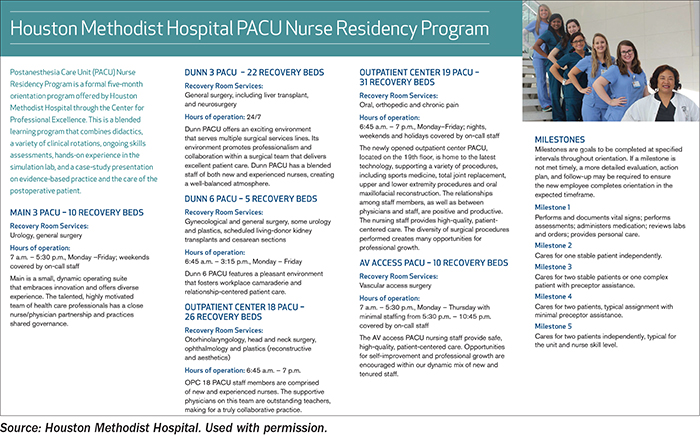
The first month of the program concentrates on critical care, including a month of clinical time in the ICU with a nurse preceptor. Nurse residents also spend a total of four days spread over one month in the classroom where Fielden teaches the foundation of paranesthesia nursing. They spend the rest of their time in the PACU partnered up with a preceptor. The PACU rotation varies depending on the nurse’s background, from 4–6 weeks to 8–12 weeks.
The Houston Methodist Hospital System has six facilities with PACUs around the Greater Houston area. Any of those PACUs can participate in the program if they want to hire and train medical-surgical nurses, OR nurses, emergency department (ED) nurses, and even new graduate nurses. Fielden tweaks each program for the residents’ and facilities’ particular needs. For example, she has developed a fast-track program for ED nurses who only need to spend a week in the ICU.
Some of Methodist’s settings, such as the PACU at Houston Methodist Clear Lake Hospital, a community hospital, will hire and train new graduate nurses. New graduate programs include additional time and training so residents can develop nursing skills before moving into PACU and critical-care skills. Residents first spend time on the medical-surgical unit to develop a basic nursing foundation, learn medication administration, and how to discharge patients. They then rotate to the ED, where they become competent in starting IVs and rapid patient assessment. Nurse residents also rotate to the preoperative unit to hone their IV skills and learn preoperative assessments and skills.
The program’s nurse residents are not passive observers but are actively involved with patient care. “They get their hands dirty and learn to make critical-care assessments, manage IV medication drips, and document,” says Fielden.

Elizabeth Liu, MSN, RN, AGNP-C
Elizabeth Liu, MSN, RN, AGNP-C, was a new graduate nurse when she entered the residency program. “I would have felt lost and overwhelmed without this program,” she says. “As a new graduate, it was difficult to connect the dots regarding a patient’s situation, but the direct exposure to the PACU through the residency program solidified my foundational knowledge of acute and critical care. With the support of an amazing preceptor and manager in the residency program, I flourished.”
Liu went on to precept many program residents and is currently the clinical resource nurse for the 56-bed high-acuity Walter 3 PACU at Houston Methodist Hospital. “The PACU Nurse Residency Program helped me in my nursing career because it gave me a strong foundational knowledge and an understanding of multiple service lines. It taught me that you can wear different hats by switching your thought process between different surgeries, such as neurosurgery and general, bariatric, and kidney surgeries. The program kept me on my toes, and I learned to think quickly on my feet.”
Fielden has garnered so much interest in the nurse residency program that she had to develop a screening tool to assess applicants. “I get applications from all over the country,” she says.
Fielden recommends screening candidates to determine who is truly interested in PACU and who might just want to try it out and maybe go to CRNA school later. “Completing the program requires a big commitment. We’re really looking for nurses who have a passion for the PACU,” she says. “I ask candidates why they want to work in PACU, and as part of the application process, I bring them on board to the PACU to shadow a nurse, so we can watch how they interact with team members.”
She also recommends developing a partnership with an organization’s ICUs. “I use three ICUs for the PACU residency program and partner closely with the surgical ICU, so the preceptors know what I’m expecting at the end of the clinical month there.”
With new graduate nurse programs, it’s also important to cultivate relationships with the ED and medical-surgical units so resident nurses get a well-rounded experience. “Lay this groundwork before you open up the program, so everyone is ready,” Fielden says.
Fielden follows her nurse residents’ progress closely and follows up with them to ensure they are confident and ready to work independently before they graduate and come off orientation. PACU supervisors and department heads are happy with the nurses from the program. “They often say the graduates are better prepared than PACU-experienced nurses hired from the outside,” says Fielden.
Nurses who graduate from the program are also enthusiastic. “They say, ‘Yes, I’m ready! Get me off orientation! I can do this,’” Fielden says. “It’s been great to see these nurses thrive, and we’re not experiencing huge dips in staffing like we have seen in other departments.”
The Houston Methodist Hospital PACU Nurse Residency Program has inspired other healthcare systems to develop similar programs to address PACU staffing needs. One example is the Perianesthesia Program at Emory Healthcare in Atlanta, Georgia.
“This staffing market is tough. We’re not getting nurses with 5 to 10 years of perianesthesia experience applying anymore,” says David Reinhart, DNP, MBA, RN, CNOR, director of education, Perioperative Services Enterprise, Emory Healthcare. “When developing our residency program, the ultimate goal was to keep the recruitment pipeline of skilled paranesthesia nurses flowing for our six hospitals and thirteen surgery centers.”
 Emory’s Perianesthesia Program includes both preoperative and PACU training and was developed using a competency-based orientation program provided by the American Society of Perianesthesia Nurses (ASPAN). The program provides the essential criteria to orient nurses to the paranesthesia setting (sidebar, Competency-based orientation program for RNs in the perianesthesia setting).
“We took the subjects from that orientation program because we wanted our program to be evidence-based,” says Reinhart. “We ended up with a multidisciplinary teaching program that includes a couple of anesthesiologists, one that lectures about inhalation gasses, and the other one teaches pain management, and a respiratory therapist that teaches airway and ventilator management.”
Reinhart recommends a few key tips for other leaders developing similar programs:
• get executive and department administrative support
• use an evidence-based curriculum to develop your program
• engage a multidisciplinary team to teach.
The Emory program varies depending on the facility’s acuity and needs. Some facility directors in the system accept new graduate nurses for training. “The settings with higher acuity patients tend not to take new graduates, but other hospitals, such as those that only perform orthopedic and spine procedures will accept new nurses,” says Reinhart. “Some people are still convinced that you need two years of critical care experience before you can work in perianesthesia, but with this robust program, we can take new nurses and they are excelling and even becoming leaders.”
The positive results of Emory’s Perianesthesia Program are dramatic. “We started our Perianesthesia program in Fall of 2021. Twenty-two nurses have completed the program, and our retention rate is 80%,” says Reinhart. “You just have to be creative and shake up the approach to recruit, train, and retain skilled nurses.”
—Catherine Spader, RN, is a healthcare writer based in Colorado.


