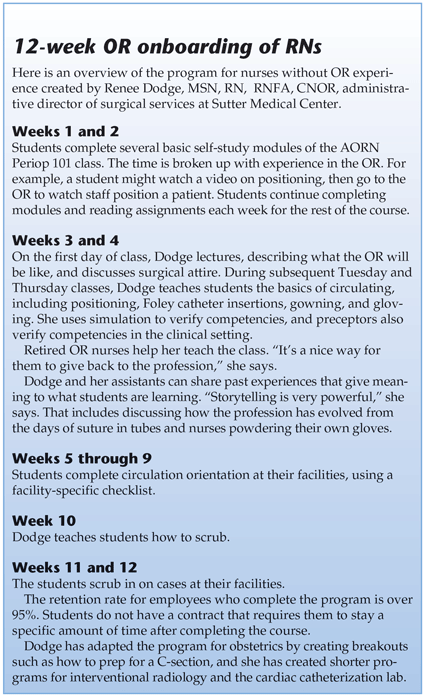
If you told OR leaders they could onboard a nurse without previous surgical experience in just 12 weeks, most would scoff, “Impossible!” But at Sutter Health University, the impossible has become not only possible, but highly successful, thanks to an innovative program created by Renee Dodge, MSN, RN, RNFA, CNOR, administrative director of surgical services at Sutter Medical Center in Sacramento, California.

Renee Dodge, MSN, RN, RNFA, CNOR
Since the program’s start in 2011, 220 graduates, including 55 new graduates, have completed the program and are fully functioning in the OR.
“I didn’t think it was possible either, when I first started,” says Dodge, who teaches the program. “But by the end of the 12 weeks, about 70% to 75% of the students can circulate basic cases on their own without a preceptor.”
In fact, nearly all of the students from the last two cohorts were circulating on their own for some cases by the end of week 5. Students from various facilities within Sutter Health gather at a centralized location for classes, which are balanced with individualized, preceptor-based education at the originating facility (sidebar below).

Yvonne
Gardner
The program is the keystone of an overall initiative to create an effective way to develop new OR nurses. “We were experiencing a chronic shortage of nearly 400 OR staff across our healthcare system,” says Yvonne Gardner, an organizational learning consultant with Workforce Equanimity, Elk Grove, California.
Gardner previously worked with Dodge as head of talent management for Sutter Health, which has 24 hospitals and multiple surgery centers in Northern California. “That meant millions of dollars in lost revenue because of elective surgery cancellations and temporary nurse premium pay,” she says.
Gardner and Dodge credit the four-part initiative for onboarding OR nurses with enhancing the bottom line, improving quality, and shaping the future of the organization.
A shared department commitment to nurses who don’t have experience in the OR starts with the hiring process, including considering new nurse graduates. “Like most OR directors, when I got a resume from a new grad with zero OR experience, I honestly didn’t give it much consideration,” Dodge says. “Now I look at new grads in a different way.”
That shift in view came from ensuring that the right people were hired for the OR. Several strategies accomplish that, starting with the initial interview.
Dodge recommends using behavior-based interview questions available from AORN to help select the ideal candidate (https://www.aorn.org/education/facility-solutions/periop-101/perioperative-orientation-resources). A robust interview panel of both new and tenured employees helps evaluate whether the applicant is a good fit for the organization. The focus is on hiring for attitude, then training for skills.
“You want someone who really wants the OR, that nurse who has always wanted the OR,” Dodge says. “If a nurse says, ‘I think I’d like to give the OR a try,’ I usually don’t have them at the top of the candidate list.”
Potential applicants shadow a circulating nurse for a day. Dodge says OR leaders make the experience as realistic as possible. “It’s not like a nursing school observation day, where they stand at the end of the bed watching,” she says. “We give them a real flavor of what a day in the OR is like.”
To do so, applicants shadow circulators working on complex cases and those that show the potentially non-glamorous side of the OR. That might include complex or breast reduction cases, where applicants experience the nonaromatic smell of prolonged electrosurgery.
“We’ve whittled out candidates just on the [electrosurgery] scents or the cold temperatures in the OR,” Dodge says. “Some of the nurses who come from the floors don’t understand that you may not be able to go to the bathroom for 3 or 4 hours.”
Gardner adds that applicants learn about Sutter Health’s commitment to social accountability, which includes how employees are expected to treat one another. For instance, all employees are expected to be able to hold crucial conversations.
Gardner says social accountability depends on having a system that recognizes people for doing the right thing. “People want to be part of what they see as a means for being recognized,” she says. “That doesn’t just mean monetary recognition, but instead public acknowledgment of a job well done.”
Dodge cites the example of one facility that uses photos on a display board in the physician and staff lounge to highlight what students did recently in the lab, and to summarize what they have worked on.
“It really pulls the entire surgical team, including physicians, into it,” she says.
Dodge adds that students and preceptors share successes not only to recognize accomplishments, but also to engage staff. “What we find is that someone will say, ‘Pull her into my case so she can learn a new skill as part of her training,’” she says.
Gardner recommends incorporating shared successes into daily huddles, which can become a place to brag (“What I worked on this week was…”), beg (“What I need more of this week is…”), and thank (“I want to thank [name] for…”).
“It’s a very simple but powerful technique that provides a means for showing what the organization is trying to encourage,” she says.
The program supports students by ensuring they experience real-life scenarios as part of their education. The retired nurses who help Dodge teach the course may play the role of a difficult  surgeon who is demanding multiple vascular clips at a rapid-fire pace, making it hard for the student to keep up. Or, when it’s time for the surgical pause, the “surgeon” might resist. As part of the experience, students learn scripting they can use in these types of situations. “We teach them how to stand firm and not succumb to intimidating behaviors,” Dodge says.
Gardner says support on the preceptor side of the equation includes helping them understand that their role “is to connect with the student so the student will feel comfortable asking the questions that they need to ask,” as opposed to focusing only on technical expertise.
Preceptors also take a short quiz to assess their communication style, and they are taught how to engage orientees with different types of learning styles (sidebar, right).
Preceptors smooth the way with surgeons and anesthesiologists by letting them know ahead of time that there will be a new nurse in the room. The preceptor reassures physicians that the orientee has read the preference card and studied the procedure.
“Sending the message that you’ve done your homework will go a long way,” Dodge says, adding that it’s also wise to have the charge nurse tell the surgeon that he or she will be checking in on the new person as well.
“All these things help reduce anxiety significantly,” Gardner says.
If a student is struggling in the classroom lab sessions, Dodge notifies preceptors of particular areas that need to be reinforced in the clinical setting. She also shares techniques that she has found helped a particular student to learn. “I spend a lot of time reaching out to the preceptors, but it’s worth it,” she says.
In the OR where Dodge is based, the preceptor and student complete a weekly status report (sidebar at right) that is shared with her. “I want to know as soon as possible if someone isn’t going to make it,” she says. The reports also serve as a recipe card for what will occur the following week.
Dodge says sometimes the perception is that the 3 to 11 pm shift (PM shift) is the “B” team and a place where longer turnovers occur. Instead, she takes a positive view of this shift because it’s where new nurses can form true bonds.
In fact, Dodge has noticed that many graduates of the program prefer to work the evening shift. “The camaraderie, energy, and attitude are great,” she says. “When they don’t have a case, they are watching other surgeries, helping out colleagues, or learning about new instruments.”
Some surgeons have taken notice of new graduates working the PM shift because the positive attitude and eagerness to learn more than make up for the lack of seasoning.
OR managers also can have the new nurses come in earlier as needed, giving them exposure to the busy day shift and the experience of circulating a case from start to finish, rather then simply relieving someone.
OR leaders usually choose the most experienced nurses as preceptors, but that’s not always the best choice. “Your ideal preceptor is one who is open to continued learning and honing their own skills,” Dodge says.
“More recent graduates from the program are quite capable of precepting because it’s a way they can reinforce their knowledge, and they can empathize,” she adds.
Dodge successfully piloted having graduates serve as preceptors after as little as 6 months’ experience. All the graduates from the last two cohorts had preceptors from previous classes.
A more experienced nurse mentors the preceptor to provide additional support, which helps engage staff. “You make the seasoned nurse feel valued, and it’s a strategic way of keeping them in the loop,” Dodge says.
Sutter Health is modifying the content of the 12-week program for the emergency department, and plans to expand it to the ICU. The program is also proving to be a leadership pipeline.
Dodge sows leadership seeds by telling students on the first day of class, “You’ve never stepped foot in the OR, but whether you want to be or not, you’re already a leader in your OR.”
She explains that they will be learning current AORN guidelines, which gives them a type of knowledge that is often more current than the practices used by more seasoned staff, which may be out of date.
Dodge also shares photos of past graduates who have assumed leadership positions, some as few as 7 months after completing the program.
“None of these things really are very complicated; on their face, they are incredibly simple,” Gardner says of the various strategies at Sutter Health. “But just like with anything else, sometimes it’s the simple things that we actually really don’t do consistently that can make the biggest difference in an organization.” ✥
Dodge R, Gardner Y. Preceptor and mentorship of the new wave of OR nurses. OR Manager Conference, 2016.


