When Carol Schneider, MSN, RN, CCRN, CPAN, became manager of a postanesthesia care unit (PACU) at Boston Medical Center in Massachusetts, she found a plethora of problems, including poor communication skills, low employee engagement scores, and bullying from surgeons and staff. “It was a very bad climate that was putting patients at risk,” Schneider says. A 6-month educational initiative helped turn the unit around, with nearly all participants stating they were changing their practice based on what they learned in the sessions.
Education is one of several effective strategies for promoting civility in the workplace and preventing bullying. In this third of a three-part series on bullying, OR Manager explores actions nurse leaders can take to ensure staff aren’t victims—or perpetrators—of bullying. After all, a 2017 study by Smith and colleagues notes that supportive nurse managers reduce incivility, making them key figures in these initiatives.

Peggy Ann Berry, PhD, RN, COHN-S, SHRM-SCP, PLNC
A first step in preventing bullying is to help staff understand the continuum of incivility, developed by Cynthia Clark, PhD, RN, ANEF, FAAN, strategic nursing advisor for ATI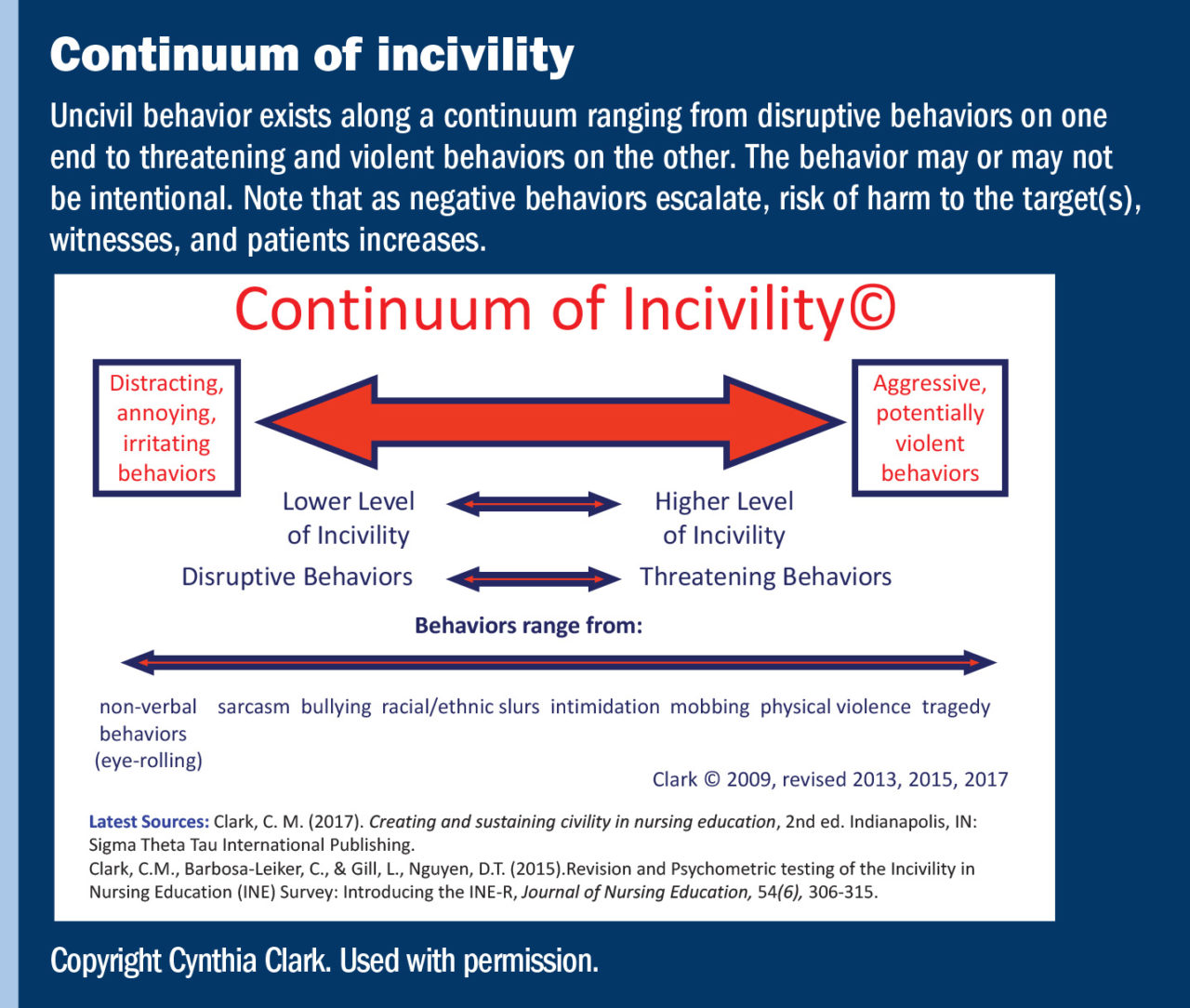 Nursing Education, founder of Civility Matters™, and co-chair for the American Nurses Association Professional Panel for Incivility, Bullying, and Workplace Violence (sidebar at right).
As negative behaviors escalate or intensify, the potential danger to others escalates as well. Clark says that although behaviors on the left end of the scale, such as eye rolling or arm crossing, might seem innocuous, they aren’t. For example, although most of us would admit to eye rolling, when asked how we feel when someone behaves that way toward us, we comment with words like diminished, demeaned, and unimportant. We may decide to avoid the person doing the eye rolling, which results in poor communication and failing to ask questions related to keeping patients safe.
“If eye rolling can result in feelings of anger and avoidant behaviors, then what might be the effect of more disruptive and high-risk behaviors?” Clark asks. “It can have devastating outcomes for ourselves, our co-workers, and our patients.” She adds that a challenge is for all members of the healthcare team to learn, practice, and master effective communication and conflict management skills.
Schneider sought to improve staff mastery of communication through education. She told staff, “We can’t control what other people say and do, but we should be able to control what we say and do. If we learn communication skills, we can put a stop to disruptive people.” To learn those skills, staff, including nurses, nursing assistants, and the unit coordinator, attended three sessions, each building on the previous one:
• Session 1: This 4-hour program included components of a healthy work environment (HWE), the importance of a HWE on patient safety, and effective communication and conflict resolution skills. As “homework,” staff developed a script to address a specific situation.
• Session 2 (2 months later): Staff practiced their script, received feedback, and learned additional skills during this 1 1/2-hour program.
• Session 3 (3 months later): During this 2-hour program, staff created a code of behavior, which is now distributed to new employees during orientation (sidebar right; see also “Sample Department Civility Pledge” in the toolbox on the OR Manager website, www.ormanager.com).
Schneider and three perioperative clinical educators led the programs, which included lectures, role-play, and discussion, and drew from American Critical-Care Nurses Association Healthy Work Environment materials. Most staff (95%) attended all three sessions.

Cynthia Clark, PhD, RN, ANEF, FAAN
Once staff understood what was acceptable behavior and what to say when they needed to speak up, the environment started to change, Schneider says. “They knew to focus on the patient, not on who wins the argument, and they had ideas on how to say what needed to be said.”
Brenda Burk, MSN, RN, an experienced OR leader who has been bullied, says Schneider’s experience isn’t surprising. Burk’s capstone project found that education improves the work environment and reduces bullying. She recommends providing education on workplace civility during orientation and annually thereafter. “People need to know what’s accepted and what’s not accepted,” she says.
Both staff and managers should attend education sessions, which can be developed from multiple resources (sidebar right). Sessions should include cyberbullying  (including postings made off duty) and the importance of every person being responsible for a civil workplace.
Susan Matt, PhD, JD, MN, RN, CNE, assistant dean for adjunct faculty affairs and associate professor at Seattle University College of Nursing, recommends adding relevant ethical mandates to education programs related to workplace civility.
“There are so many ethical issues related to bullying,” she says.
Codes of ethics from the American Nurses Association (ANA) and the International Council of Nurses (ICN) include standards that bullying violates. For instance, the ICN code of ethics states, “The nurse sustains a collaborative and respectful relationship with co-workers in nursing and other fields” (http://www.icn.ch/images/stories/documents/about/icncode_english.pdf).
And the ANA code of ethics (http://nursingworld.org/DocumentVault/Ethics-1/Code-of-Ethics-for-Nurses.html) notes, “The nurse creates an ethical environment and culture of civility and kindness, treating colleagues, co-workers, employees, students, and others with dignity and respect.…Disregard for the effects of one’s actions on others, bullying, harassment, intimidation, manipulation, threats, or violence are always morally unacceptable behaviors.”
Matt notes that “nurses need to be aware that they must adhere to codes of ethics.”

Rebecca Holland, MSN, CST, CRCST, RN, CNOR
Education alone isn’t enough. “It’s important to establish a patient safety culture and be accountable to each other and our patients,” says Rebecca Holland, MSN, CST, CRCST, RN, CNOR, director of surgical services and sterile processing at Doctor’s Hospital of Augusta, Georgia. “We need to have respect for each other as human beings.”
Holland was the victim of a bully at a hospital where she worked. “She really wanted my position as supervisor, so she systematically set about to bully me out of the hospital,” Holland says. By the time she left to accept another position, she says, “I had almost totally decompensated. My family suffered, and my self-esteem hit an all-time low.” She did not receive assistance from human resources or colleagues, but notes, “I became a better person because of it.”
Accountability can be challenging, but Holland says it’s important to have staff talk to one another about issues whenever possible, rather than asking the manager to weigh in. “Unacceptable behaviors need to be addressed immediately,” she says, adding that she encourages the use of “I” statements, such as, “I feel you were talking down to me when you were showing me the procedure.” Burk suggests adding the patient into the conversation mix when possible. For example: “I can’t give my patient my best care when you demean me in front of others.”
Holland holds bystanders accountable as well. If those who witness an event say they didn’t speak up because they didn’t want to get involved, she recommends the manager respond with a statement like this: “If you are listening, you are involved, even if you didn’t say anything.” Bystanders should let the bully know that the actions aren’t consistent with the organization’s policies.
OR managers set the tone when it comes to a healthy workplace. “Call out disrespectful communication at the very start so you have a high-functioning team,” says Peggy Ann Berry, PhD, RN, COHN-S, SHRM-SCP, PLNC, a founding fellow of the US Academy of Workplace Bullying, Mobbing, and Abuse. “Be fair in all your dealings with employees.” She adds that managers should be present in the OR, modeling professional behavior.
Organizational policies also should reflect zero tolerance for bad behavior. The desire for workplace civility should also be intentional and reflected in the organization’s mission, vision, and core values, and shared with staff. “People need to know what the organization stands for,” Clark says.
A tool for assessing the civility level of your organization is the Clark Healthy Workplace Inventory, available at https://americannursetoday.com/wp-content/uploads/2015/11/Clark-Healthy-Workplace-Inventory.pdf.
Managers need to share organizational policies with staff, including those related to use of social media, and document that they have done so.
“We all have to be aware of how to communicate skillfully and keep the patient first,” Schneider says. Burk feels the issue is even broader: “We have to change the culture in nursing. We’re so good to our patients; we need to be just as good to each other.” ✥
American Nurses Association. ANA position statement on incivility, bullying, and workplace violence. July 22, 2015. http://www.nursingworld.org/MainMenuCategories/WorkplaceSafety/Healthy-Nurse/bullyingworkplaceviolence/Incivility-Bullying-and-Workplace-Violence.html
Ciocco M. Fast Facts on Combating Nurse Bullying, Incivility and Workplace Violence. New York: Springer Publishing. 2017.
Clark C M. Creating and Sustaining Civility in Nursing Education, 2nd ed. Indianapolis: Sigma Theta Tau International Publishing.
Matt S. Ethical and legal issues associated with bullying in the nursing profession. J Nurs Law. 2012;15(1):9-13.
Smith J G, Morin K H, Lake E T. Association of the nurse work environment with nurse incivility in hospitals. J Nurs Manag. 2017;1-8. http://onlinelibrary.wiley.com/doi/10.1111/jonm.12537/full.
Editor’s note: Parts 1 and 2 of this series were published in the January 2018 (pp 1, 13-17) and February 2018 (pp 1, 13-15) issues of OR Manager. For more information on bullying, see “Managing disruptive behavior will remove bullies from the OR” (OR Manager, January 2016; 1, 15-17).


