Surgical site infections (SSIs) not only harm patients, but also can squeeze a hospital’s bottom line through increased costs and reduced reimbursement. Patients undergoing colorectal surgery are particularly at risk for SSIs, according to data from the National Healthcare Safety Network (NHSN), but an effective multidisciplinary team and an evidence-based bundle of practices can help keep these potentially deadly infections to a minimum.
For instance, when the Cleveland Clinic in Cleveland, which performs from 2,000 to 3,000 colorectal abdominal cases annually, found itself an outlier in the American College of Surgeons National Surgical Quality Improvement Program (NSQIP), clinicians got to work.
The SSI Prevention Bundle Project, launched in 2014, reduced colorectal SSIs by nearly half over 2 years. “The bundle elements are completely evidence based in every aspect,” says I. Emre Gorgun, MD, a colorectal surgeon and quality improvement officer at Cleveland Clinic.
How can OR leaders help achieve these kinds of results in their own hospitals? Interviews with OR leaders who have had success in this area reveal that it takes understanding the nature of these infections (sidebar at right) and applying a stepwise approach.
It might be tempting to jump into creating a project team, but first upper management must be on board. “The medical board and the administration all need to be part of it,” says Scott Wodicka, MD, chair of surgery at Northwell Health-Southside Hospital in Bay Shore, New York. “The entire hospital needs to be engaged in the process of trying to reduce infection.”
Identifying a project champion, typically a surgeon, is the next step. “You need someone who will commit to the project and lead it,” Dr Gorgun says. At Northwell, that was Dr Wodicka, who worked with other key surgeons and administration. “We put together a collaborative team to dive into this issue and figure out what was driving the infections and how we could prevent them,” he says.
At Cone Health, based in Greensboro, North Carolina, the multidisciplinary Colon Surgical Site Infection Task Force established in 2013 achieved a 55% reduction of deep and organ space SSIs by 2015. Sharon Hitchcock, BSN, RN, RNFA, CNOR, an OR staff nurse on the team, says other members include surgeons; nurses from the preoperative area, OR, postanesthesia care unit (PACU), and surgical units; and representatives from infection prevention, anes- thesia, and risk management.
“Be sure to have somebody from each department who will be involved serve on the committee,” Hitchcock says, adding that all hospitals in a system should be represented. “Our biggest challenge was to create a standardized bundle of care for our system of five hospitals,” she says. “You have to have the key people from each hospital to gather information and get input.”
OR leaders might also want to include staff from surgeon offices, as was done at Sacred Health Medical Center Riverbend (SHMCR), Oregon, a member of Peace Health. After implementing best practices, the hospital saw a reduction in colorectal SSIs from 17.58% in 2011 to 5.11% in 2015 in addition to reduced length of stay.
Data from 2016 show those gains have been sustained. Jan Gano, BSN, RN, CNOR, clinical supervisor of quality and safety at SHMCR, says office participation continued throughout implementation. Patients scheduled for surgery received an education booklet and attended classes given by nurses in the office.
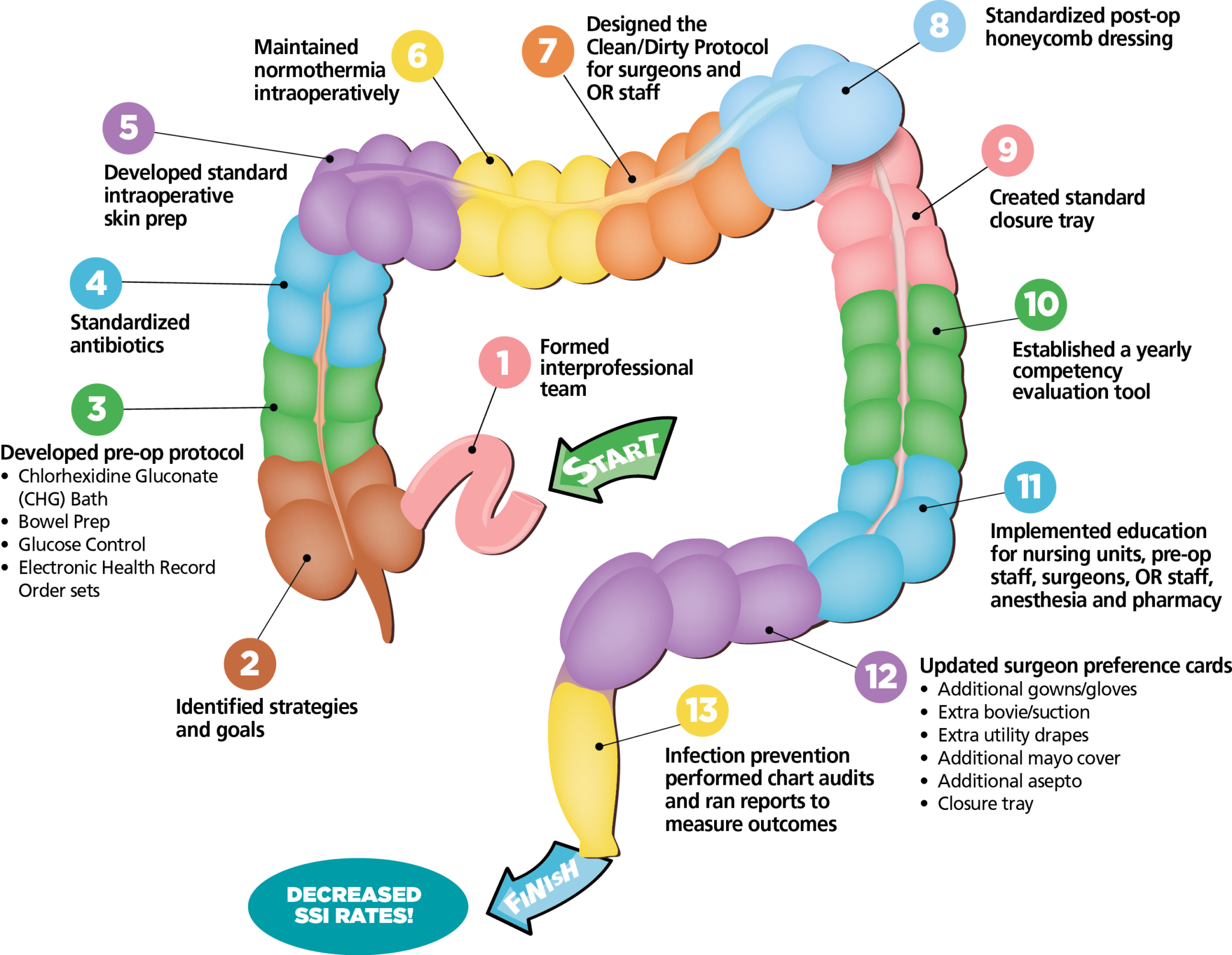
In addition to bundle elements at Cone Health, this image shows the overall process. Note that the team updated surgeon preference cards to reflect changes.
Source: Cone Health, Greensboro, North Carolina. Used with permission.
The team is responsible for developing an evidence-based bundle, the key for effective outcomes. For example, at Cone Health, 95% of patients who received five or more of the bundled elements avoided an SSI (sidebar at right). Northwell Health-Southside Hospital, which performs about 200 colorectal cases annually, had a 79% reduction; in the first 6 months of 2016, only four infections developed in 91 cases.
The team at SHMCR drew on best practices from a recent NSQIP conference and what they found in the literature. “We implemented an enhanced recovery pathway at the same time,” says Julie Weigandt, RN, CNOR, clinical data abstractor and NSQIP coordinator. The combination of the two is a powerful tool in improving outcomes for colorectal patients.
Creating the bundle, often divided into preoperative, intraoperative, and postoperative segments, takes time (sidebar, p 9). “In each phase we reviewed the literature and our previous experience,” Dr Gorgun says. “It took 2 to 3 months to develop the bundle.” That’s partly because even evidence-based practice bundles have to be adapted to meet an organization’s needs.
For instance, Frances Edwards, DNP, RN, CIC, program director of infection prevention at Northwell Health-Southside Hospital, says the team decided to develop a prophylactic antibiotic checklist to supplement the bundle that had been developed by the system.
“It lays out all the prescribing regimens,” she says. “Then all the surgeon and anesthesiologist have to do is agree on one of the antibiotic options.” Both the surgeon and anesthesiologist sign the form before the patient enters the OR so any disagreements can be resolved before surgery.
In the beginning, Dr Wodicka says, many surgeons balked at having to complete another form, but now they ask for it if it’s missing from the medical record.
Some commonalities of bundles include the following.
Identification of risk factors.Several patient risk factors have been identified for colorectal SSIs, including diabetes and high or low body mass index. A 2016 study identified other risk factors as female gender, dirty or contaminated surgery, and preoperative stay of more than 72 hours.
Patient prep at home. This typically includes a bowel prep and oral antibiotics. “Research shows that if you do a bowel prep without oral antibiotics [before surgery], patients are more likely to get SSIs,” Weigandt says. Patients also bathe with chlorhexidine gluconate (CHG).
Skin prep. “This was one of the hardest things to change,” Weigandt says of the switch from povidone-iodine to CHG and the change in prep technique in the OR. Intensive education was key.
Antibiotics. One decision to make is whether to adjust the intraoperative antibiotic dosage by weight and length of surgery. At Northwell Health-Southside Hospital, weight-based dosing is used, with redosing for longer procedures.
Dr Gorgun says the Cleveland Clinic team consulted with the infection prevention department to choose an antibiotic regimen that did not require dosage adjustments, and ceftriaxone and metronidazole were chosen. Donald Fry, MD, executive vice president of clinical outcomes at MPA Healthcare Solutions and adjunct professor of surgery at Northwestern University, recommends these antibiotics:
Dr Fry notes that cefazolin is preferred over cephalothin, which is gone from the wound in 90 minutes after administration.
Normothermia.To maintain optimal patient temperature, individual patient warming units are used at Cone Health, along with warming fluids as needed.
Clean/dirty protocol. A second set of instruments and supplies should be used for closing the incision. “We also change out Bovies and bulb syringes, and redrape the patient to make the area as clean as possible,” Hitchcock says. The surgical team changes gowns and gloves before closure.
Wound care. Gano says that SHMCR uses a wound protector to protect the skin edges during surgery. Postoperatively, Hitchcock notes that the honeycomb dressing used at Cone Health allows for clear visibility of the incision. “When blood and drainage reach the outside line of the dressing, the nurses know it’s time to change it,” she says.
Standardization in bundle implementation contributes to success. For instance, Lori Ottaviano, RN, director of perioperative services at Northwell Health-Southside Hospital, says the same type of thermometer is used throughout the hospital to ensure consistent temperature readings.
Follow-up on implementing the bundle should be built into the system. Ottaviano says each morning, the manager of same-day surgery contacts the units with inpatients coming to the OR for colorectal surgery. “That helps ensure that nobody falls through the cracks,” she says.
Here are some key numbers related to colorectal surgical site infections (SSIs).
More than 25% of elective colon resections among Medicare patients have an adverse outcome (including infections) when followed for 90 days after discharge, according to a 2016 study by Fry and colleagues.
Between 2008 and 2014, there was a 2% decrease in colon surgery SSIs, according to the National and State Healthcare Associated Infections Progress Report, published in 2016.
By implementing a variety of targeted solutions, a project from the Joint Commission Center for Transforming Health Care that included seven hospitals reduced colorectal SSIs by 32% over 2.5 years and saved more than $3.7 million.
A body mass index higher than 30 or lower than 20 correlated with a higher risk of colorectal SSIs for all seven hospitals in the Joint Commission project, as did using dirty instruments, contaminated gloves, and gowns for wound closure. Other variables that correlated for at least five of the hospitals were diabetes, surgery longer than 3 to 4 hours, inconsistent or ineffective use of antibiotic prophylaxis, and inconsistent wound management and lack of evidence-based practices for managing different types of surgical wounds.
As part of the Joint Commission project, SSIs were categorized as follows, from least to most serious:
Even though a multidisciplinary team develops the bundle, more work to obtain buy-in is needed. Dr Gorgun shared data showing the need for change and kept surgeons informed of progress. “You need collegiality and teamwork,” he says.
Weigandt agrees that the surgeon champion is key at this stage. “There were many times when our surgeon champion made a big difference, and it continues to influence our results.”
Giving feedback about successes helps encourage buy-in. “It was very important that as we were chipping away at the infection rate, the front line staff knew their work was having an impact on their patient population,” says Denise Sirakowksi, MS, RN, associate director of perioperative services at Northwell Health-Southside Hospital. “That’s important because once the patient leaves the OR, staff don’t always hear about patient outcomes.”
Buy-in may include committing to using the bundle beyond elective cases. “The elective cases are the easy ones, but the difficult ones are the ones that happen at two or three o’clock in the morning on a weekend,” Dr Wodicka says. For example, a patient with a suspected small bowel obstruction may have perforated diverticulitis with a partial obstruction, causing clinicians to scramble to apply the bundle tool retroactively. To avoid that, Northwell Health-Southside Hospital may start applying the bundle to exploratory laparotomy cases, not just elective colorectal ones.
Sometimes buy-in is a matter of making it simple to do the right thing. “We wanted people to be able to easily find the antibiotic checklist, so we changed the color of the form to green to make it stand out,” Sirakowski says.
“Education is a huge piece of this work,” Hitchcock says. “When you have this many people involved in the process, you need to be aware that education must be rolled out on all levels, including nights and weekend shifts.” She adds that only nurses competent in colorectal cases should be assigned to them.
Dr Wodicka provided education to staff on the nursing units to reinforce the importance of following the protocol. “By educating them and showing how this whole process evolved, it makes sense to them and they’re more engaged with it,” he says.
Education should include patients, Weigandt says. “They attend class before surgery so they understand what’s going to happen and what their expectations and responsibilities are.”
Dr Gorgun says that he provided education for the entire colorectal surgery department. He adds that education should include how to classify wounds because classification affects the standardized infection ratio (SIR) reported by NHSN. The SIR reflects actual vs predicted infection rates, with a baseline of 1. Lower rates indicate fewer infections.
“The SIR attempts to even out differences between tertiary and community hospitals and provides a more precise measure,” Dr Gorgun says. Failing to correctly classify a wound that is contaminated can have a significant effect on the SIR.

“The hardest part is to sustain the change,” Dr Gorgun says. “You can’t let your guard down.” He recommends that the surgeon champion regularly remind colleagues of the bundle and share data. For example, as head of the quality improvement section of the surgical department, he shares internal data monthly and results from NSQIP and NHSN quarterly.
“Education and reevaluating are key,” Hitchcock says. “You have to periodically go over the protocol step by step to make sure you are accurately implementing it.” She adds that the Colon Surgical Site Infection Task Force still meets on a regular basis.
Gano agrees that regular follow-up and data sharing are vital: “We do frequent reeducation and share the NSQIP results.” In addition, the surgery quality committee that meets every other week reviews colorectal SSI data to spot trends that need to be addressed.
This type of data review can lead to fine-tuning protocols based on a bit of detective work. For example, Dr Wodicka says at Northwell Health-Southside Hospital, the case of every patient who develops an infection is reviewed. “All the elements were adhered to in the protocol, so we looked at other factors that could potentially contribute to the infection.”
That analysis has led them to target keeping FiO2 during the surgical procedure above 80%. “If you look in the literature, there’s not a whole lot of data that says it makes a significant difference, but some references and some bigger universities have adopted the practice,” he says. The theory is that the higher oxygen level ultimately results in better immune function and reduced risk of infection.
Reducing colorectal SSIs depends on a concerted effort and continued follow-up. That’s why Dr Wodicka says hospitals need to keep the team together even after its initial success. “We still meet on a biweekly basis as a small group, but on a monthly basis as the large collaborative,” he notes. “That keeps everybody on board because if it’s out of sight, it’s out of mind.” ✥
Cynthia Saver, MS, RN, is president of CLS Development, Inc, Columbia, Maryland, which provides editorial services to healthcare publications.
Centers for Disease Control and Prevention. National and State Healthcare Associated Infections Progress Report. 2016.
Cima R, Dankbar E, Lovely J, et al. Colorectal surgery surgical site infection reduction program: A National Surgical Quality Improvement Program-driven multidisciplinary single-institution experience. J Am Coll Surg. 2013;216(1):23-33.
DeHaas D, Aufderheide S, Gano J. Colorectal surgical site infection reduction strategies. Am J Surg. 2016;212(1):175-177.
Edwards F, Aprile A. Surgical site infection reduction in colorectal surgery utilizing a checklist of evidence-based practices. Am J Infect Control. 2016;44(6):S98-S99.
Fry D E, Pine M, Nedza S M, et al. Benchmarking hospital outcomes for improvement of care in Medicare elective colon surgery. Am J Surg. 2016;212(1):10-15.
Hitchcock S, Sipsis J, Thompson S C, et al. From guts to glory: Standardized bundled approach for colon surgical site infection reduction. Poster presented at AORN Surgical Conference & Expo 2016.
Joint Commission Center for Transforming Health Care. Reducing colorectal surgical site infections. November 2012. http://www.centerfortransforminghealthcare.org/assets/4/6/SSI_storyboard.pdf.
Keenan J E, Speicher P J, Thacker J K M, et al. The preventive surgical site infection bundle in colorectal surgery: An effective approach to surgical site infection reduction and health care cost savings. JAMA Surg. 2014;149(10):1045-1052.
O’Rourke K. New tool for infection risk after colorectal surgery. Medscape. March 8, 2016. http://www.medscape.com/viewarticle/860009.
Pedroso-Fernandez Y, Aguirre-Jaime A, Ramos M J, et al. Prediction of surgical site infection after colorectal surgery. Am J Infect Control. 2016;44(4):450-454.


