May 2022 saw a critical shortage of the iodinated contrast medium (ICM) iohexol that extended well into June because of a COVID-19-related shutdown of a GE Healthcare plant in Shanghai, China, that interrupted the manufacture of ICM. According to the American College of Radiology, contrast media were added to the US Food and Drug Administration (FDA) drug shortage list on May 9.
Contrast medium is used to confirm accurate needle placement and injectate delivery, and to exclude the flow of medication into off-target tissue in interventional pain procedures. Iohexol has been unavailable or in limited supply due to the shutdown, which led the American Society of Regional Anesthesia and Pain Medicine (ASRA Pain Medicine) on May 23 to develop and publish recommendations clinicians should take during the shortage.
OR Manager discussed the implications surrounding the shortage, as well as the rapid response from a multidisciplinary team, with anesthesiologist and pain medicine physician David Dickerson, MD, chair of the American Society of Anesthesiologists’ Committee on Pain Medicine.

David Dickerson, MD
“The shutdown led to a significant supply chain error where people were trying to order their usual amount of stock for their patients and were seeing that their orders weren’t being fulfilled,” says Dickerson. “There are two different types of contrast media: one, called gadolinium, is for MRI [magnetic resonance imaging] scans. Then there’s iodinated contrast media, or ICM, which is used for CT [computed tomography] scans.” CT scans are one of the most common diagnostic imaging tests done in the country, making ICM a critical supply.
According to Dickerson, while ICM is mostly used for CT scan purposes—about 50 to 200 milliliters of the media per usage—it is also an important component in pain procedures, which often end up being in areas that have lots of blood vessels. Specialties including interventional cardiology, interventional vascular surgery, and interventional radiology, use ICM for various interventional therapies.
“We effectively want to make sure the medicine is going to go around the nerve area or into the epidural space to the nerves in order to reduce the inflammation in that area,” says Dickerson. “When these procedures are done with contrast, you see when you’re in a blood vessel and need to reposition your needle.”
The amount needed for such usage is a fraction of what is needed for a CT scan, about 1 to 3 milliliters. However, that can lead to wasteful practice, says Dickerson. “When you’re doing 20 to 30 procedures in the course of the day, and you’re using single-use vials, you might be using 1 milliliter out of a 10 milliliter vial 20 times. That means you’re wasting 90% of the vial each time.”
Then the shutdown happened, and immediate guidance for alternative usage was needed.
“For instance, we don’t use gadolinium contrast in pain procedures,” Dickerson explains. “People who don’t recognize why that’s the case might say, ‘Well, just use the other contrast.’ And that’s dangerous. There’s some injury associated with gadolinium; it can damage brain cells and cause significant injury for patients.”
“When we saw the shortage was coming, multiple pain medicine societies, including spinal intervention societies, came together in multidisciplinary working groups to share information to do with policy and procedure related to medication shortages,” says Dickerson.
The groups collaborated to create a summary document that:
1) notified clinicians about the shortage
2) listed ways for clinicians to save existing supply of ICM for critical use
3) guided clinicians to employ strategies and techniques to get therapy for patients or targeted delivery of steroid or other medications to the area of interest while avoiding the need for contrast.
The shortage forced the delay of many non-emergency exams. The goal of quickly releasing guidance was to help clinicians leverage all the ways available to treat pain issues with procedures that do not require contrast, when possible, and create an awareness of how to keep patients safe.
“Step one is to allocate and create prioritization for patients and procedures that really need to be done during the shortage period,” Dickerson explains. “Then step two is making sure that we understand how not to harm patients. We highlighted that we have multiple approaches to targets, when you should still use contrast and when you can make do without contrast if you know you will avoid a significant vascular area.” For instance, the released guidance says that transforaminal epidurals in certain areas of the body should still be performed with ICM, and that gadolinium contrast agents should not be used for spinal procedures.
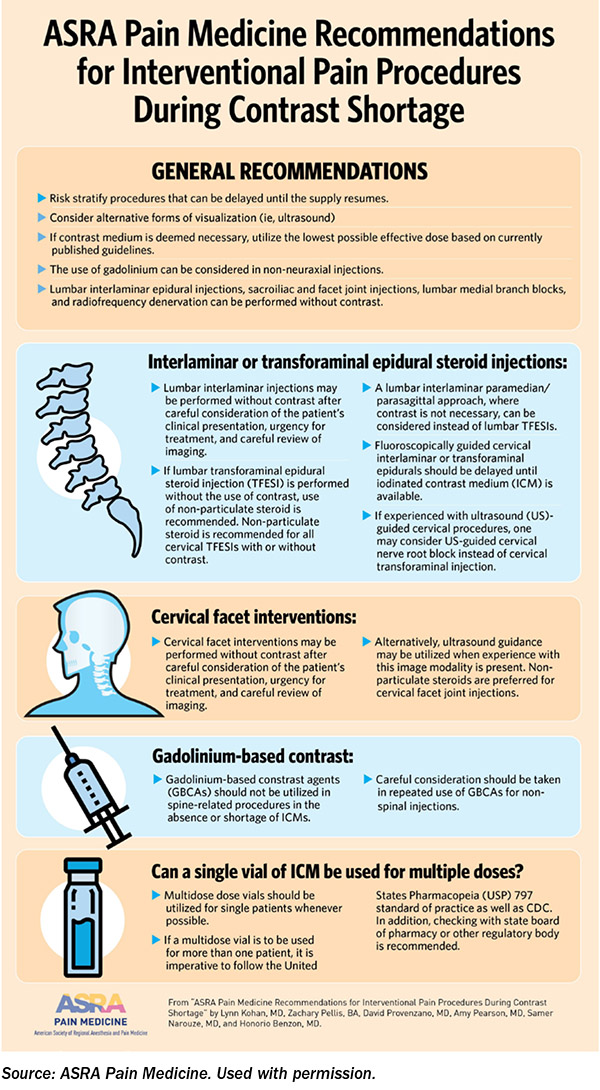
The Shanghai factory is open and has resumed production, says Dickerson. “The challenge is not just learning to adapt to a shortage like this, but really, how do we prevent it from happening again?”
“To have a nondiversified supply chain puts so much at risk diagnostically because of that CT scan need,” he adds. “We need a process improvement person and patient advocacy groups with the ability to work with members of Congress, to ask that we require companies that import these drugs to diversify their contracts so they have redundancy and the ability to backfill, so we’re not subjected to geopolitical happenstance.”
According to Dickerson, there are members of Congress and specific committees that are very interested in healthcare issues and want to work with stakeholders and healthcare representatives to enact legislation that can be protective instead of reactive to help mitigate future supply issues like this one.
“Another thing we could look at, which takes a lot of work with the FDA, is figuring out ways to repackage these medications in the future to be in smaller vials so that we don’t have to waste as much of that for the solution,” he adds, alluding back to the way ICM is packaged and wasted. “We have to create diversified supply chains, and we have to package these drugs in the right size for 20 to 30 procedures to minimize waste and allow us to use singledose vials that are going to be the right size for 95 percent of our patients.”
—Tarsilla Moura
Contrast media shortage resources. American College of Radiology. Last accessed June 2022.


