Even the most experienced OR leaders often view physician preference cards (PPCs) as a beast that acts out and demands attention at the most inconvenient times. Two organizations that have managed to tame the PPC beast shared their experiences with OR Manager.
Updating cards saves more than $3.2 million
Tresa Osborne, BS, RN, CNOR, system director for clinical value analysis at Centura Health Supply Chain in Denver, faced a challenge. The PPCs for the 16-hospital system hadn’t been updated in about 7 years, and a planned switch to a new electronic health record system (Epic) meant cards needed to be revised before transferring to the new system.
“We took a hybrid approach,” Osborne says. She and her colleagues at Centura (senior supply chain analyst Terry Walb, RN, and value analytics analysts Jesselyn Taggart, MHA, and Pernilla Paquette MBA, MS) first worked with Deloitte to refresh the cards and put an update system in place. Now Centura staff manage the entire process.
To start updating the cards, clinical coordinators (called assistant nurse managers) for the service lines reviewed copies of current cards that had been placed in a binder for easier access. One of the first changes identified was the need for a hold column so that fewer items would be opened. “This results in a big savings by avoiding waste,” Osborne says.
The clinical coordinators also found too many items listed in the “notes” section of PPCs, which meant they were not identified for billing. This section was deleted, and each item moved under the appropriate category: drapes, sutures, or gloves. OR directors voted on what the categories would be.
Once the clinical coordinators had annotated the books with the updates, Osborne and her colleagues scheduled “surgeon fairs”—one-on-one meetings with each surgeon. “We sent a letter to let them know what we were doing and why,” she says. The letter was signed by the CEO and the chief medical officer to signal the support of upper leadership.
“These big initiatives need a push from the top down,” says Osborne, who credits the success of the meetings to the clinical coordinators’ willingness to accommodate each surgeon’s schedule. The coordinators reviewed the edits in the book with each surgeon.
“At first [surgeons] complained that they didn’t have time, but when they saw how everything was ready to go, they gave a lot of positive feedback for the process,” Osborne says. The meetings were scheduled for 1 hour, although some ran longer or a subsequent meeting was planned.
Data entry came after the surgeon review. Because of the clinical coordinators’ busy schedules, in some cases Centura hired temporary workers to enter the data, which the coordinators then checked.
To maintain PPCs, Centura hired a full-time OR nurse to take the lead. Staff request a change by completing a template available on the hospital’s intranet. If the PPC nurse approves the change, it’s made within 3 business days, with 1 day being most frequent.
“We took away mass edits [of PPCs] because they’re often done incorrectly,” Osborne says, noting that only the PPC nurse is able to make global changes. Adding the position was easily justified by the $3.2 million saved over the first year.
In addition, supply chain directors in the hospitals post a placard where a supply item is located to notify clinical coordinators that a conversion is in progress, so they can request a change in the card. The PPC nurse then verifies the item has been approved and ensures it has a billing number assigned. Osborne adds that the Epic dictionary can be shared with the billing system.
“It’s imperative that directors and senior leadership encourage clinical coordinators to get the work done,” Osborne says. “Staying on top of it is huge.”
Increased satisfaction
A survey of the OR staff at UPMC Presbyterian Shadyside Hospital in Pittsburgh, Pennsylvania, identified outdated or inaccurate information (noted by 95% of respondents) and inconsistent formatting among specialties (noted by 90% of respondents) as the biggest frustrations related to PPCs, according to Lesia Very, MSN, RN, unit director.
Very and her colleague Sherri Jones, MS, MBA, RDN, LDN, FAND, quality improvement specialist, presented a poster on their experience with PPCs at the annual OR Manager Conference in October 2015.
Service line coordinators (clinicians) are in charge of updating the cards, so Very worked with them in creating a better process. This included involving team members to update and design a more standardized format, and the simple changes resulted in significant time savings.
Very admits it can be a challenge to get staff to see updating PPCs as a priority. “Emphasize that it’s important to do this because of the costs associated with each procedure,” she recommends. “People aren’t aware of how much things cost, so we let them know.”
She also emphasizes the importance of differentiating between which supplies need to be opened and which ones can simply be available in the room.
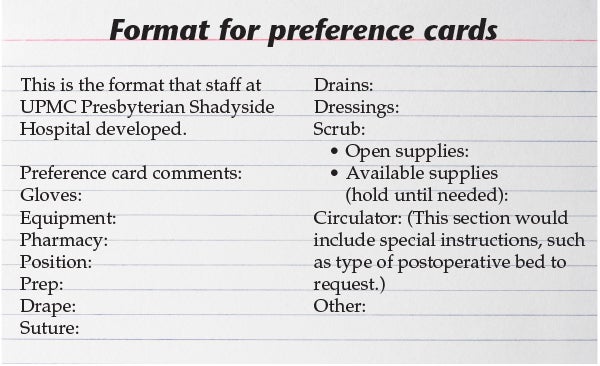
“The service line coordinators worked on standardizing the card format,” Very says, adding that the conversion to the standard format took several months (sidebar above). The cards are computerized and linked to the sterile processing department (SPD).
Standardization, along with the introduction of custom supply packs for common procedures, helped reduce the number of items on each card by an average of 15. In turn, the time it took for SPD staff to fill case carts dropped by an average of 10 minutes. The time it takes to restock items not used was also reduced.
Staff and physicians were happier with the new cards and process. “We had a decrease in turnover time, so we had satisfaction from physicians,” Very says.
She adds that when it comes to PC projects, “One of the most important things is getting your staff engaged. It has to be a team effort.” ✥
Cynthia Saver, MS, RN, is president of CLS Development, Inc, Columbia, Maryland, which provides editorial services to healthcare publications.


