Demand for anesthesia technicians is on the rise, according to a recent Chicago Tribune headline.
The article touts the position as a way to “work in the operating room without going to medical school.” Although this description may be an overreach, it does help raise awareness of the growing and valuable role of the anesthesia technician.
According to the American Society of Anesthesia Technologists and Technicians’ Standards of Practice, there are three levels of practice: anesthesia technician, certified anesthesia technician, and certified anesthesia technologist.
The extent of the responsibilities associated with each role depends on individual expertise, education, and certification (sidebar below). Certification is not mandatory.
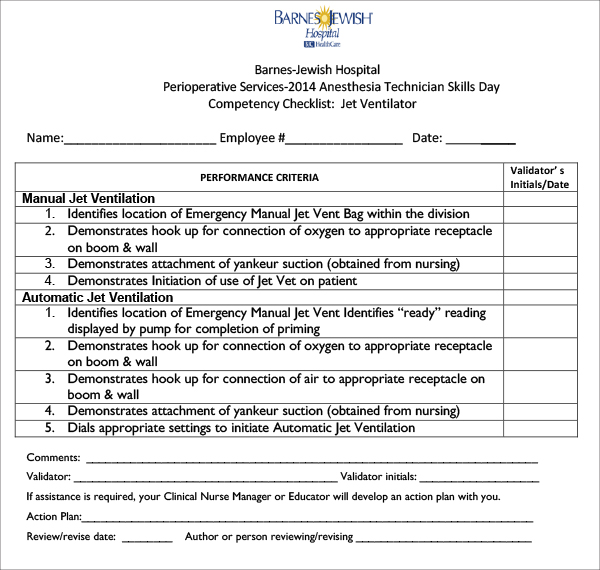
Checklist used with permission from Barnes-Jewish Hospital, St Louis.
Barnes-Jewish Hospital in St Louis employees 40 anesthesia technicians to cover more than 60 ORs on two campuses. Anesthesia technicians assist anesthesia providers in obtaining and preparing equipment and supplies, and they must be knowledgeable about anesthesia techniques, instruments, and technology.
“Our anesthesia technicians are pivotal to the smooth running of the OR,“ says Gail Davis, MSN, APRN-BC, CCRN, manager of perioperative education and development.
Their preoperative responsibilities include:
• setting up the anesthesia gas machine
• checking to make sure the appropriate gas lines are attached and on
• setting up and laying out the appropriate equipment and supplies for intubation, central lines, and capnography
• priming and prepping rapid infusers
• helping to bring the patient to the room.
Intraoperatively, one anesthesia technician will typically cover two to three rooms—running for supplies and taking blood work to the lab. Anesthesiologists have the technicians’ cell phone numbers and can call them at a moment’s notice. In between cases, anesthesia technicians clean the anesthesia equipment and provide appropriate maintenance such as changing the soda lime in the filter.
The anesthesia technicians have their own manager, who is an RN. He does daily assignments and helps train them on the equipment and supplies needed for all of the different specialties.
“Though Barnes-Jewish has employed anesthesia technicians for about 15 years, the uniqueness of our program came 4 years ago when we decided to align their competencies like we do for nurses and surgical technicians,” Davis told OR Manager. “Doing so added a standard of professionalism,” she says.
To ensure competency, the anesthesia technicians now participate in annual skills days with the RNs and surgical technicians. Skills days are scheduled on two weekends and include 10 stations, each with a competency checklist (sidebar, p 26). Some stations are run by RNs, including cardiopulmonary resuscitation, malignant hyperthermia, 12-lead ECG placement, and central line setup.
Anesthesia technicians also run specific stations, such as setup and function of the difficult airway cart, jet ventilator, transcutaneous capnography, soda lime, and rapid infuser.
All RNs, surgical technicians, and anesthesia technicians have to show competency at all 10 stations.
“Every year we look at which pieces of equipment or processes have the highest use and which have the highest potential for mistakes,” says Davis. “We make sure those are included in the skills days to ensure competency and standardization.”
Davis says they also assess the competency checklists each year that are at each station, and update them if necessary. “We have developed competency checklists for each station to guide us and to make sure the teaching steps are standardized,” she says. “I may always teach ECGs the same way, but someone else might put in an extra step. We want everyone to go through the same steps.”
The competency checklists also provide a baseline for information used in orientation of new anesthesia technicians.
Because there are very few anesthesia technician training schools in the St Louis area, the majority of them are trained on the job, notes Kimberly Dick, MSN, RN, CNOR, clinical nurse educator.
The OR education staff give them information during orientation to get them ready to go in the rooms. Once in the rooms, they have hands-on training with other anesthesia technicians that is overseen by their manager, and then they have preceptors who are experienced anesthesia technicians.
Typically, anesthesia technicians are in training for 6 weeks before they are allowed to be on their own.
The anesthesiologists love having these technicians to assist them, and the skills day participation has really helped build their teamwork with the surgical technicians and nurses, says Dick.
When the anesthesia technicians were first included in the skills days, the head of anesthesia did a survey of all the anesthesia providers to see if the additional training increased their efficiency.
According to Davis, the overwhelming response was that the rooms run more smoothly as a result of the training, and the equipment and supplies that they needed were more readily available.
Standardizing the processes into a checklist format, they said, was key to the increased efficiency. ❖
American Society of Anesthesia Technologists and Technicians Standards of Practice. http://www.asatt.org/about-us-menu/standards-of-practice-menu#ps
Dick K, Davis G. Skills collaboration: A team approach. Poster session, 2014 AORN Surgical Conference & Expo.
Milano S. Anesthesia tech demand rises. Chicago Tribune. August 5, 2013. http://www.chicagotribune.com/business/careers/chi-anesthesia-tech-demand-rises-20130805-story.html
Anesthesia technicians have not met the requirements to apply for the American Society of Anesthesia Technologists and Technicians (ASATT) national certification examination, or have met the requirements but choose not to pursue certification.
The anesthesia technician:
• assists anesthesia providers in various settings
• performs duties under the direct supervision of an anesthesia provider and/or RN
• provides support for surgical cases by assisting in the preparation and maintenance of patient equipment and anesthesia delivery systems before, during, and after anesthesia
• performs first-level maintenance on anesthesia equipment
• cleans, sterilizes, disinfects, stocks, orders, and maintains routine anesthesia equipment and supplies.
Educational requirements to work in the role of an anesthesia technician are at least a high school education. In some cases, a 2-year degree in healthcare may be required.
The anesthesia technician demonstrates proficiency in:
• basic life support
• purpose, use, and care of physiological monitors relating to the administration of anesthesia
• ethical and legal issues and responsibilities
• biologic hazards, infection control, and standard precautions
• fire, electrical, laser, and explosion hazards in the OR and other anesthesia-related areas
• storage, use, and safe handling of bulk and cylinder gases
• structure, function, and care of all components of anesthesia delivery systems
• sterile technique and principles of aseptic practice
• use of common anesthetic gases
• type and indications for local, regional, and general anesthesia and monitored anesthesia care
• principles of purchasing and supply levels
• communication skills.
Source: The American Society of Anesthesia Technologists and Technicians Standards of Practice.


