Improving teamwork between OR and sterile processing department (SPD) staff is an obvious way to increase the safety and efficiency of surgical procedures, but getting everyone on the same page can be challenging. Often the staff have limited understanding of what takes place in each respective department.
Firsthand observation has helped bridge the gap between the two departments at Children’s Hospital, LCMC Health in New Orleans. As part of an initiative aimed at familiarizing OR staff with the SPD, not only did communication improve, there was also a decrease in patient safety events.
In 2016, SPD staff at Children’s Hospital, LCMC Health began noticing some problems with instruments and equipment. “Items coming out of the decontamination area were still dirty,” says Bridget Viloria, RN, CNOR, clinical manager of surgical services. Additionally, there was friction between the departments because of broken or missing instruments in surgical trays and delays in instrument sets needed for cases.
Administration at the 224-bed hospital tasked Viloria with investigating the problems, and over a 6-month period, her observations revealed faulty instrument handling in the OR, such as:
• instruments were not consistently being disassembled after use
• suctions were not routinely being flushed
• equipment was not being sprayed with enough enzymatic solution to remain wet and therefore easier for the decontamination staff to clean.
Viloria and her colleagues launched a training initiative to address these issues and ensure compliance with evidence-based policies. “We wanted to make sure that OR staff were consistently following a step-by-step approach and handling every piece of equipment the same way to ensure the cleanliness of all instruments and equipment,” she explains.
The team adopted the Plan, Do, Study, Act (PDSA) methodology and decided to have OR staff work with their colleagues in sterile processing. “We wanted the OR staff to be more proactive in the operating room to help out their colleagues in the decontamination area,” Viloria says.
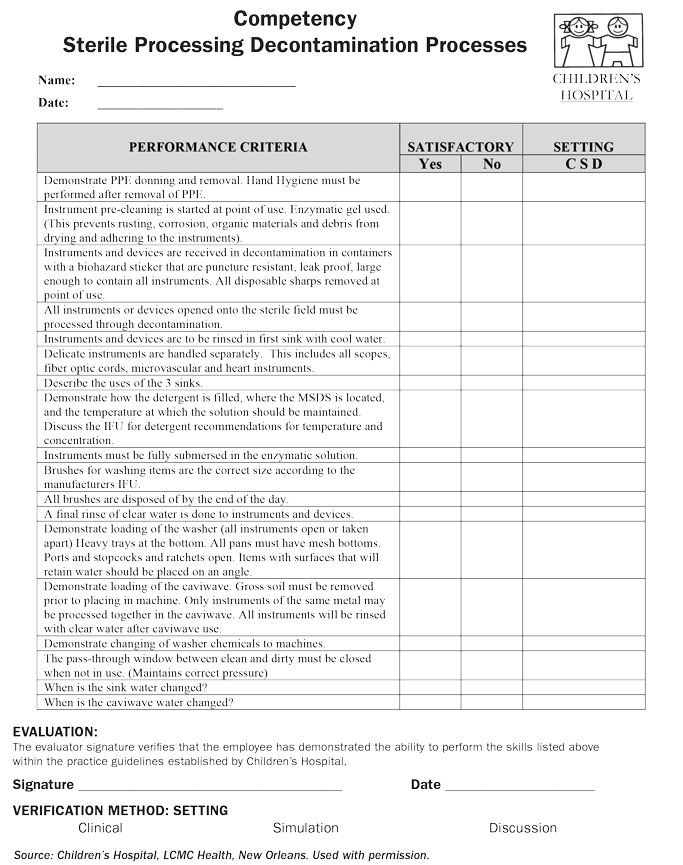
Over a period of 2 to 3 months, each of the hospital’s roughly 50 perioperative nurses and scrub technicians spent 1 day in the decontamination area. They shadowed their SPD colleagues to observe the cleaning process from start to finish, received hands-on training, and underwent competency testing on evidence-based instrument and equipment handling.
Training was conducted during the day shift and was part of the regular workday for SPD staff. “This did slow down the cleaning process. However, it did not delay any items that were needed for surgery,” Viloria notes. Instruments used during the day were used for training. “If an item such as a drill was not used that day, the training was done separately from the regular OR workflow,” she says.
After OR staff completed their training, the SPD coordinator evaluated them using an 18-item competency test (first sidebar below).
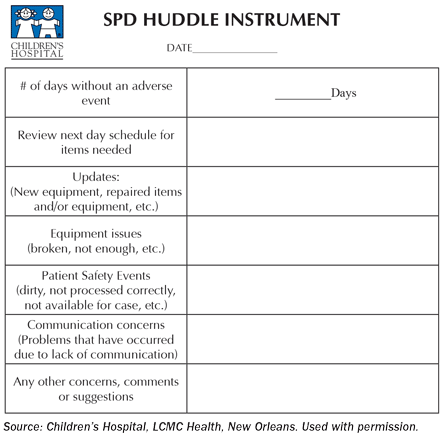
Viloria and her team also implemented a daily communication huddle tool for SPD staff to improve communications and outcomes (second sidebar below). Huddles, which are held at 2 pm and last about 10 minutes, sometimes reveal problems that could affect patient safety, Viloria says. “One part of the huddle is used to identify communication concerns. This helps identify communication breakdowns so staff can be more aware, thus increasing patient safety.”

Bridget Viloria, RN, CNOR
In addition, the team instituted practices to improve interdepartmental communication, foster teamwork and positive relationships, improve decontamination processes, and reduce instrument set errors. For example, they revised instrument count sheets, restructured and hired staff to match workload, and implemented a weekly meeting of perioperative nurses, surgical technicians, and SPD staff.
Instrument sets were reviewed to include only necessary items, and count sheets were updated accordingly. This step decreased the number of items needed to be placed in the set, improving set turnover time, Viloria says. Count sheets, currently in paper form, have been standardized for ease of documentation.
In addition, staff were assigned to different areas of responsibility (stations), Viloria says. “We now have personnel rotating assigned stations such as peel packing and wrapped item station, instrument set station, and the decontamination area. This is so the staff can focus on one area at a time.”
Four new SPD staff were hired to provide better coverage for decontamination, the day shift, and the evening (7 pm to 11 pm).
All nurses, surgical technicians, the SPD coordinator, and three morning shift SPD personnel attend the weekly meeting, which is held on Fridays before the first case. Discussion focuses on service line information. The SPD coordinator reports any new items and problems, and sets up in-service training for the group as needed.
“This meeting has helped communication because the SPD staff can answer any questions that relate to their department. It also gives the SPD coordinator an opportunity to discuss any changes in the SPD department that the staff may need to be aware of,” Viloria notes.
“Staff reception of the initiative was very positive,” Viloria says. “We were having so many issues and there was so much frustration that everybody was willing to do what they had to do to make their lives and jobs easier in the long run.”
The initiative succeeded in increasing awareness of others’ work demands. “The OR nurses and scrub techs could see what it was like for the SPD staff to stand at their workstations all day and what they had to go through on a daily basis to clean, decontaminate, sterilize, and package surgical equipment and instruments, so they could be more mindful of better helping their colleagues from the operating room,” she says.
“Because of the training, the OR staff are more aware of the need to open and adequately spray their instruments with enzymatic solution after the procedure and avoid opening items unnecessarily. They now understand the steps in the instrument cleaning process.”
The OR staff gained other new insights, she says. “The staff learned about the importance of communication between the two departments. They learned about the large amount of work that is done in the SPD to have instruments and equipment ready when needed. And they learned how to work as a team to get what is needed.”
Patient safety events fell by a dramatic 91% between January and June of 2017, from 22 events per month to just 2 events per month. Other improvements:
• items are no longer found dirty after being processed by the decontamination area
• it’s less common to have instruments missing from from sets
• there is less broken equipment in sets
• items are available for procedures when needed.
“Morale and relationships have improved because there is less frustration now that we are having better outcomes,” Viloria says. “We learned that interdisciplinary collaboration is key to positive patient outcomes. We could not have done it without having everyone collaborate, communicate, and get along well, and understand what each other was doing on a daily basis.” ✥
Montello J, Viloria B. Optimizing outcomes of sterile processing department processes through enhancement of inter-professional care delivery in the perioperative setting. OR Manager Conference. 2017. http://www.eventscribe.com/2017/posters/ORMC/SplitViewer.asp?PID=MTM3Mjk5ODA2MjU#.
AORN. Guidelines for Perioperative Practice. Guideline for cleaning and care of surgical instruments. Denver, CO: AORN, 2015. www.aorn.org.
AORN. Guidelines for Perioperative Practice. Patient work and safety. Denver, CO: AORN, 2017. www.aorn.org.
AORN. Guidelines for Perioperative Practice. Sterilization and disinfection. Denver, CO: AORN, 2017. www.aorn.org.
Association for the Advancement of Medical Instrumentation. Comprehensive guide to steam sterilization and sterility assurance in health care facilities. ANSI/AAMI ST79:2010 & A1:2010 & A2:2011 & A3:2012. www.aami.org.
Better communication and teamwork improve sterile processing efficiency. OR Manager. 2015;31(6), 17-18, 30. https://www.ormanager.com/better-communication-teamwork-improve-sterile-processing-efficiency/
Evaluating decontamination procedures prior to sterilization. Briefings on Infection Control. 2010;8(4):1-4. http://www.hcpro.com/content/247115.pdf
Klacik S. Don’t let faulty instrument processing put a damper on instrument packaging. OR Manager. 2015;31(6),19-21.
Larson J. Team training leads to better outcomes and staff morale. AMN Healthcare. January 10, 2012. https://www.amnhealthcare.com/latest-healthcare-news/476/1033/
Nadeau K. The full scope of instrument care. Healthcare Purchasing News. January 25, 2017. https://www.hpnonline.com/full-scope-instrument-care/.
Patterson P. Safer surgery: Six steps that aim for excellence in sterile processing. OR Manager. 2013;29(4):1, 6-7.
Seavey R. OR and SPD working together to improve instrument processing. Managing Infection Control. July 2007;84-102. http://csao.net/files/pdfs/OR and SPD Working Together707.pdf.


