One of the most misunderstood and misused management buzzwords is “empowerment.” It is a noble thought that a manager can empower an employee, but only you can empower yourself, and once you have done that, no one can take that power away from you.
Trying to empower someone who looks in the mirror and sees a disempowered person looking back is like trying to make water flow uphill. Trying to disempower a person who has a personal sense of empowerment is like trying to stop water from flowing downhill.
To be truly self-empowered and to foster a positive culture of ownership in your workplace, you must conscientiously work to inspire positive attitudes and behaviors in yourself and your co-workers. The Self-Empowerment Pledge features seven promises—one for each day of the week (sidebar below).
We have seen people make amazing—even miraculous—personal changes when they take these promises to heart. People have used these promises to quit smoking, lose weight, start working on a long-postponed project, or have a difficult conversation, among many other examples.
In Chicken Soup for the Soul: Inspiration for Nurses, Bob shares the story of Kyle, a Midland Memorial Hospital nurse who was a drug addict and had been stealing narcotics from his unit’s medication room. Verbally making those promises every morning and then breaking them every afternoon became such a painful thing, Kyle couldn’t live with himself. He and his wife met with Bob, and he confessed to what he’d been doing.
The hospital sent him to a drug treatment program, and Kyle is currently approaching his third year of being drug-free and serving as a positive example for many others. He says the changes he made were a miracle. It was the miracle of self-empowerment.
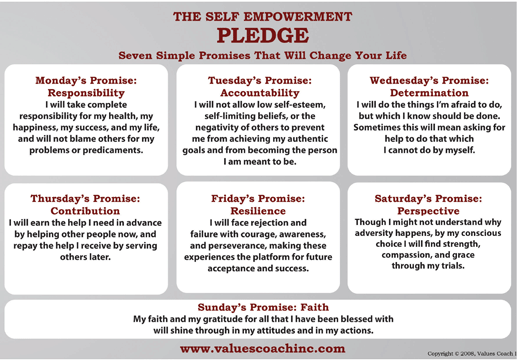
Life-altering success begins only when you take complete responsibility for your circumstances and your outcomes, and refrain from blaming other people.
Holding yourself accountable—not just for meeting obligations, but for fulfilling your true potential—means confronting self-imposed limitations and self-limiting beliefs. Do not allow low self-esteem to prevent you from being your best. Do not settle for anemic dreams and goals because you believe you are not capable or deserving of more.
Confront your fears: Do what you have to do, and ask for help when you need it. If you want to achieve big goals, you must do things you are afraid to do.
Commit to paying forward and to paying back. One of the great paradoxes of life is that the more you devote yourself to service to others, the richer and more rewarding your life will be.
Every great accomplishment was once the “impossible” dream of a dreamer who simply refused to quit when the going got tough. In his book The Last Lecture, Randy Pausch writes: “brick walls are not there to stop you, they are there to make you prove how much you want something.” Internalizing Friday’s promise will help you bounce back every time you fall and blast your way through every brick wall.
Make the “silver lining” promise of seeing the best in every situation and growing stronger through your trials. If you’ve spent any time with support groups, you have seen how people can choose to find hidden blessings even in tragedy.
Promising to be faithful isn’t a promise about religion. Everyone, regardless of their religious beliefs or nonbeliefs, needs faith: Faith in themselves, in other people, in the future, and hopefully faith in things unseen. Ending your week with Sunday’s promise will remind you to be thankful for all of your blessings.
Read these seven promises, and then ask yourself these two questions:
• If I took these promises to heart and acted upon them, would I be better off in every way—personally, professionally, financially, and spiritually—in 1 year than where my current life trajectory is taking me?
• If everyone at work took these promises to heart and acted upon them, would we do a better job of serving our customers and supporting each other, and would this be a better place to work?
If you’re being honest, the answer will be yes. The promises are simple, but keeping them will require desire and determination. Fortunately, you don’t have to do it all at once. Focus on one promise each day, and make all seven promises to yourself each week. Do this each day for 1 year. It will be the best daily 1 minute you ever invest in yourself.
Here’s how the promises work. Repeat each day’s promise to yourself at least four times on that day: morning, afternoon, evening, and right before bed. Repeating the promise will take you about 15 seconds, roughly the equivalent of a TV commercial. Whenever possible, say the promise out loud with conviction as if you really mean it, even if you don’t.
Doing this means promising yourself that you will be responsible for your life, accountable to yourself, determined to achieve your goals, committed to making a contribution, resilient in the face of adversity, positive in facing your challenges, and willing to let your faith and gratitude shine through in your attitudes and actions.
When you catch yourself whining and complaining, procrastinating, gossiping, blaming others for your problems, taking when you should be giving, and pretending that you have no power, you are developing what psychologists call cognitive dissonance: trying to hold two incompatible beliefs at the same time. This is a form of mental illness!
You could decide that you are okay with having a bit of mental illness, so you would keep making and breaking the promises, and thus living with cognitive dissonance. Or you could stop making the promises because the longer you make the promises, the more painful it becomes to catch yourself breaking them.
If you keep making the promises, though, you must begin to change your attitudes and behaviors to become more consistent with the promises—thereby alleviating cognitive dissonance.
As you do that, you will start to empower yourself to get out of debt, quit smoking, work on your book or graduate school application—whatever you’ve been pretending that you’re not empowered to do. As you start to achieve those results, the promises become part of your personal character DNA because you have proven to yourself that they work.
In The Mind and the Brain: Neuroplasticity and the Power of Mental Force, Jeffrey M. Schwartz and Sharon Begley write: “We are seeing evidence of the brain’s ability to remake itself throughout adult life, not only in response to outside stimuli, but even in response to directed mental effort. We are seeing, in short, the brain’s potential to correct its own flaws and enhance its own capabilities” (emphasis added).
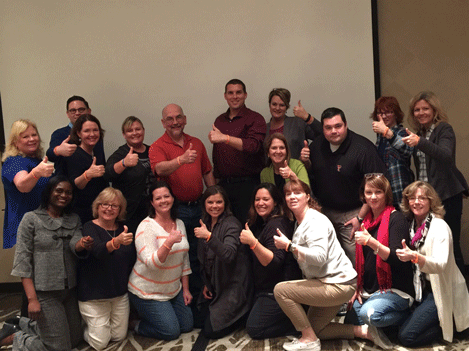
Nurse leaders from Midland Memorial Hospital in Midland Texas, and others at the Nurse Directors Fellows Program of the American Organization of Nurse Executives wear their wristbands for Thursday’s Promise on Contribution. Photo courtesy of Joe Tye.
By consistently saying the seven promises, you will hardwire those commitments into the neural networks of your brain. Words shape thoughts, thoughts catalyze beliefs, beliefs inspire actions, actions build habits, and habits create results. That is why we say that making a commitment to these promises will—not can, might, could, or should—change your life.
It’s easy to feel empowered when things are going great. But when your world caves in on you, that’s when you most need to be inspired, motivated, and self-empowered, and that’s when it is most difficult to find those strengths. Internalize the promises of The Self-Empowerment Pledge now, before you need them, so that when you face daunting challenges, these promises will be hardwired into your psyche.
People who work in operating rooms know that the elaborate presurgical handwashing routine is not only about infection control; it is also a ritual that helps each member of the surgical team leave behind the world outside and prepare mentally and emotionally for the task at hand.
Putting on that day’s wristband from The Self-Empowerment Pledge in the morning and taking it off in the evening (and before you wash your hands to enter the surgery suite) is a ritual intended to take you from one mindset to another.
There are many variations on this ritual. Some people who cannot wear a wristband, for example, wrap it around their name tags every morning. People switch the order of the promises, depending on whatever is the most pressing challenge on a given day.
One person looking for a new job made a commitment to wear the wristband for Friday’s Promise on Resilience every day until she was hired. Someone else laminated each of the seven promises individually, and every evening he puts the promise for the following day on the seat of his car so he’ll see it on his way to work.
When people recite the promises as part of a group ritual, it enhances the impact on each individual, sometimes in surprising ways. Every morning at 8:16, the daily leadership huddle at Midland Memorial Hospital begins with the group saying both The Pickle Pledge and that day’s promise from The Self-Empowerment Pledge.
One Friday, after that day’s promise had been recited, someone asked if the group would join him in reciting Saturday’s promise on perspective. He had recently received some bad news, which most of his colleagues did not know about, and this simple request sparked an emotional outpouring of support.
 Working with a PledgePartner
The best way to internalize the seven promises is to work with a PledgePartner so that you can encourage each other. The PledgePartner Agreement (sidebar left) can be downloaded from the resources page of The Florence Challenge website (www.TheFlorenceChallenge.com).
When we tell you that having The PledgePartner Agreement can significantly accelerate your progress, we are speaking from personal experience. We agreed to help each other achieve important goals: Bob needed to lose a significant amount of weight, and Joe wanted to finish writing a book. Eighteen months later, Bob was 100 pounds lighter, and Joe’s book, Winning the War with Yourself, was posted on Amazon. Having a PledgePartner often leads to a long-lasting friendship. Many people have said that long after their formal PledgePartner agreement had ended, they stayed in touch and continue to support and encourage each other.
In The Power of Habit: Why We Do What We Do in Life and Business, Charles Duhigg quotes Lee Ann Kaskutas, a senior scientist at the Alcohol Research Group: “There’s something really powerful about groups and shared experiences. People might be skeptical about their ability to change if they’re by themselves, but a group will convince them to suspend their disbelief. A community creates belief.”
Group reading has a double benefit. First, people are more likely to stick to promises if they’ve been made publicly (and if co-workers gently remind them of the promises when they break them). Second, when a critical mass of people within an organization internalize and act upon the promises, they inevitably have a positive impact on culture.
As these promises become a part of your character DNA, you will find yourself continuously raising the bar. You won’t just decide to quit smoking; you will want to start exercising and eating a healthier diet. You won’t just obtain your BSN degree; you will set your eyes on higher education. You won’t just change your own life for the better; you will find yourself increasingly drawn to helping others change their lives for the better.
Duhigg C. The Power of Habit: Why We Do What We Do in Life and Business. New York: Random House. 2012.
Newmark A, Thieman L. Chicken Soup for the Soul. Inspiration for Nurses. New York: Simon & Schuster. 2015.
Schwartz J M, Begley S. The Mind and the Brain: Neuroplasticity and the Power of Mental Force. New York: HarperCollins Publishers Inc. 2002.


