Each year, 3 million Americans have cataracts removed, according to the American Society of Cataract and Refractive Surgery (ASCRS). Between the aging population and the increasing number of cataract procedures being performed, it’s not surprising that ophthalmology has led the way in specialties that are moving to the outpatient setting.
As many ambulatory surgery centers (ASCs) continue to merge or be acquired by chains and hospitals, independent ophthalmic ASCs are proliferating. Two such centers are located in Georgia and New York.
The Glennville Eye Surgery Center in Glennville, Georgia, recently opened with five surgeons and one OR. The center, which is open part time, is an outpost of the Georgia Eye Institute Surgery Center in Savannah, where there are two ORs and 12 surgeons. Procedures at the new ASC include retina, cornea, glaucoma, and ocular plastics such as eyelid and eye socket surgery.
In Carle Place, a small town on Long Island, the 30-year-old Island Eye Surgicenter, which has three ORs, will be replaced in fall 2016 by a new facility with twice the capacity.
According to Kent Jackson, executive director of the Outpatient Ophthalmic Surgery Society (OOSS) in Centennial, Colorado, about 25% of all ASCs do ophthalmology, and 20% of all ASCs (about 900 total) are single-specialty ophthalmology. The most common procedure is cataract surgery.
As with other specialties, patient volume in ophthalmology has increased now that more people are insured under the Patient Protection and Affordable Care Act (ACA). Not only are there more patients, there is also a greater variety of patients and different payers, Jackson says.
“Our biggest issues right now are improving reimbursement, managing quality reporting, and navigating state regulations,” he notes. The ACA is also changing the structure of healthcare through accountable care organizations (ACOs) that are responsible for patients’ long-term well-being. “Providers must learn how to organize for a changing environment, such as packaging their services with those of other providers in ACOs,” Jackson notes.
Popular specialties like ophthalmology face an additional challenge: The number of clinicians is not keeping up with the growing demand, and more complex regulations put additional pressure on current staff.
“Higher volume increases income, but also brings higher costs, and there is no corresponding increase in the number of surgeons,” Jackson explains. “With more demand on their time, there is more need for efficiency.”
Susan Erickson, MS, BSN, RN, administrator of Ophthalmology Surgery Center of Dallas, reports annual case volume rose 5% between 2014 and 2015, reaching 14,000. The ACA was responsible for part of that, as evidenced by new types of coverage. “We find a lot of patients on ACA plans have different coverage from other insurance plans,” she says.
The center, which opened in 2010, is physician owned and has eight ORs. Cataracts top the list of procedure types, but glaucoma, retina, and cornea transplant cases also are common.

Cindy Beauvais, RN
The Georgia Eye Institute Surgery Center, which also opened in 2010, has had a steady growth in patients, which led to the decision to open a second center. The facility handled 5,788 cases in 2015.
In her 2 years as clinical director at the Georgia Eye Institute, Cindy Beauvais, RN, has overseen the development of the Glennville facility, about 60 miles southwest of Savannah, which will be served by five of the Georgia Eye Institute’s 12 physicians. Beauvais has hired a local nurse whom she is training in ophthalmic procedures.
Following an initial survey, Georgia inspectors granted the Glennville facility a state license. In early February it received an accreditation survey by the Accreditation Association for Ambulatory Health Care (AAAHC).
Planning for an unannounced survey in a remote facility that is only open part time has called for imagination. What if the facility was empty when surveyors arrived? Beauvais made arrangements with Georgia Eye’s physician practice located in the same building to greet AAAHC surveyors and allow them to wait while staff made the 90-minute drive from Savannah.
Another challenge will be supply chain management. “I don’t have nearly the storage area that I do in Savannah,” Beauvais notes. She is analyzing needs to determine par levels and create order templates, and she is working with vendors to establish a reliable just-in-time system.
Replacing Island Eye Surgicenter on Long Island with a new facility will double the capacity to six ORs. According to executive director Robert Nelson, PA-C, case volume reached 7,000 in 2005, and the owners expected it to stabilize at that level. Instead, business continued to grow by 15% annually, reaching 14,000 procedures in 2015. Ownership had grown also, to 13 physicians from the original eight.
“We were wildly successful, and that was a good thing,” Nelson recalls. “But we were running out of capacity. I could no longer accommodate the growing volume of cases from surgeons already on staff, and there was absolutely no way I could integrate new surgeons.”

Robert Nelson, PA-C
He believes there is another good reason why new ophthalmology centers are cropping up. “Ophthalmologists by nature tend to be more entrepreneurial than those in other specialties, and they have an insatiable appetite for technology,” he says.
Nelson, a certified physician assistant, regularly assists with eye procedures. In addition to treating patients, his colleagues conduct and publish research, and they test new technologies.
For example, Island Eye was an early adopter of laser-assisted cataract surgery, using a Catalys Femtosecond laser that performs the initial steps in preparing the eye for cataract surgery, corrects astigmatism, and replaces the knife traditionally used to cut the cornea. According to Nelson, Island Eye is only the fourth ASC in the US to acquire the $500,000 device. Currently about 40% of cataract procedures at the center are done with the laser.
Every surgical specialty has its own unique practices, and no matter how skilled clinicians are, they need training to work in different specialties.
“Ophthalmic training is no different than other specialties,” Beauvais says. “Our nurses have basic skills, but need to be trained in ophthalmic terms and skills.” She expects to have difficulty staffing the new Glennville ASC because of its remote location, although she has already found a local nurse.
Certification is available, but not required for practice. Among resources are the programs offered by the American Society of Ophthalmic Registered Nurses (ASORN), San Francisco. ASORN has published a four-book series, Essentials of Ophthalmic Nursing, which covers ocular anatomy, embryology, various eye disorders, and pharmacology. The series is available for $349 (visit www.asorn.org/publications).
Meanwhile, Beauvais and other managers are using on-the-job training, pairing a new hire with an experienced nurse.
With all the changes facing the specialty—new markets, new products, and new regulations—it may be hard to know where to start in organizing an ophthalmic ASC or in adding those procedures to an existing one. Strategic planning becomes crucial.
In the OOSS member magazine, The Ophthalmic ASC, consultant John Pinto explains that strategic planning should project the next 5 to 10 years and cover such issues as growth rate, institutional relationships, the mix of services and providers, and succession of leaders.
“The chief value of a strategic plan is that it allows the business owners to agree on and align their interests for a common goal and to inform the management team of the basis for tactical priorities,” he says.
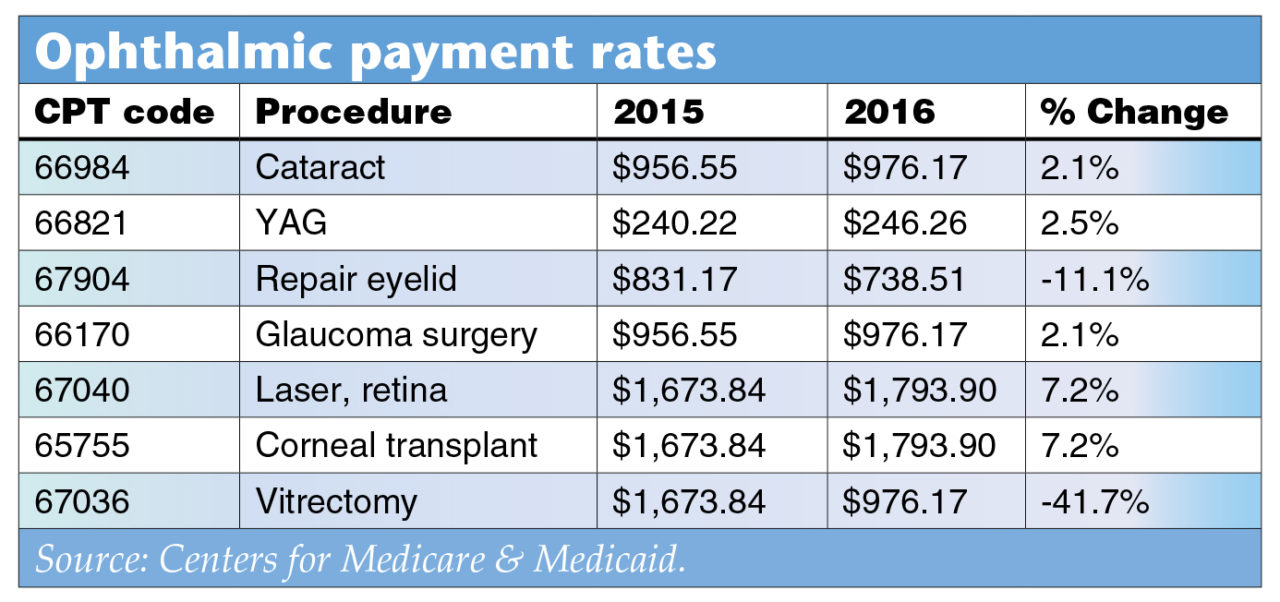 Asked what their biggest challenge will be in the coming year, many ASC managers name reimbursement. Pay updates vary according to procedure and may not reflect actual costs (sidebar, right).
“The cost of supplies is rising. Retina and glaucoma supplies are very expensive, and Medicare reimbursement just covers the supply cost,” Erickson notes.
Intraocular lenses present a different and sometimes confusing payment structure. The actual price of a lens can range from about $60 for a standard monofocal lens under a group purchasing contract to $900 or more for a multifocal or specialty lens. In its reimbursement schedule for cataract surgery, Medicare has valued standard lenses at $150 each, and included that amount in a bundled payment that currently has a national reimbursement of $976.17 for CPT code 66984.
At the high end, however, the lens cost could exceed the total reimbursement. Because of the disparity, Medicare allows ASCs to charge the patient directly the difference between $150 and the actual cost of their lens.
Several ASCs report that insurance companies also adopt that policy, while some pay more for the standard lens, and others require the patient to pay the entire cost. ASCs need to know that they can and should bill Medicare patients who select the premium lenses the entire cost, minus the $150 reimbursement. As one manager notes, “The ASC needs to charge the patient for this cost or risk losing a lot of money.”
CMS is trying to develop quality measures that relate to outcomes in ophthalmic surgery, especially for cataracts. So far, it seems those efforts have fallen short, both because of the rarity of complications and the short duration of these outpatient procedures.
The new quality measure, ASC-11, is a case in point. Following protests from ASCs, CMS changed the measure from mandatory to voluntary for this year, and has been asked to drop it entirely. It covers vision improvement within 90 days of cataract surgery.
ASCs have long argued that the measure is unreasonable because they do not see their surgical patients for follow-up examinations. For those who participate in ASC 11 reporting, CMS has directed that they obtain the postoperative results from the operating physician’s office.
CMS also is contemplating a measure that would track the incidence of unplanned anterior vitrectomy during cataract surgery.
The Food and Drug Administration (FDA), meanwhile, has been trying to track the rare but potentially serious complication toxic anterior segment syndrome (TASS). In 2012, the FDA began working with the American Academy of Ophthalmology to create a national registry of TASS incidents.
The term “TASS” was created by researchers at the University of Utah following a 2006 outbreak of inflammation following ocular surgery. An investigation revealed the most common cause of irritation was the presence of enzymatic cleaners because of inadequate cleaning and sterilization of instruments.
Another possible cause is preservatives in fluids, such as balanced salt solution, used in eye surgery. ASCRS developed guidelines for processing instruments and created a website for reporting TASS cases (www.ascrs.org/tass-registry).
As with vision outcomes, ASCs are unlikely to hear of postoperative TASS unless informed by the physician. However, preventing it remains the task of OR and central processing staff.
The complex nature of ophthalmology puts great responsibility on surgeons and owners, but also on nurses and staff. To make the ASC successful, managers must balance many variables, but none more so than physician relationships.
“You need a lot of finesse, and good rapport with the physicians,” Beauvais says. “The biggest challenge is to balance the needs of the physicians while keeping costs in mind. It’s their surgery center, but you have to be diligent and say, ‘What’s the cost?’ when they request items or procedures that are not economically feasible.”
While all specialties are important, ophthalmology is, in a sense, a higher calling. “It’s unique in the sense that you’re working on a critical organ, a critical part of the anatomy,” says one veteran administrator. “The eyes are the gateway to the soul.” ✥
Since 2012, ambulatory surgery center (ASC) quality reporting requirements have included use of a standard surgical checklist. However, checklists suggested by the World Health Organization and Centers for Medicare & Medicaid Services are based on general surgery. These checklists include protocols for anesthesia and patient monitoring that vary from those used in ophthalmology, according to the American Society of Ophthalmic Registered Nurses (ASORN).
ASORN and other ophthalmic professional groups organized a task force to develop a more specialized checklist. The result is a sample ophthalmic surgical checklist, available at www.asorn.org.
Because this checklist is more general than what some ophthalmic ASCs require, ASORN and the task force invite ASCs to modify it as necessary.
ASORN advises users in a memorandum: “Please make any changes necessary to best address the type of patients, procedures, anesthesia, and facility you have. For example, ASCs whose only procedures are cataract surgery with topical anesthesia may not need many of the listed elements. Check with the physicians, anesthesia providers, nurses, and facility administrators to determine which elements are required under state licensing rules or by accreditation organizations.”
Following is a section of the sample checklist for a time-out before incision:
All team members have introduced themselves by name and role. The surgeon, anesthesia provider, and nurse verbally confirm patient, site, and procedure.
The surgeon and nurse verbally confirm:
• antibiotic
• devices
• dyes
• gas
• implant style and power
• mitomycin-C/anti-neoplastics
• tissue
The surgeon reviews:
• critical or unexpected steps
• operative duration
The anesthesia provider reviews:
• patient-specific concerns
Nurses review:
• sterility
• equipment
• concerns.
Centers for Medicare & Medicaid Services. Proposed 2016 ASC payment rates for ophthalmic services. www.cms.gov.
DeJohn P. Tracking TASS: Registry eyes an elusive target. OR Manager. March 2012;28:27-28.
Pickles V. Strategic planning for your surgery center. The Ophthalmic ASC. August 2015;6-12.


