An organization’s culture is shaped by the collective attitudes and behaviors of the people who work there, and if no one is willing to make personal changes, no program of the month is likely to have a lasting impact. To change their attitudes and behaviors, people must be made aware of the need to do so and given tools to help them.
Each article in this series will cover one of the three key elements of The Florence Challenge: People are emotionally positive, people are self-empowered, and people are fully engaged. These are the three essential elements of building a culture of ownership.
Do you have a strong culture of ownership in your organization? Take a short quiz, from the Values Coach Cultural Blueprinting Toolkit, to give yourself a numerical ranking and brief assessment (www.Culture-IQ.com).
Before you take it, please look in the mirror and make sure you are not wearing rose-colored glasses.
When we walk into your healthcare facility, our first impression will be created by the visible architecture of bricks and mortar. But that won’t be our lasting impression, will it? Nor will our lasting impression be solely determined by your clinical excellence because, even as healthcare professionals, we will most likely have no idea whether or not you did a good job after you put us to sleep. But we will know how you treated us and how you made us feel.
When your building was constructed, the contractors had a detailed set of blueprints and construction documents. Prior to that, hundreds (or thousands) of hours were devoted to committee meetings to conceptualize the design and determine equipment layout, workflow patterns, and color schemes. If there was a good architect and builder, the final product was seamless; there were no gaps between the foundation and the superstructure, and no bubbles in the wallpaper.
But there was no blueprint to define the Invisible Architecture™—the culture that would shape the employee experience and the patient experience. In our book, Building a Culture of Ownership in Healthcare, we describe a construction metaphor in which the foundation is core values, the superstructure is organizational culture, and the interior finish is workplace attitude. As with physical construction, there are no gaps between the levels. If integrity and respect are core values, you will never hear two people spreading rumors about a co-worker, which violates their integrity and the dignity of the person being gossiped about.
A culture of ownership is characterized by people who exemplify the three elements of The Florence Challenge: to be emotionally positive, self-empowered, and fully engaged. Making that commitment to yourself and asking your staff to commit to it will lead to better service for patients and providers as well as mutual support among co-workers.
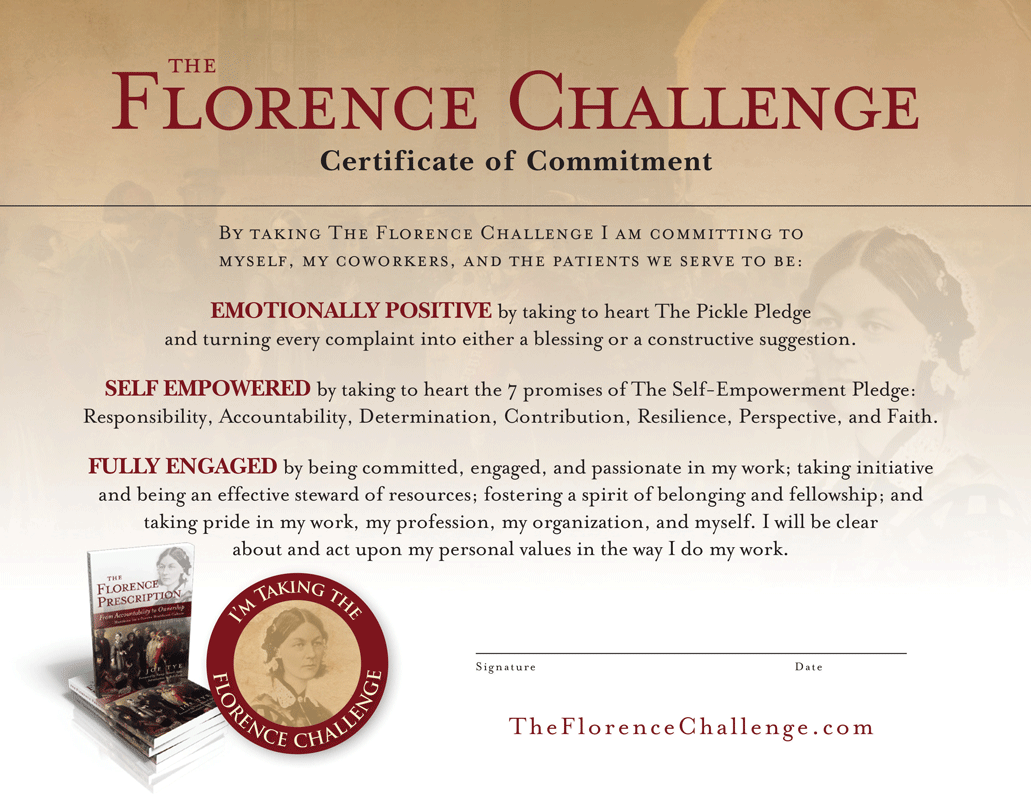
The Florence Challenge Certificate of Commitment reminds staff to maintain behavioral changes. All images courtesy of Joe Tye. Used with permission.
The three commitments of The Florence Challenge build upon one another. The first step to building a culture of ownership is awareness of, and intolerance for, bullying, chronic complaining, gossiping and rumor-mongering, passive-aggressive behavior, and other forms of toxic emotional negativity (TEN).
This is the emotional and spiritual equivalent of cigarette smoke. The first step to promoting a healthy workplace and lifestyle is eliminating harmful toxins, and the first step to building a more positive culture is eliminating attitudes and behaviors that pollute that culture.
The Florence Challenge Certificate of Commitment can be downloaded at www.TheFlorenceChallenge.com. Ask everyone in your department to sign it, and post the certificates in a prominent place to remind everyone of their pledge (see The Florence Challenge certificate on the right).
The second step is encouraging personal initiative and self-empowerment—encouraging people to “proceed until apprehended” by having the courage to take initiative and always do the right thing. The third step is building a culture where people are engaged in the work and take pride in their organizations. These two steps will be discussed in other articles in this series.
Surveys by Gallup, Press Ganey, Modern Survey, and others on employee engagement have found that only about one-quarter of all employees are engaged in their work, and much has been written about bullying and lateral violence in the healthcare workplace. Our own literature review showed the word “bullying” in nursing journal titles 115 times over the past 5 years. And our culture assessment survey of 42 hospitals and healthcare associations found that more people disagreed than agreed with the statement that they work in a positive and respectful culture.
That is the healthcare crisis within. If every employee and provider at every hospital, long-term care facility, and outpatient clinic in America strongly agreed with the statement, “Our people reflect positive attitudes, treat others with respect, and refrain from complaining, gossiping, or pointing fingers,” we could more effectively cope with the impositions of the external healthcare crisis.
Eradicating TEN from the workplace is almost always the non-negotiable first step toward building a more positive and productive culture of ownership. TEN exacts an enormous toll on employee morale, patient satisfaction, and productivity. It is a leading contributor to stress and burnout, compassion fatigue, and turnover.
Because emotions are contagious, an emotionally negative healthcare workplace can cause iatrogenic emotional harm to patients in hospitals and residents in long-term care settings. In her New York Times article, “No Time to be Nice at Work,” Georgetown University professor Christine Porath cites a survey of more than 4,500 healthcare professionals in which 71% tied disruptive behavior, such as abusive, condescending, or insulting personal conduct, to medical errors, and 27% tied such behavior to patient deaths.
Employees have the right to a workplace that is free from fear, bullying, gossip and rumor-mongering, and chronic complaining. Managers can support their staffs by declaring the workplace to be a “Pickle-Free Zone” (PFZ), just as a smoke-free zone protects workers’ health. A PFZ is any area where TEN is not wanted or welcome. A PFZ doesn’t prohibit people from discussing and resolving legitimate problems; it just means they are not welcome to whine about them.

The Pickle Pledge is a promise to turn complaints into blessings or constructive suggestions.
People used to smoke everywhere—in hospital cafeterias, nursing stations, restaurants, taxi cabs, and even airplanes—and those who were bothered by it could do little to change their circumstances. When the former Surgeon General, C. Everett Koop, MD, called for a smoke-free society in 1986, many people wondered what he’d been smoking. Cigarettes contain an addictive drug, and they were heavily promoted by industry under the guise of what was called protecting “smoker’s rights.”
Today, virtually every hospital in America has a smoke-free campus. One never hears the term “smoker’s rights” or the question, “Mind if I smoke?” The smoking section in most restaurants is out back by the dumpster, and if anyone were to light a cigarette on an airplane, the air marshal’s role would not be to arrest the smoker but rather to save him or her from being assaulted by fellow passengers. The change in our culture has been nothing short of miraculous.
TEN is the emotional and spiritual equivalent of cigarette smoke. Scientific research has shown that toxic attitudes and emotions are detrimental to health and longevity. And one toxic negative person can pollute the emotional climate of an entire department the way one person lighting a cigarette instantly pollutes the lungs of everyone else in the vicinity.
The Pickle Pledge is a very simple (though by no means easy) promise to turn every complaint into either a blessing (“my head is killing me” becomes “thank goodness for modern pharmacology”) or a constructive suggestion (“the first symptom of dehydration is a headache, so I should drink some water”).
By honoring the footnote to the pledge, ie, consciously avoiding negative behavior in oneself or in others, a person also commits to refusing to allow negative co-workers to ruin their day (or to ever do that to anyone else).
Toxic behaviors lead to poor communication and teamwork, which lead to poor outcomes. Taking The Pickle Pledge creates a common commitment among staff to adopt more positive attitudes.
When Values Coach conducted the initial Culture Assessment Survey at Midland Memorial Hospital, it was calculated that approximately $14 million of the hospital’s annual payroll expense was wasted on complaining, gossiping, and other emotionally negative behaviors.
Less than a year later, that amount had been cut in half, yielding an annual cultural productivity benefit of more than $7 million.
More important, by making the commitment, many people have made amazing personal changes. For example, one nurse said The Pickle Pledge led to more meaningful discussions with her family, who used to complain a lot more. Some hospital CEOs have reported that negative staff members are leaving because their co-workers will no longer tolerate their behavior.
In addition, The Pickle Pledge is now being adopted by the entire Midland Independent School District.
The Pickle Challenge is a designated time period in which to heighten awareness about creating a more positive work environment. People do some self-reflection and ask themselves if they can be a little more grateful about something. They are expected to contribute at least a quarter to a common fund every time they exhibit toxic behavior, or they are called out by someone else, or they realize they could be more grateful instead of negative.
Contributions to The Pickle Challenge may be used to support a good cause like a charity, a hurricane relief fund, or a social event with co-workers to encourage a more positive workplace environment.
Following are some of the most important requirements of a successful Pickle Challenge initiative.
Every morning at 8:16, a large group gathers in the main lobby of MMH for the daily leadership huddle, which begins with everyone reciting both The Pickle Pledge and that day’s promise from the Self-Empowerment Pledge (which we will cover in part 2 of this series). Most participants know these promises by heart, and having prospective employees attend the huddle has become a key element in the hospital’s recruiting strategy.

Staff at Community Hospitals and Wellness Centers in Bryan, Ohio, decorated pickle jars to represent their departments (administration, laboratory, maintenance, and environmental services).
Effective culture change must have more the feel of a social movement than that of a management program. The best way to gain widespread engagement and ownership is to make it fun, and even a bit silly. One of the 10 core values at Zappos—which has turned teaching others about its culture into a profit center—is “create fun and a little weirdness.” That’s what The Pickle Challenge does. When people see decorated pickle jars all around the organization, it is a visible reminder to turn complaints into gratitude and initiative (see photo on right).
At MMH, pickles are everywhere. The Pickle Pledge is one of the displays permanently mounted on the wall in the MMH Culture of Ownership classroom, there are decorated pickle jars in most departments, and for special events, the food service department makes Pickle Pledge cakes and cupcakes. After a storm knocked down a big tree, one MMH employee turned a 2,000-lb tree stump into a chainsaw carving that now stands at the employee entrance to remind people to leave their bad attitudes in the parking lot.
Staff at MMH are calling their work areas Pickle-Free Zones. A PFZ door hanger asks people to “leave your gossiping, complaining, criticizing, and toxic emotional negativity at the door.” And to show their personal commitment, staff are wearing Pickle-Free Person buttons to let whiners and gossips know that they do not want to participate in spreading toxic emotional negativity.
It takes courage for someone to step up and be a “spark plug” for positive culture change, especially if that person has not historically been perceived as a cheerleader. One of the most important duties of a leader is to encourage, honor, and protect those who are trying to help foster a better organization by becoming better people.
The Pickle Pledge and The Pickle Challenge can be a key first step to combatting bullying, disrespect, disengagement, passive-aggressive whining and complaining, and other forms of TEN in the healthcare workplace. Although we believe that compassion fatigue is a problem that should be taken seriously, we also know that some of it is self-inflicted by our own negative attitudes and negative thinking.
When people take The Pickle Pledge to heart and an organization makes The Pickle Challenge a part of its cultural DNA, clinical quality and patient safety are enhanced, and patient satisfaction increases. MMH attributes much of its reductions in infection rates to building a culture of ownership.
MMH is currently working with a research team from Texas Tech University to quantify the overall impact of the commitment to a Culture of Ownership. In addition to the cultural productivity benefit of more than $7 million per year mentioned above, the following results have been achieved:
• reductions in infection rates and improvements in other quality measures
• reductions in nursing turnover
• reduced overtime and use of agency nurses
• reductions in utility expenses as people turn off lights and turn down air conditioning when they leave a room
• improvements in the hospital’s reputation within the community.
In the first 18 months of The Pickle Challenge for Charity, more than $75,000 has been donated by 43 participating hospitals to a wide range of charitable causes by people turning some 300,000 complaints into contributions. But perhaps the greatest beneficiaries are the individuals who are committed to making The Pickle Pledge a part of their own personal DNA and who have much better relationships with their families as a result. ✥
Porath C. No time to be nice at work. New York Times. June 19, 2015. http://www.nytimes.com/2015/06/21/opinion/sunday/is-your-boss-mean.html.


