This article is the third in a three-part series by Joe Tye, chief executive officer and head coach, Values Coach Inc, and Bob Dent, senior vice president, chief operating and chief nursing officer at Midland Memorial Hospital in Midland, Texas. Part 1 was published in March (pp 19-21, 27) and Part 2 in April (pp 19-22).
Imagine you are commissioned to help create a healthy workplace environment. First, you would eliminate substances that are inimical to good health: Make sure no-smoking signs are observed, the water supply is safe, and there is no friable asbestos in the building. Then you would help people transform bad habits into good ones. For example, you could provide resources to encourage exercise and weight loss. But ultimately you would want people to maintain good health disciplines because of their own inner inspiration.
In Part 1 of this series, we presented strategies, including The Pickle Pledge and The Pickle Challenge for Charity, to eliminate toxic emotional negativity from the workplace. In Part 2, we discussed The Self-Empowerment Pledge to help motivate people to take responsibility for their lives, achieve their goals, and be resilient. In Part 3, we focus on the personal values that inspire people to work toward being authentic and strive to achieve meaningful goals.
Every year, Fortune magazine partners with the Great Place to Work organization to identify the 100 best companies to work for in America. Historically, they have used three criteria: trust, pride, and camaraderie. But, in 2017, they changed the criteria to values, innovation, financial growth, leadership effectiveness, maximizing human potential, and trust. In this article we argue that the most effective leaders maximize human potential by helping people live their values, and that the resulting outcomes are higher trust, a more innovative culture, and better financial performance.
According to a study by Vanguard Communications, 63% of 2,700 Yelp reviewers gave the top 20 hospitals in the country, as ranked by US News & World Report, a score of between 1 and 3 stars out of 5. The unhappy patients were not reacting to inadequate clinical care—these hospitals have some of the finest clinical outcomes in the world—but rather to the way their caregivers made them feel.
Organizational values define strategy, and personal values shape culture. In his book, What Got You Here Won’t Get You There, Marshall Goldsmith says one of the most important lessons he learned from coaching Fortune 100 executives is that people will not make fundamental personal changes in their attitudes or behaviors unless those changes are guided by their personal values.
Culture does not change unless and until people change, so the first step toward cultural transformation is often helping individuals crystallize and operationalize the personal values that guide those changes.
As part of orientation, every new associate of Midland Health completes a 2-day Values Coach course for The Twelve Core Action Values. Inculcating The Twelve Core Action Values into the cultural fabric of the organization was the single most important element of the cultural turnaround we describe in our book, Building a Culture of Ownership in Healthcare. The course, which is a central component of the organization’s vision that Midland will become the healthiest community in Texas, is now being integrated into the cultural fabric of the Midland Independent School District.
People will not change unless they are given new tools, structure, and the inspiration to use them; and they will not sustain new attitudes, behaviors, and habits unless those are coherent with their own underlying personal values. The most significant impact of the Culture of Ownership initiative at Midland Health has come not from our work on culture but from helping people think about and act upon their own personal values as they complete the course on The Twelve Core Action Values with co-workers in a class taught by peers.
“We know from our research that the people who are clearest about their [personal] vision and values are significantly more committed to their organizations than are those who are not clear about their vision and values.”
—James M. Kouzes and Barry A. Posner: A Leader’s Legacy
Most people intuitively have good solid values, but very rarely do they specifically define those values or conscientiously apply them to how they spend their time and money, manage relationships, or decide what they put into (or let come out of) their mouths.
The Values Coach course on The Twelve Core Action Values is a 60-module curriculum on values-based life and leadership skills. The values are universal and eternal, regardless of an individual’s political opinions, religious belief or nonbelief, ethnic background, or any other factor. From authenticity to leadership, they are the values to which we all aspire. Each value is reinforced by four cornerstones that include practical action strategies for making those values a bigger part of one’s life.
Many people who have taken The Twelve Core Action Values course say it has changed their lives. For example, an employee hired by the Midland Memorial Health (MMH) facilities department after being laid off from a long-time job in the oil fields said the course gave him a completely different perspective on what work could and should be. He had applied to work at MMH just to make ends meet, and he now hoped to stay for the rest of his career.
The Twelve Core Action Values are:
The greatest triumph of the human spirit is to become the person you were meant to be, and the greatest tragedy is to pretend to be someone else for the sake of a larger paycheck or higher status. This value is the ultimate source of personal motivation. After all, who wants to be a phony?
The saying, “If you know who you are, then you will always know what to do” forms a bridge between authenticity and integrity. The root of the word integrity is integer, which has both an inner and an outer dimension. It means you can be relied upon to be consistent at home and at work. Trust, respect, and reputation are not values; they are attributes that are earned by being a person of integrity.
In her book, Notes on Nursing, Florence Nightingale said that the ability to acutely observe is more important than compassion or clinical skills in determining quality patient care. Awareness is the essential ingredient of employee engagement and the antidote to medical mishaps caused by disengagement and carelessness. Awareness is also a fundamental ingredient of emotional intelligence and personal happiness. Awareness is the key to success in virtually every dimension of life—whether that be parenting, caregiving, leading employees, managing time, or managing money.
Fear is a reaction, and courage is a decision. Fear is the emotion people feel when they do brave things. Especially in today’s uncertain world, it is essential that we teach people practical skills for living with courage in an age of anxiety. Courage is the catalyst for a “proceed until apprehended” mindset that inspires people to take initiative and do the right thing, even when it takes them outside of their comfort zones.
Fear is a reaction, courage is a decision, and perseverance is making that courageous decision every day. Every great accomplishment was once the “impossible” dream of a dreamer who refused to quit in the face of adversity. And the bigger the dream, the greater the challenge. Obstacles and setbacks are an inevitable part of the journey. One of the greatest gifts a manager can give to people is the determination to stay strong and keep moving in the face of obstacles and setbacks.
Faith as a value is not about religion. Faith is the marriage of fidelity—being faithful to a person, an organization, or a cause—and trust—and having faith in a person, an organization, or a cause. The Four Pillars of Faith are faith in yourself, faith in other people, faith in the future, and faith in something beyond the visible material world.
A purpose is broader than a mission; fulfilling one’s purpose is a lifelong journey that is never “mission accomplished.” The work people choose to do, and the attitude with which they choose to do that work, are the most important choices they can ever make. Great managers keep reminding us of the underlying purpose behind our work: the “big why” that inspired us to join the healthcare profession.
Jonathan Swift said that vision is the art of seeing the invisible. Visualization and vision work together; visualization is seeing the process, and vision is seeing the outcome. The art of management engages people in a dialogue to move toward a shared vision for the future.
As you become clearer about your purpose and vision, you must be willing to focus your time, energy, relationships, and material resources on achieving that purpose and fulfilling that vision. How you spend your time and money says more about what your values really are than what you say they are. Focus is the essential discipline of transforming the vision of tomorrow into the reality of today.
Enthusiasm is a master value. As Ralph Waldo Emerson said, nothing great was ever achieved without it. To be enthusiastic, you must eliminate toxic emotional negativity, stoke positive emotions, and work to be cheerful and optimistic. Without enthusiasm, you won’t make the commitment, do the work, and recruit the help you need to achieve your biggest goals.
Service is an outer reflection of you as your best self and of the other Core Action Values. To paraphrase Kahlil Gibran, service is love made visible. Service is both what you do for others and the attitude with which you do it. Whatever you most need in life, the best way to get it is to help someone else get it who needs it even more than you do.
Anyone who makes a good faith effort to practice Core Action Values 1 to 11 will become the sort of person who influences and inspires others. And that is an excellent definition of what it means to be a leader. Management is a job description, whereas leadership is a life decision. You don’t need a job title to be a leader, and in today’s turbulent world, we need leaders in every corner, not just in the corner office.
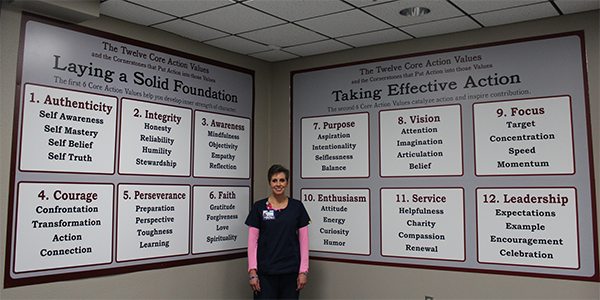
Certified Values Coach trainer Lori Forbus in the Midland Memorial Hospital Culture of Ownership classroom. Photos courtesy of Joe Tye. Used with permission.
Midland Health began its Culture of Ownership journey in early 2014. We conducted the Culture Assessment Survey and launched The Pickle Challenge for Charity, and then adopted The Self-Empowerment Pledge. In the third phase, more than 60 Midland Health associates became certified Values Coach trainers and used a team teaching approach to share the course with more than 2,000 associates. Results to date have included:
• annual cultural productivity benefit of more than $7,200,000
• significant reductions in overtime and $2.5 million annual reduction in contract labor expenses
• a 32% reduction in overall RN turnover and 43% reduction for new nurses in first 2 years of employment
• reduction of more than $1 million annually in utility costs
• shift in patient satisfaction from record low to record high, with emergency department rates moving from the bottom 10% to the top 10%.

Several of the Midland Health Certified Values Coach trainers pose with their INSPIRED Award for Values and Culture Excellence.
Go to www.Culture-IQ.com and take this culture quiz to rate the culture of your organization or your perioperative suite. You will receive a score of between 8 and 24 with a brief assessment.
Ask everyone in your area to take the quiz and anonymously submit their numbers to you. Average the numbers. If your score is below 20, re-read the three articles in this series and work on building a more positive Culture of Ownership. Your patients and your colleagues deserve it, and a better culture will make your job much more productive and enjoyable.
Authors’ note: Parts of this article are adapted from our books, Building a Culture of Ownership in Healthcare and The Heart of a Nurse Leader.

 Joe Tye is CEO and Head Coach, Values Coach Inc. and author of The Florence Prescription: From Accountability to Ownership; he can be reached at Joe@ValuesCoach.com.
Bob Dent is senior vice president, chief operating and chief nursing officer at Midland Memorial Hospital in Midland, Texas and 2018 President of the American Organization of Nurse Executives; he can be reached at Bob.Dent@MidlandHealth.org. Their book Building a Culture of Ownership in Healthcare earned the 2017 Book of the Year Award for Professional Interests from the American Journal of Nursing.
Goldsmith M. What Got You Here Won’t Get You There. 2011. Round Table Companies: Mundelein, IL. https://vanguardcommunications.net/reviews-online-rank-top-hospitals-poorly/.
Tye J, Dent B. Building a Culture of Ownership in Healthcare. 2017. Sigma Publishing: Indianapolis, IN.


