The most successful perioperative services leaders are those who have built excellent teams that balance individual responsibility and accountability with respect for all team members, regardless of the roles they play. To create that culture, OR leaders must model the behavior and attitudes they expect from their staffs.
One way to involve staff in setting higher expectations for one another is to use professional peer review (PPR). Several OR leaders who have embraced this model say that it helps them engage their staffs in quality and performance improvement through constructive feedback rather than punitive measures.

Cherry Shogren, MSN, RN, NEBC
“Nursing leaders are successful in meeting quality and financial goals of their departments when they hire motivated nurses who understand how they affect those goals and are empowered through shared decision making,” says Cherry Shogren, MSN, RN, NEBC, director of professional development at UnityPoint Health in Des Moines, Iowa. “Peer review promotes that understanding and empowerment by linking practice standards, outcomes, and constructive peer feedback to enhance quality.”
Shogren also views PPR as a professional responsibility. “Peer review goes back to our own professional concepts of who we are and our own professional standards,” she says.
Laura Harrington, MHA, BSN, RN, CPHQ, CPCQM, says nurses have to take the lead in assessing their own care: “If we don’t look at our own care, somebody else will. We can evaluate our care better than anyone else.”
Harrington, executive director of quality and patient safety at Boston Medical Center and author of the book Nursing Peer Review: A Practical, Nonpunitive Approach to Case Review, 2nd edition, says PPR “helps the nurse be the best nurse he or she can be.”
PPR facilitates evaluation of performance to determine needs, whether it’s redesigning the system or providing additional education for staff.
This article focuses on the concept of PPR and its benefits. Part 2, which will appear in the February issue of OR Manager, will discuss implementation.

Laura
Harrington, MHA, BSN, RN, CPHQ, CPCQM
In 1988, the American Nurses Association (ANA) defined peer review as “the process by which practicing registered nurses systematically assess, monitor, and make judgments about the quality of nursing care provided by peers as measured against professional standards of practice.”
PPR such as that described by ANA differs from the peer feedback embedded in the annual peer review. “The distinguishing piece is that annual peer review is about citizenship, but professional peer review is about quality standards of actual practice,” says Barb Haag-Heitman, PhD, RN, FAAN, PHCNS-BC, an independent healthcare consultant for Nursing Consulting Partners in Milwaukee, Wisconsin, and coauthor of the book Peer Review in Nursing: Principles for Successful Practice.
Haag-Heitman explains what she means by citizenship: “For example, teamwork is often included in the peer feedback and peer ratings given for behaviors, such as ‘cooperates and performs duties in a way that helps your coworkers perform their duties’ or ‘takes ownership and responsibility for addressing problems.’ These items are not unique to nursing and are too general to drive safety and quality.”
Standards incorporated into PPR include those from ANA and from specialty organizations such as AORN. The components of PPR, role actualization, quality and safety, and practice advancement overlap with six principles supporting the components (sidebar, p 19).
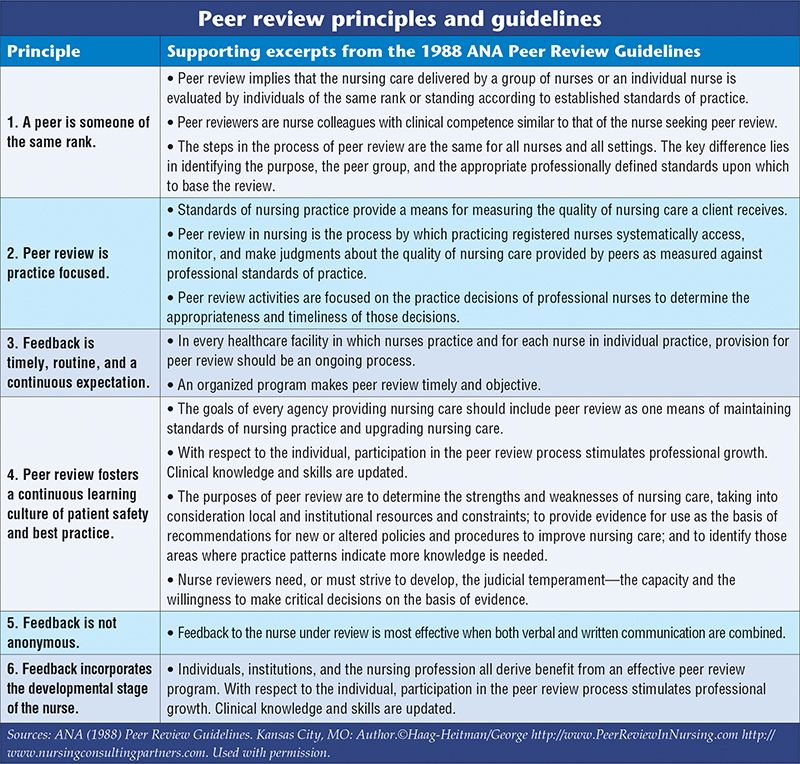
Haag-Heitman recommends hospitals have shared governance in place before tackling PPR. “Peer review is operationalized through the shared governance model,” she says. “It’s part of self-regulating the discipline of nursing, and shared governance is the framework for that.”
As with any global initiative, Harrington says it’s vital to obtain buy-in from leadership and other stakeholders.
Education is another essential plank for supporting PPR. A 2012 study by Judith Pfeiffer, PhD, RN, NEA-BC, and colleagues revealed many nurses misunderstood PPR and identified barriers, including fear of retribution, language barriers, and lack of professionalism.
“There’s a lack of clarity as to what peer review should include,” says Pfeiffer, director of nursing education, development & research, and psychiatric services for the UC San Diego Health System. “It’s not just kudos. Feedback needs to be specific so that it’s useful.”
Haag-Heitman agrees that the ability to give and receive feedback is one of the biggest barriers for PPR. “Training is a must,” she says, adding that feedback needs to be transparent. “We have the false assumption that only anonymous feedback is honest.”

Colleen
LeClair-Smith, DNP, RN, NEA-BC
Colleen LeClair-Smith, DNP, RN, NEA-BC, director, Magnet, NDNQI (National Database of Nursing Quality Indicators®), and nursing recruitment and resource pool at University Medical Center (UMC) in Lubbock, Texas, acknowledges that giving feedback can be challenging.
“Think about a 6-month nurse giving peer feedback to a 15-year nurse and how awkward that can be for both people,” she says.
Looking back, LeClair-Smith says that if she could start the PPR (which UMC refers to as Peer 2 Peer Feedback) implementation process again, she would do it differently. “I would spend more time instructing, coaching, and mentoring staff about how to provide and receive feedback,” she says. She recommends the book Crucial Conversations: Tools for Talking When Stakes Are High, 2nd edition as a resource.
Shogren says UnityPoint has been applying the principles of crucial conversations for several years, and sees the concepts as helpful for people holding each other accountable during PPR.
Finding time for feedback is another challenge. “The speed of the work and the tension is so high that it’s hard to take a few minutes to talk to someone in a way that moves the practice forward,” Pfeiffer says. She tells staff, “Use clear language and ‘I’ statements so people don’t get defensive.”
Promoting honest feedback starts early at UMC, during nursing orientation. Adonica Dugger, DNP, RN, CNOR, CCM, OR services director, works with orientees and preceptors on giving feedback to one another. “No one can get better if you don’t tell them what they need to work on,” she says. This lays the groundwork for giving and receiving feedback as part of PPR.
Dugger adds that education about PPR has to focus on how it affects patient care and helps staff members do their best to take care of patients. “We try to get everybody to understand that the whole purpose is to help you do better, not to drag you down,” she says.
A committee at UnityPoint created an education module for PPR that staff can complete online. “It stresses how peer review relates to holding each other accountable,” Shogren says. Videos show staff demonstrating how to provide feedback. Staff also received a postcard at home announcing peer review and briefly explaining what it is, such as “opportunity for professionals to review and collaborate on the quality and appropriateness of care” and “measured against professional standards of practice.”

Barb
Haag-Heitman, PhD, RN, FAAN,
PHCNS-BC
Despite ANA’s statement that PPR is an important component of quality efforts, the practice has not been widely developed. In a recent study, Haag-Heitman found hospitals with Magnet status are more likely to conduct PPR than those without this recognition, but even Magnet hospitals tend to include PPR as part of the annual evaluation as opposed to focusing on its use in improving quality.
Yet, PPR can be a powerful tool for quality. “It makes people accountable, and helps ensure quality, safety, and the implementation of standards,” Haag-Heitman says. It’s also a requirement for those seeking Magnet recognition.
One of the differences between PPR and standard quality initiatives is a focus on the positive. “The whole idea is fostering a learning culture of patient safety and best practice, where people help each other to achieve success collectively,” Haag-Heitman says. “It can be a more proactive and collegial approach where people feel like they have each other’s backs.”
LeClair-Smith adds that PPR aligns well with UMC’s quality initiatives and strategic planning. “Using professional guidelines and standards of practice should serve as a roadmap for professional peer review,” she says. “Professional peer review in conjunction with evidence-based practice can assist nursing staff with aligning their practice to desired outcomes.”
Haag-Heitman says the ORs she has worked with have targeted a variety of metrics for PPR, including use of radiofrequency scanning, handoffs, and family participation in stage 1 recovery.
Dugger says the OR at UMC is monitoring time-outs, turnover time, and pressure ulcers, including proper positioning of patients intraoperatively.
Both Haag-Heitman and Dugger say that frontline personnel need to be the ones to identify their outcome metrics of success. Dugger notes nurse leaders gave members of the OR’s unit-based council members some suggested metrics, but adds, “They were the ones who chose the measures we would monitor.”
LeClair-Smith says that since PPR was implemented at UMC, the incidence of pressure ulcers has fallen by 85% over an 18-month period. She adds that although many measures played a role in the decrease, PPR was one strategy.
“The OR staff play a significant role in pressure ulcer prevention within the entire organization related to the length of time patients spend in the OR for certain procedures,” LeClair-Smith says. ✥
Cynthia Saver, MS, RN, is president of CLS Development, Inc, Columbia, Maryland, which provides editorial services to healthcare publications.
American Nurses Association. Peer review guidelines. Kansas City, MO: ANA, 1988.
Garner J K. Implementation of a nursing peer-review program in the hospital setting. Clin Nurse Spec. 2015;29(5):271-275.
George V, Haag-Heitman B. Differentiating peer review and the annual performance review. Nurse Leader. 2012;10(1):26-28.
Haag-Heitman B, George V. Peer review in nursing: Principles for successful practice. Sudbury, MA: Jones & Bartlett Learning, 2010.
Haag-Heitman B, George V. Nursing peer review: Principles and practice. Am Nurse Today. 2014;6(9):48-52.
Harrington L, Smith M. Nursing peer review: A practical, nonpunitive approach to case review, 2nd ed. Danvers, MA: HCPro, 2014.
Pfeiffer J A, Wickline M A, Deetz J, et al. Assessing RN-to-RN peer review on clinical units. J Nurs Manag. 2012;20(3):390-400.


