Surgical site infections are multifactorial, and perioperative leaders often struggle with how to reduce or eliminate them. In 2013, after an unexplained increase in surgical site infections (SSIs) among patients undergoing total hip arthroplasty at our facility, we began to investigate the cause.
A fairly robust ERAS (enhanced recovery after surgery) protocol was already in place, along with rigorous programs aimed at addressing National Patient Safety Goals at Franciscan Health in Indianapolis, a 267-bed community hospital where nearly 9,000 procedures are performed annually.
What seemed to be missing was direct attention to the OR environment and the level of cleanliness therein. And once we delved into a thorough examination of our practices, we found that we needed not only a more rigorous cleaning protocol for the OR, but also a means of disinfecting our lead wearables.
This article describes our efforts to reduce bioburden and thereby improve patient safety.
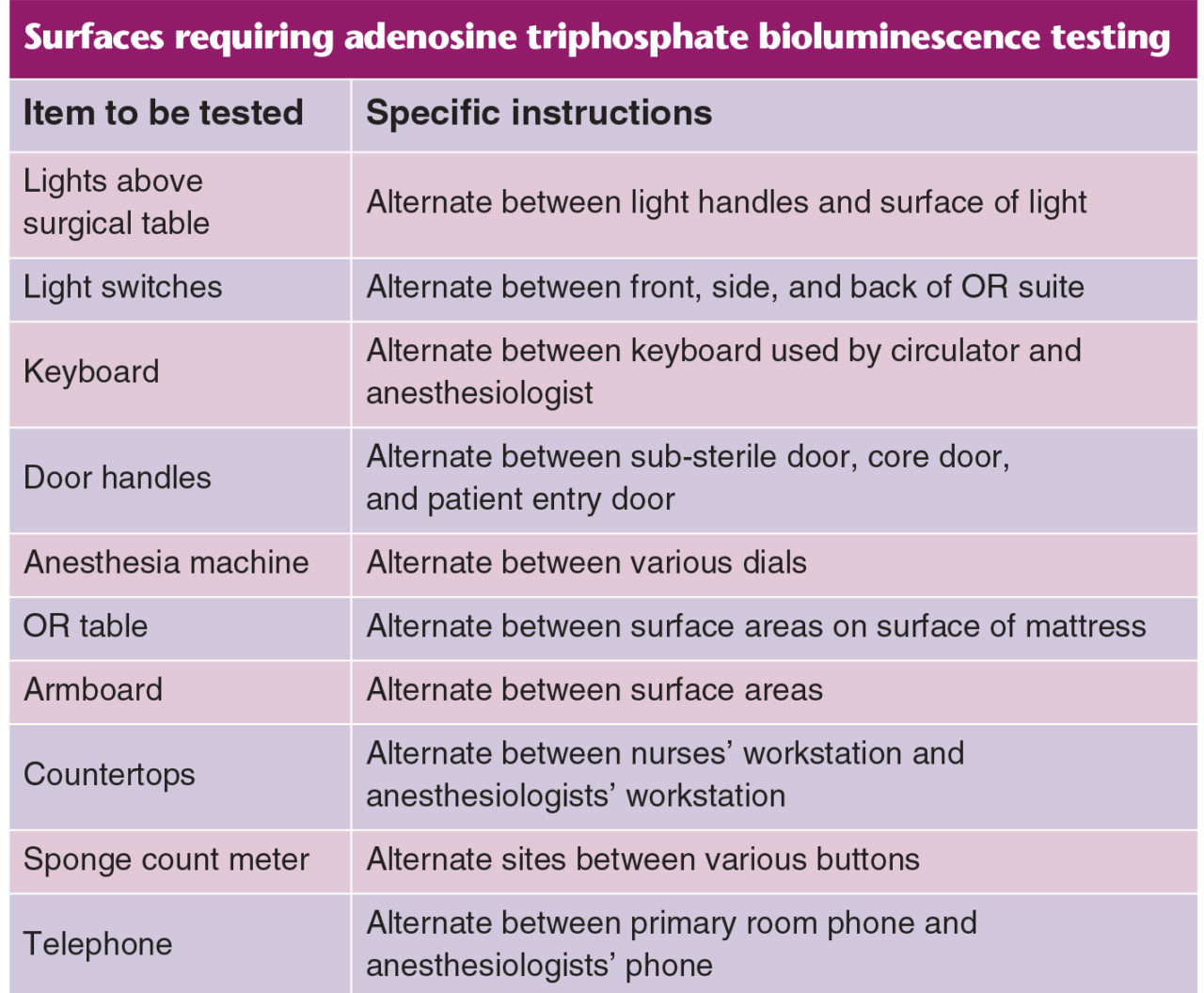 Microbes that cause SSIs are not visible to the naked eye, so a method of determining cleanliness at a microscopic level is essential for the accurate detection of bioburden. The hospital was using adenosine triphosphate (ATP) bioluminescence technology to test the cleanliness of inpatient hospital rooms, but this practice had not yet been applied in the OR. ATP bioluminescence meters measure the concentration of ATP as relative light units (RLU) in organic material and living cells.
Anecdotal information was collected from OR staff nurses, surgical technologists, and cleaning personnel regarding their perceptions of OR cleanliness. Staff saw colleagues wearing gloves for a patient care activity and then touching keyboards, door handles, countertops, etc, with those same gloved hands. They identified 10 high-touch surfaces as areas of concern, and these became the basis of weekly ATP testing during the next 5 years (sidebar at right).
Surgical attendants, the team members responsible for between-case and terminal room cleaning, performed the weekly ATP tests. This practice provided the team with immediate feedback regarding the effectiveness of their cleaning so that re-cleaning could be done when necessary. Initial ATP testing results validated the suspicions that more arduous OR cleaning protocols were a must.
In ascending order, the top five surfaces of concern were:
• the various buttons and dials on the anesthesia machine
• the surface of arm boards
• the surfaces and handles of surgical lights above the sterile field
• the sponge count meter
• the surface of the OR table mattress.
The remaining high-touch surfaces were also problematic, but these failed ATP testing at a lower rate with an overall lower bioburden count. The literature suggests that environmental contamination plays a role in the spread of pathogens such as methicillin-resistant Staphylococcus aureus, vancomycin-resistant enterococcus, norovirus, and Clostridium difficile. With that in mind, enhanced cleaning protocols were introduced utilizing the expertise of infection prevention specialists as well as AORN Recommended Practices for Environmental Cleaning.
Immediate improvements were not realized because the bioburden and biofilm buildup were significant. Early ATP test results on overhead lights, the surgical table mattress, and anesthesia dials were frequently greater than 400 RLU—much higher than the score of 30 RLU or greater that indicated a failed ATP test with the brand of meter we were using (Hygiena, Camarillo, California). These items frequently had to be re-cleaned multiple times to work through the layers of contamination and achieve a passing score of 10 RLU or less.
Two months after implementation of these new service protocols, ATP testing began to show a reduction in the bioburden counts.
 The increased attention on ensuring a cleaner environment raised concerns about the x-ray garments and lead wearables in use every day for orthopedic, spine, and neuro procedures to protect teams from radiation exposure.
An article was brought to my attention about contamination concerns related to x-ray garments, and the fact that a group of surgeons brought suit against the facility made an impression on me. Part of the lawsuit states: “The general condition of the PPE [personal protective equipment] provided to physicians and staff in the hospital was decrepit….Namely, the leaded skirts, jackets, aprons and thyroid collars were filthy, tattered, and torn, and there was no procedure for cleaning them.” It was hard to read this article and not be concerned about my garment inventory.
At our facility, we had protocols in place for cleaning nearly every piece of equipment, every piece of OR “furniture,” and even for the floors, walls, and ceilings. Yet we didn’t have a protocol for cleaning the lead wearables; at best, they were spot cleaned with a disinfectant wipe when a known exposure occurred. Much of our lead inventory had a foul odor, and staff routinely scoured the x-ray racks searching for the least offensive (and least perspiration-laden) garment among them.
When we started looking into cleaning protocols for these garments, there was hardly any information available online, and most garment manufacturing companies offered little guidance. In fact, initial requests for information were ignored until an orthopedic surgeon reached out with a request for cleaning guidelines. I compiled the responses he received into a chart so we could compare the recommendations (sidebar above).
Along with the research on cleaning recommendations for lead wearables from the garment manufacturing companies, a literature review was done to determine if x-ray garments truly posed a threat to team members and patients.
In a study exploring pathogenic organisms on the lead aprons of interventional radiologists, 25 garments were cultured. Of those, 84% or 21 of the aprons tested positive for Tinea species, and the same number were also positive for Staphylococcus aureus, three of which were methicillin-resistant Staphylococcus aureus.
In another study by Honigsberg et al, researchers cultured 109 lead wearable garments and found bacterial contamination on 88 of them. Identified pathogens included Staphylococcus aureus, Pseudomonas aeruginosa, and Klebsiella pneumoniae.
We explored options within our department and facility in an attempt to develop a servicing program for our x-ray garment inventory. However, we found it challenging to come up with the time, resources, and space to properly clean 500+ x-ray garments in accordance with manufacturers’ guidelines.
When presented with ATP test results, our infection prevention department immediately supported investing in a lead cleaning service. They partnered with our perioperative leadership team to budget for a cleaning service, and we entered into a service contract with a third-party vendor to manage the cleaning we could not handle (Radiological Care Services, Indianapolis, Indiana).
Different brands of ATP testing equipment use similar technology but have different pass/fail threshold numbers. With the initial testing of our lead garments, we had some of the dirtiest lead the cleaning company had ever seen—including one garment that scored over 1,000,000 RLU!
With quarterly cleaning, the failure rates prior to the cleaning process were markedly reduced. Post-cleaning, we were provided with reports that demonstrated clean lead that passed all ATP testing. Feedback from surgeons and OR team members solidified the hospital’s commitment to providing clean, safe lead wearables.
Our patients expect to be cared for by skilled team members in a safe and clean environment. We owe it to them and to one another to ensure that our OR environment isn’t compromised by hidden risks. Providing a safe environment for patients and team members isn’t just a job for infection control; everyone plays a part.
ATP testing is recommended for lead and any surfaces of concern in perioperative services. Testing should be performed with the infection prevention team, and results should be shared with senior leadership to gain support for regular, thorough cleaning.
Having made the journey from equipment and lead wearables contaminated with bioburden to an environment in which everyone can feel good about the cleanliness of both, there is no turning back.
Be bold and lead a new initiative, and be proud of the change you bring to your department and facility. As change agents and thought leaders in the perioperative environment, we don’t have to wait until it becomes a governing body mandate or a best practice recommendation to do the right thing.

Rhonda L. Anders, MSM, BSN, RN, CNOR, NE-BC, formerly with Franciscan Health in Indianapolis, Indiana, is director of perioperative services at Eskenazi Health in Indianapolis.
AORN. Recommended Practices for Environmental Cleaning. AORN J. 2014;9(5):583.
Balkissoon R, Nayfeh T, Adams K, et al. Microbial surface contamination after standard operating room cleaning practices following surgical treatment of infection. Orthopedics. 2014;37(4):e339-e344.
Carling P, Parry M, Bruno-Murtha L A, et al. Improving environmental hygiene in 27 intensive care units to decrease multidrug-resistant bacterial transmission. Crit Care Med. 2010;38(4):1054-1059.
Dancer S J. The role of environmental cleaning in the control of hospital-acquired infection. J Hosp Infect. 2009;73(4):378-385.
Honigsberg H, Speroni K, Fishback A, et al. Health care workers’ use and cleaning of x-ray aprons and thyroid shields. AORN J. 2017;106(6):534-546.
Jaber M, Harvill M, Qiao E. Lead aprons worn by interventional radiologists contain pathogenic organisms including MRSA and Tinea species. J Vasc Intervention Radiol. 2014;25(3):S99-S100.
Richard R D, Bowen T R. What orthopaedic operating room surfaces are contaminated with bioburden? A study using the ATP bioluminescence assay. Clin Orthop Relat Res. 2017;475(7):1819-1824.
Weber D J, Rutala W A, Miller M B, et al. Role of hospital surfaces in the transmission of emerging health care-associated pathogens: Norovirus, Clostridium difficile, and acinetobacter species. Am J Infect Control. 2010;38(5 Suppl 1):S25-33.
Yezli S, Barbut F, Otter J. Surface contamination in operating rooms: A risk for transmission of pathogens? Surg Infect. 2014;15(6):694-699.


