 Safety
Reforming instrument reprocessing practices does not always end with the main sterile processing department (SPD). Holding clinics to the same standard adds to the challenge, whether they are associated with hospitals or operate independently. Nonetheless, standardization is just as essential to maintaining efficiency and quality standards. Establishing and maintaining best…

Complex problems do not always require complex solutions. Consider the surgical safety checklist. In 2020, more than a decade after the World Health Organization (WHO) started advocating that every hospital use the checklist, research from PSNET found that more than 90% of ORs in countries with a high human development…

When it comes to the adoption of artificial intelligence (AI) in medicine, radiology is leading the charge. As of May 13, 2024, the US Food and Drug Administration (FDA) had approved nearly 900 AI- and machine learning (ML)-enabled devices, and the vast majority of them are in radiology. One example…

Gastrointestinal (GI) endoscopy is one of the most common procedures in the US. Performed more than 17.1 million times per year in inpatient and outpatient hospital settings as well as ambulatory surgery centers (ASCs), GI procedures account for 68% of all endoscopies, according to a May 2022 article in Digestive…

Rural hospitals in the US have been facing a prolonged, multifaceted crisis. The literature presents several reasons for why healthcare facilities in rural areas struggle, including shrinking budgets, rising chronic illness and public health issues like addiction and obesity, poor telehealth and broadband access, aging populations, deteriorating mental health, and…

Is working with a healthcare vendor a necessary evil? For leaders in the perioperative space, where vendors abound, it may be tempting to answer “yes.” The relationship between vendors and nurse leaders is a delicate balance between give and take, but sometimes the take seems to outweigh the give. Nonetheless,…

Over 20 years ago, an article from Johns Hopkins published in The New England Journal of Medicine showed that Staphylococcus aureus decolonization of the nares can decrease risk of surgical site infections (SSI). Since then, nasal decolonization—the application of a topical antimicrobial or antiseptic agent to the nares—has been adopted…

Ambulatory surgery centers (ASCs) play an increasingly crucial role in delivering outpatient surgical care that is efficient, effective, and—most importantly—safe. As the ASC sector continues to grow and evolve, maintaining best practices in hand hygiene and environmental cleaning and disinfection is imperative to protect patients from infections. ASCs also should…

Takeaways Although women comprise half the population, they were left out of medical research on major causes of death for both women and men—cancer, heart disease, and stroke—until 1990. Using surgical tools designed by men, for men can impact every aspect of a woman surgeon’s work, from learning new procedures…
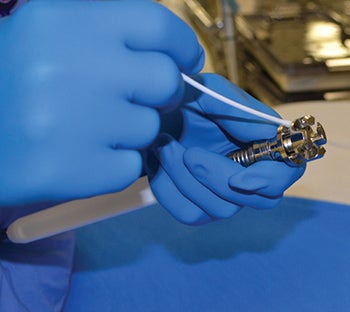
Inspecting surgical devices is a time-consuming process. However, diligently checking every instrument prior to sterilization is essential to ensuring safe, proper functioning. As the last people to see devices before they are used for patient care, sterile processing technicians must be thorough. Exterior surfaces should be inspected for flaws such…