Perioperative nurse leaders anticipate a tsunami of retirements will soon sweep away the wisdom that makes the OR the profitable cost center it is. A 2013 survey found that more than a third (37.8%) of OR nurse leaders plan to retire by 2018 and nearly two-thirds (64.8%) plan to exit their roles by 2022.

Anne Fairchild, MS, BSN, RN, CNOR
“If you don’t have succession planning, you may lose business in the OR,” says Anne Fairchild, MS, BSN, RN, CNOR, an independent perioperative consultant and chief executive officer of Vanguard Enterprises, LLC, in Tulsa, Oklahoma. “The turmoil that comes in the wake of losing your strong leaders can cause surgeons a high level of frustration,” she says. “Surgeons may end up working with staff not familiar with their preferences, which can translate into increased turnover time and fewer cases completed during assigned block time. The frustration can cause surgeons to look for another organization, taking their business with them.”
Replacing a leader is also pricey. “The cost of interim leadership while you’re recruiting the right person, onboarding that person, and the 6 months to a year it takes that person to get up to speed can have a significant financial impact on the organization,” Fairchild says.
In addition to cost, the time needed for succession planning may seem daunting. However, it’s time well spent. “It doesn’t have to take a lot of time,” says Fairchild, who suggests setting aside as little as 4 hours per month. “Think of it as time that will provide a huge return on investment.”
Fairchild and several OR leaders share succession planning advice that can be adopted in any facility. The key is to establish a program that meets the organization’s strategic needs.
“Our program is designed to get the right talent, know our talent, grow our talent, and move our talent,” says Kevin Lutz, DPM, chief operating officer for OhioHealth Grant Medical Center in Columbus. Grant performs more than 20,000 procedures annually in its 30 ORs.
Part of getting the right talent is evaluating the current leadership environment. “Look at whether your leaders are aligned with your organization’s vision and values, and if they’re not, mitigate any damages,” Dr Lutz says.
That may involve what he calls “hitting a hard reset,” where leaders are told (off the record) that they aren’t in alignment and given a day off with pay to consider whether they can commit to the organization’s direction. “If they decide they want to commit, they have to come back with a written action plan,” Dr Lutz says. If not, the leader is asked to leave the organization.

Lisa Counts, MBA, BSN, RN, CNOR
A team that includes both managers and staff should interview candidates for open leadership positions, says Lisa Counts, MBA, BSN, RN, CNOR, administrative nurse manager for OhioHealth. “You want to gain some insights into their personality and their leadership style. There are different leaders for different times,” she notes.
Managers should consider the leadership potential of those interviewing for open staff positions, she adds. “No one’s game ready to be a director or manager,” she says. Those with leadership potential can be nurtured from the time they join the organization, adding to the talent pool.
Knowing your talent ensures that your organization will have a ready pool of leaders. “You have to think about who will replace me and who will replace that person,” Dr Lutz says.
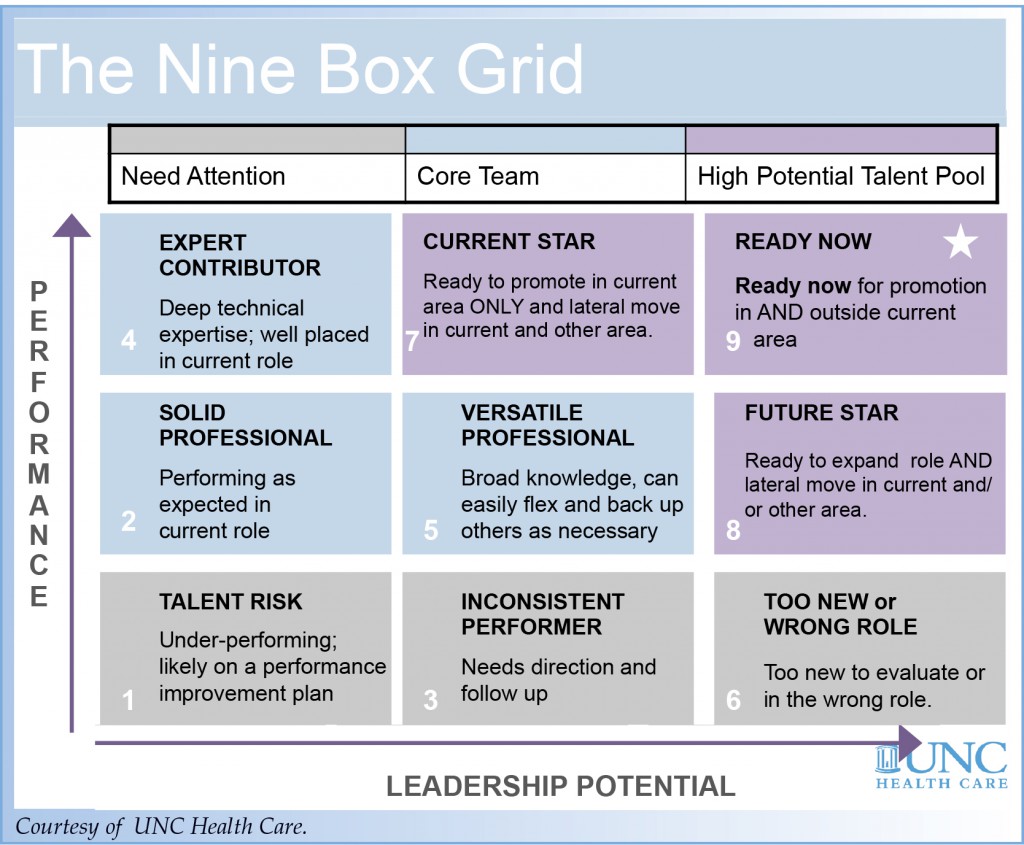
A common way to analyze talent on an organizational level is the nine-box grid (sidebar). “It’s easy to use,” Fairchild says, adding, “some experts suggest that every employee should be ranked, and although there’s value in that—because it helps you avoid missing someone with potential—I’m not sure how it’s possible to manage the process.” She suggests using the grid twice yearly, with annual review the minimum.
Leaders can also use software programs such as Halogen eSuccession, Peoplefluent.com, PeopleStreme.com, SuccessFactors.com, and TalentQuest.com.
Not everyone will self-identify as having leadership potential. “You have to show them that they can be a great leader,” Dr Lutz says. Counts will say to staff, “You have a lot of great leadership qualities. Are you interested in this?”
Interest is part of the “triangle” that Jayne Byrd, MSN, RN, uses to evaluate staff: performance; potential; and values, interests, and commitments.

Jayne Byrd, MSN, RN
“You may have a brilliant potential manager, but they aren’t willing or able to make a greater commitment because of family demands,” says Byrd, vice president, surgical services, at Rex Hospital, Raleigh, North Carolina, part of the UNC Healthcare System. Although it might not be the right time for someone to pursue a leadership role, having the discussion raises awareness and may lead to future management roles as the person’s situation changes.
“It is often difficult for OR managers to thoroughly assess every employee due to time, resources, and other constraints,” says Yvonne Gardner, vice president of talent management and organizational effectiveness at Sutter Health in Northern California. “I suggest that managers focus on nurturing the handful of employees with high potential.”

Yvonne Gardner
Sutter, a not-for-profit health system, was recently recognized by The National Center for Healthcare Leadership as a top 10 “BOLD” healthcare organization using evidence-based leadership development practices to achieve excellence and improve the quality of healthcare in their communities.
Gardner recommends frontline managers assess staff in terms of aspirations, ability, and engagement by asking whether the individual:
Individuals with about 80% or more “yes” responses are usually high performers with high potential.
OhioHealth uses an individual development plan (IDP) for personal and professional success to help grow talent.
Employees are asked to consider career objectives and the needs in their personal lives, and to gather materials such as performance evaluations to help identify strengths and weaknesses. After they complete the IDP form, which includes sections for development opportunity, development actions, and three follow-up times, they discuss the form and the next steps with their managers.
Corporate leadership classes at OhioHealth provide opportunities to interact with different levels of management. In addition, the monthly surgery leadership team meeting now includes charge nurses and clinical leaders, Counts says. “It exposes them to discussions about strategy that they weren’t previously exposed to.”
Networking, participating in special projects, and attending conferences provide informal opportunities for growth. More formal leadership programs can be effective, too. A study in the Journal of Nursing Administration reported that 1 year after completing a leadership program in an acute care hospital, all the participants remained with the organization and 73% had transitioned to a leadership role.
Fairchild recommends mentoring staff and assigning mentors from different levels of the organization.
“If I know that as a perioperative leader I’m going to be retiring within the next 5 years, then I should be looking at employees who might be able to step into my role. If they don’t have what they need, for example, a master’s degree, then I should mentor them in that area.”
She also has found job shadowing to be an effective technique. “It’s a way to mentor someone without a large time investment.”
At Sutter Health, Gardner says those high performers with high leadership potential participate in leadership development programs that are guided by the four E’s:
“Most people can look at the four E’s and understand what’s needed,” Gardner says. “For example, if a nurse in one of our programs recognized that she has limited formal leadership experience, we would look for opportunities to assign her to lead a unit project.”
Employees with leadership potential at Rex Hospital can move through three education courses: emerging leaders, strategic leaders, and advanced leaders.
“They work collectively on projects with others and have homework as part of the program,” Byrd says.
Those in the advanced leadership course have a mentor, usually a vice president or director, who meets with the employee monthly. Employees progress through the courses on their own time frame. Those who have leadership potential also receive career coaching and assessment.
“We often have multiple candidates for each role, so when someone leaves, we don’t have to advertise outside of the organization,” Byrd says. In 2013, 79% of open leadership positions at Rex Hospital were filled with internal candidates.
“Challenging your talent gives you a stronger bench,” Dr Lutz says. He recommends moving people to positions where they feel uncomfortable.
Several months ago, for example, Counts moved from perioperative operations to strategy and business development, where she is thriving.
It’s important to identify who needs immediate promotion so that the person doesn’t go elsewhere, she says. Of course, that’s not always possible. “Don’t be afraid to lose someone you’ve already lost,” Dr Lutz advises.
Moving staff to a managerial role can be challenging. One strategy is to “try out” a leadership role by serving in an interim position, with the understanding that if it doesn’t work out, the person can return to the staff position.
To attract nurses of the millennial generation to engage in leadership, Counts has rotated the charge nurse position in the OR. “It allows for that generation to have flexibility with their time and to fill leadership needs,” she says.
Managers and directors must be held accountable for succession planning if it’s going to be successful, Counts says. “They need to have direct accountability; otherwise, your organization won’t be prepared. Leaders have to approach succession planning strategically, the same way you would do the business, the marketing, and the specialty line growth.”
Gardner agrees: “People often make the mistake of seeing succession planning as one more thing to do and as separate from their other responsibilities. But if you put it in the context of what your role as a leader is—to develop and coach people to be successful—it becomes part of what you do as a leader.”
This approach also has the potential to ease the leadership burden. “If you can move people around more easily to fill gaps, I truly believe your leadership of the unit will become easier,” Gardner says. ❖
Cynthia Saver, MS, RN, is president of CLS Development, Inc, Columbia, Maryland, which provides editorial services to healthcare publications.
Sherman R O. Perioperative nurse leader perspectives on succession planning: A call to action. Nurs Economics. 2014;32(4):186-193, 203.
Titzer J L, Shirey M R, Hauck S. A nurse manager succession planning model with associated empirical outcomes. JONA. 2014;44(1):37-46.
The nine-box talent management grid (see below) helps leaders assess the talent and potential of employees related to leadership.
Yvonne Gardner, vice president of talent management and organizational effectiveness at Sutter Health in Northern California, says it’s easy for leaders to confuse high performance with high potential. “Some people are truly amazing at their current jobs, but managers should think through whether the individual aspires to be a leader, is engaged with the organization, and has the ability to succeed in a different role,” Gardner notes.
“There may be an employee who is very good at taking care of patients and surgeons, but doesn’t have good interpersonal skills with team members,” says Anne Fairchild, MS, BSN, RN, CNOR, an independent perioperative consultant and chief executive officer of Vanguard Enterprises, LLC, in Tulsa, Oklahoma. “Completing the nine-box grid requires a group effort. Ask your frontline managers to have each direct report complete an assessment form, then set aside a day where the entire perioperative leadership team ranks employees,” she suggests. “Identify missing skills that can be taught—and ones that can’t be taught—to help determine high performers.”
The assessment tool Fairchild recommends is from the website http://www.leadership-tools.com/access-free-tools.html, where you can download PDF versions of tools for free or pay a small fee to obtain copies in Word on Excel.
This talent management tool includes education and special training, key accomplishments in the past 2 years, personal strengths, personal development plan, desired next step leadership roles, number of years within the organization, number of direct reports, community involvement, and relevant work experience.
Gardner says that a common pitfall of the nine-box grid is that “Managers are sometimes hesitant to use the lower boxes. It can be hard to separate performance and potential, which is what the nine-box grid hopes to distinguish.” She recommends managers consider the risk of losing the person, the impact of that loss, and whether there is a successor to the individual.
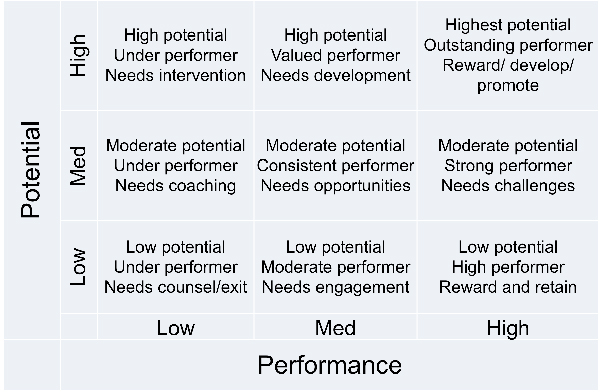
Courtesy of Anne Fairchild, MS, BSN, RN, CNOR.


