• Visual management (VM) tools support Lean efforts, leading to improved quality and efficiency.
• VM boards provide an overview of processes, facilitate problem solving, and promote staff-manager collaboration.
• Other VM tools such as color coding and customized instrument trays can help reduce errors and save money.

Jessica Gruendler, DNP, NEA-BC, NI-BC, CPHQ, CNOR(E)
Lean is a system of continuous process improvement that reduces and eliminates waste, leading to enhanced efficiency and quality and reduced costs (sidebar, Lean principles). The concept’s roots lie in the Japanese auto industry, where the Toyota Production System was created, but it has widely spread to all types of organizations, including healthcare.
Visual management (VM) supports Lean efforts by providing information that can be used to make improvements. The goal of VM is “to translate operational performance metrics into easy-to-understand visual overviews,” says Jessica Gruendler, DNP, NEA-BC, NI-BC, CPHQ, CNOR(E), senior director of nursing operations, perioperative, and procedural services at two hospitals that are part of UCSF Health in San Francisco, California. Benefits to safety and efficiency include more effective communication, better (and faster) decision making, and increased staff satisfaction.

UCSF Health’s recent efforts to improve first case on-time starts (FCOTS) illustrate the integration of VM into Lean. Populating a run chart with two weeks of FCOTS data eased sharing of the baseline and trends with staff. Obstacles to on-time starts, such as delayed lab work or unavailable rooms, were presented in a Pareto chart. “Everyone could easily see which issues were most prevalent,” Gruendler says.
Solutions included having a technician start at 5 am to ensure each room was ready for the first case, and changing the start time for staff assigned to provide break relief from 8:30 to 6:30 am so they could arrive early enough to help with setting up for large cases such as spinal fusions. “We went from 50% to over 75% on-time starts over 6 weeks,” Gruendler says.
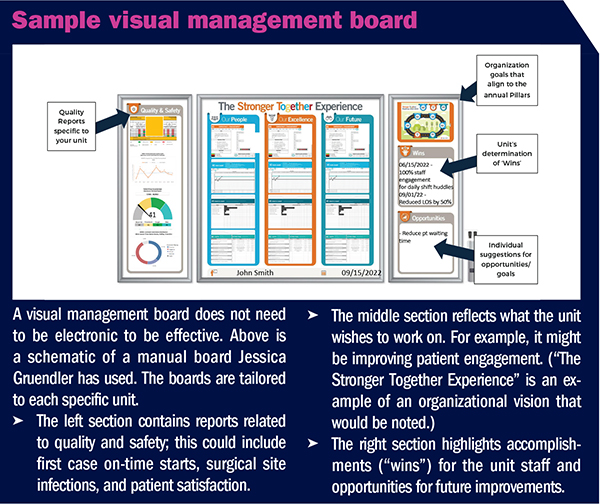
Run charts and Pareto charts are often components of other VM tools such as electronic dashboards or poster boards. Depending on the purpose, a VM board might include key data points, standards (such as key performance indicators), and status of problem-solving initiatives (sidebar, Sample visual management board).
Benefits vary. For example, Sexton and colleagues reported using a dashboard in the electronic health record (EHR) during handoffs between postanesthesia care unit (PACU) and medical-surgical nurses improved communication and reduced boarding of patients in PACU. Whatever the nature of the approach, VM offers an accessible means of improving both workflow and quality.

Hazel Darisse, DNP, MSN, RN, CNOR, NEA-BC
Sibley Memorial Hospital in Washington, DC, uses a tracking board to provide a bird’s eye view of the perioperative process, from time of admission to PACU. “That’s very valuable to surgeons, anesthesiologists, staff, and especially charge nurses, who are managing the entire OR patient schedule,” says Hazel Darisse, DNP, MSN, RN, CNOR, NEA-BC, director of perioperative services for Sibley and the holder of a Six Sigma Green Belt.
At Vanderbilt University Medical Center (VUMC), electronic dashboards “provide the information we need to run our daily operations,” says Vikram Tiwari, PhD, senior director of surgical business analytics at VUMC. For example, a board in the OR shows the status of every surgery, which helps the charge nurse to effectively manage add-on cases. The board also can be viewed by PACU staff, and the preoperative holding area has a VM board to help nurses manage patient flow. In some cases, “the same information is available, but it’s displayed differently depending on what the person needs,” he says. Surgeons and anesthesiologists can access the OR dashboard via an Epic app on their phones and choose to display what they need, such as only their own cases.

Vikram Tiwari, PhD
Salem Health in Salem, Oregon, is expanding its VM system by looking at the value stream for patients, starting with the referral from the primary care provider to the surgeon through to the day of surgery, says Mathew Boles, MD, executive vice president of surgical services and medical affairs. He and other executives can use the electronic dashboard, which pulls information from the EHR system, to identify the number of patients in key “buckets,” such as those waiting authorization or a date for surgery. Andon, a Lean tool, highlights status in a quick glance to see if indicators are on track (green versus red). “We can track the journey of the patient from referral through the day of surgery,” Dr Boles says.

Mathew Boles, MD
The dashboard also can help assess if surgical procedures are falling within case classification targets—the number of days from the submission of the request to when the patient is scheduled for surgery. “Our goal is to have 100% of patients meet their classification window,” Dr Boles says. The goals are 45 days for routine cases, 30 days for patients with a more urgent diagnosis, and 14 days for a semi-acute condition. Add-on cases have their own classification targets, ranging from urgent (within an hour) to emergent (within 48 to 72 hours).
The bottom line is the VM system provides an overview of the entire care continuum while allowing users to drill down to a more granular level such as a particular surgeon. Having conducted several simulations, Salem Health is currently testing the system for one service line. This process aligns with the Lean concept of test of change, which helps identify problems before broader implementation.
Not all boards are digital. For example, Vanderbilt uses traditional magnetic boards to show staffing for the day. Tiwari says staff move magnetic pieces throughout the day to provide a quick overview of staffing needs. White boards also help plan for the day.

Marjorie Wall, EDBA, CRCST, CIS, CHL, CSSBB
Cedars-Sinai’s sterile processing department (SPD) has an electronic dashboard that tracks quality measures such as turnaround time and missing instruments. “We can see where the issues are,” says Marjorie Wall, EDBA, CRCST, CIS, CHL, CSSBB, associate director for sterile processing at Cedars-Sinai in Los Angeles.
Problem solving comes next. VM boards promote that step by providing a venue for sharing information and facilitating development of solutions, beginning with tracking trends and reasons for trends. “You can’t improve something if you don’t know the issue,” Darisse says.
Pareto charts help by providing a means to identify the most common problems. Darisse says the EHR has made VM much easier. “You can trend just about anything,” she says. After reviewing the data, staff and managers develop goals and action plans that are posted.
VM boards can also be used to show progression toward goals. For example, Wall is using the SPD dashboard to track progress of an updating physician preference cards project. Once projects are complete, boards can help check for sustainability. “You have to monitor key measures to make sure the interventions stick,” Wall says.
Boards can also help facilitate behavior change. Gruendler says the SPD at USCSF Health was routinely receiving multiple instruments from the OR that had not undergone point-of-care decontamination, as well as instrument trays that were in disarray. SPD staff started taking photographs of bloody instruments and haphazard trays. The photographs were shared with the staff who had been in the room, but also placed on the OR’s VM board, along with a Pareto chart that showed the frequency of the problem. It took about 6 months, but the behavior did change.
VM boards require a basic understanding of Lean concepts, so staff education is necessary. In general, VM appeals to younger staff. “They get the metrics, they get statistics, and they get the graphs,” Darisse says. “They’re tech savvy. Kids are doing Pareto charts in elementary school.”
Once staff understand Lean, setting up a board begins with deciding on the purpose. At Sibley, the VM board in each unit focuses on four items: service excellence (eg, patient experience), operational excellence (eg, turnover time), clinical excellence (eg, rates of infection), and workplace excellence (eg, employee engagement).
Staff should have input into the look and content of the board, and information should be updated to show progress. While in a previous position, Wall’s SPD staff took on the issue of missing instruments. Two major initiatives were successful in addressing the problem. The first was color coding instruments to make it easier for the SPD tech to place them in the correct set. The second was organizing assembly workstations. “We made sure everything the technician needed was in an organized, labeled bin,” she says. Cards that showed the contents and organization provided a quick reference point. “Everybody could find what they needed quickly and restock appropriately,” Wall says.
This process promoted ongoing staff engagement. The team monitored the number of missing instruments each month and found improvements after each change. In addition, the team could quickly identify initiatives that did not work.
Information related to projects should be updated regularly and analyzed. Some staff may find it cumbersome to obtain reports from Epic, Tiwari says, so he uses Tableau to display data. Power BI and Python are other helpful analytic tools. However, simpler tools such as updated run charts and Pareto charts that show progress can work as well (sidebar, Sample run chart).

Leaders should remember that no board is an island. Regular review and discussion by staff and management are essential, with the frequency depending on the board’s purpose. At UCSF Health, representatives from the C-suite review unit boards twice a week. This provides an opportunity for the unit level team to showcase what they have accomplished and what is needed for future success. For example, Gruendler was able to present data that justified the purchase of a point-of-care lab testing machine to address the problem of delayed test results. Having leaders go into the units aligns with the Lean principle of Gemba—a Japanese term that means “going to the actual place” (in other words, seeing where the work is done).
One of the most important impact of boards is on organizational culture. “[VM] boards help us shift the culture from a top down to a staff up focus because it’s holding the staff members accountable,” Gruendler says.


Anthony Bondon, CRCST, CHL, BSM, AAS, SME, LSSYB
Boards are not only for tracking projects and workflow. Anthony Bondon, CRCST, CHL, BSM, AAS, SME, LSSYB, director of sterile processing at WellStar Kennestone Regional Medical Center in Marietta, Georgia, has three VM boards in the SPD breakroom. The first highlights work culture-related items. This includes the department’s six Cs: class, confidence, character, courage, culture, and commitment. The second board, which addresses shift readiness, shows cases for the day, any supply issues, and staffing. “Staff and the supervisor do a daily huddle to review the information,” Bondon says.
The third board is education focused. It includes information such as scholarship and education opportunities and new equipment. Bondon also uses the board to address any ongoing problems. For example, when there were several issues related to bioburden, he posted text reminding staff of the decontamination process. “We’re also sure to include the ‘why’ for each step, which improves adherence,” Bondon says. “All three boards help us in creating a more efficient workflow and eliminate inconsistencies.”
Sharing is critical. “We are transparent in sharing data with the team so we can show the good and the bad of our efforts,” he adds.
Other VM tools can support Lean. For example, some SPDs typically use colored-coded tape to reduce inadvertent mixing of different instrument sets.
Cedars-Sinai takes color-coding a step further. Instrument trays have internal bar codes that are color coded to the service line and department. SPD staff place an external tag on the outside of the tray that is the same color as the internal barcode. This process makes is easier for staff to put trays in the correct SPD storage area, so it is easier to subsequently put the right trays on the right transport carts. “We’re able to walk to shelves and confirm the trays have the right color coding and are in the right location,” Wall says.
Another example is the use of custom trays. Plastic microsurgery instruments are delicate and at high risk for damage, and differences between instruments can be difficult to distinguish. “There may be only a millimeter difference between two forceps or scissors,” Wall says. Cedars-Sinai partnered with a vendor to create a custom tray where each instrument fits perfectly into an allotted slot. OR staff put the instruments into the slots, protecting them during transport. “We’ve been able to drastically reduce our damaged instruments,” Wall says.
Customization also helps manage back-up inventory when an instrument is missing or out for repair, Wall says. For example, a photograph of the instrument, along with a description, catalog number, and PAR (periodic automatic replacement) level can be placed on the peg board, sometimes referred to as the back-up wall. “That way you know when to order new instruments, how many to order, and where to put them,” Wall says.
“Surgery is a team sport, where everyone has to be working well together and in synchronization,” Tiwari says.
VM facilitates this by enabling everyone see the same data. Having access to the same information allows surgeons, nurses, and other team members to make informed decisions in real time. By supporting Lean principles, VM advances the team’s goal of providing efficient, high-quality care. ORM
—Cynthia Saver, MS, RN, is owner of CLS Development, Columbia, Maryland, which provides editorial services to healthcare publications.
Disciplined Agile. The five principles of Lean. 2022.
Do D. The five principles of Lean. The Lean Way Blog. 2017.
EASE. Lean visual management board basics. 2023.
EXM. The 3 essentials of a Lean visual management board. nd.
Lean Enterprise Institute. What is lean? nd.
Lean Enterprise Institute. A brief history of lean. nd.
Pannell R. Principle 7: Visual management in Lean: The 3 second rule. All principles of Lean. 2020.
Sexton P, Whiteman K, George E L. Improving PACU throughput using an electronic dashboard: A quality improvement imitative. J Perianesth Nurs. 2022;37(5):613-619.


