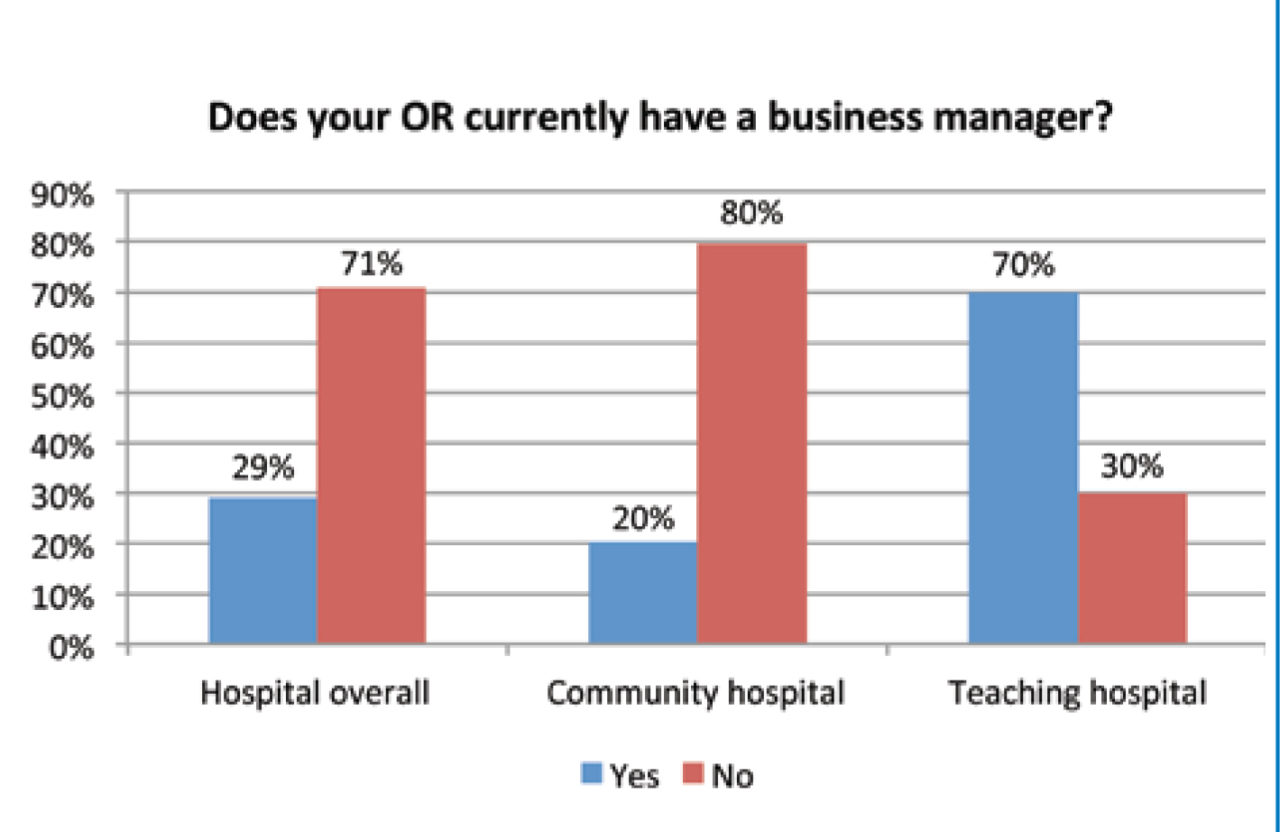
The role of business manager continues to grow in teaching, but not community, hospitals, according to the 2015 OR Manager Salary/Career Survey. Fewer than a third (29%) of OR leaders report that their hospital has a business manager, and 70% of those managers work in teaching hospitals.
Other highlights from the survey:
• salaries for business managers are stable
• more hospitals are requiring a master’s degree for those in the role
• business managers are significantly more involved in quality improvement (31% this year vs 7% in 2014).

Mary Lou Jones, BSN, CCI
Mary Lou Jones, BSN, CCI, perioperative business manager at Marciopa Integrated Health System in Phoenix, isn’t surprised by the increasing role that business managers play in ensuring quality. Jones, a member of the perioperative services quality improvement committee, says, “Our business team can impact several aspects of quality initiatives.”
For example, the team strives to provide patients with the highest quality products at the lowest possible costs. High quality helps reduce the risk of complications such as postoperative infection and device failure, and low cost not only directly helps the organization’s bottom line, but also improves patient satisfaction.
“Patients have to feel it’s worthwhile for them to have the procedure performed at our facility versus our that of our competitors,” Jones says.
OR Manager recently spoke with Jones and two other business managers about the survey results and the role of business managers.

Data for the OR Manager Salary/Career Survey were collected from March 23 to May 1, 2015. The survey list comprised OR directors, managers, or similar positions within hospital ORs. The survey was closed with 348 usable responses. To ensure representation of the target audience, results were filtered to include only the 343 respondents who work full time as a manager or director. The margin of error is±5 percentage points at the 95% confidence level. Survey results on staffing and salary data for OR directors and managers appeared in the September and October issues of OR Manager.
Despite its value, the business manager position has failed to penetrate deeply into the overall OR marketplace. In 2009, 37% of respondents reported having an OR business manager, compared to only 29% this year. However, use of business managers in teaching hospitals continues to grow, rising from 54% in 2009 to 65% in 2014, and 70% this year.
Nearly half (42%) of OR leaders say that business managers must have a bachelor’s degree, down slightly from 58% in 2014; however, the difference comes primarily from an increase in respondents who require a master’s in business administration (38% this year vs 21% in 2014).

Nestor Ventura, MHSA, MBA, CMRP, CHRF
Nestor Ventura, MHSA, MBA, CMRP, CHRF, surgical services business manager at Nicklaus Children’s Hospital in Miami, says the higher education requirement is part of an overall trend in healthcare.
“I see a move toward higher education in all aspects of healthcare, especially in Magnet hospitals, and the OR business manager role is no different,” says Ventura, who has been in his current role about 10 years. “Organizations want individuals who can perform on their own and consistently deliver results. I don’t necessarily think that a master’s degree is a prerequisite to that, but it does indicate a level of commitment and dedication that is necessary.”
Nicklaus Children’s Hospital has nine ORs, one hybrid OR, and four minor procedure rooms. Annually, the hospital completes about 11,000 cases in the main ORs and 4,000 in the procedure rooms.
Not all business managers agree that a master’s degree is essential. Jones recalls an early mentor who had an associate degree in nursing, yet was expert at business analysis and could build reports that senior leadership clamored for. “It wasn’t a piece of paper that made him credible,” she says. “It was just that he was so good at what he did on a day-to-day basis.”
The percentage of respondents who report hospitals require a clinical background for their business manager remains essentially unchanged at 29% (vs 28% in 2014).
Whether a clinical background should be required for business managers, Jones says, depends partially on the organization’s structure. “If you have only one business manager, I would favor one with a strong clinical background,” she says. A clinical background helps the individual visualize how new products will be used and what service lines need to be consulted before a change is made.
The average annual salary for business managers remained stable at $85,503, compared to $86,000 last year.

Megan Mitchell, BS
More than a third (34%) of business managers have five to nine direct reports, and 28% have three to four. Only 11% have no direct reports, and 14% have 10 or more. The range for those who have 10 or more direct reports was 11 to 25, with a mean of 16.17.
The primary increase in scope of responsibility was in quality improvement, but business managers also saw their responsibilities expand slightly in the areas of billing/reimbursement (56% vs 47% in 2014), OR scheduling (52% vs 30% in 2014), and purchasing OR supplies and equipment (69% vs 60% in 2014). It’s too soon to say if these increases mark the start of a trend.
Megan Mitchell, BS, who has been finance manager of perioperative services at Memorial Medical Center, an affiliate of Memorial Health System in Springfield, Illinois, for 3 years, has seen her scope of responsibility expand. Mitchell has become more involved in operations as she has taken on additional responsibilities such as preventive maintenance agreements, equipment purchasing, and project management.
 “[The role] is also more than just the traditional finance role of preparing a budget and reviewing capital purchasing requests,” she says. “I now make recommendations on the front end.” Memorial Medical Center has 21 main ORs, six ambulatory ORs, and six procedure rooms, with a total annual volume of 24,550.
“My area of responsibility has grown incrementally over the years,” Ventura says. “In addition to some of the typical responsibilities of the position—including OR materials management, charge capture management, and departmental data analysis and reporting—I now oversee the surgical scheduling function, and I have moved toward a much more strategic role in finding opportunities to make the OR more efficient as well as engaging physicians on their productivity and volume growth.”
With the implementation of a new electronic health record, Ventura also became more involved in documentation. “I look for ways to reduce screen time for nurses and improve documentation,” he says.
“One of the most challenging, but interesting aspects of the role is that you never know what you are walking into every day,” Mitchell says. “The OR is such a dynamic environment; it’s important to be flexible and fluid.”
Ventura notes that it can be difficult to standardize equipment and cost per procedure, adding, “The most common challenge is the balancing of physician preference items with cost reduction and standardization efforts.” Supply overutilization and misuse, as well as accuracy of documentation to obtain full reimbursement, are common issues most business managers face.
Jones says, “One of the consistent challenges is to educate the staff that the choices they make have a direct impact on the business side of the OR.” For instance, staff might open an item before confirming a certain approach with the surgeon, so the items might be wasted, or supplies may be overstocked, which increases costs.
“You need to be out there with staff to obtain their support,” she says. She also keeps a candy dish on her desk; when staff stop in, casual conversation often prompts staff to offer simple insights that can lead to cost savings. In one case, a staff member noted the flimsy drapes increased waste, so the drapes were changed to ones that cost slightly more but decreased waste, which thereby reduced costs.
 Success stories
Despite challenges, business managers can point to many successes:
• Performing more of the equipment service onsite rather than contracting with a third party saved Memorial Medical Center at least $35,000 this year.
• An OR optimization project at Nicklaus Children’s Hospital increased first case starts from about 60% to 85%, reduced turn overtime by 10%, and improved communication among all of the OR team members and sterile processing department staff.
• Negotiating a new orthopedic implant contract with a different company put Maricopa Integrated Health System on track to save more than 30% this fiscal year.
The effectiveness of the business manager depends on excellent collaboration with OR nurse leaders. Ventura says collaboration starts with focusing on the mission of the organization and continues with building trust. “Clinicians need to trust that the business manager is not just focused on an arbitrary bottom line and recognizes the value of improving care and maintaining a high level of safety in the OR,” he says.
Mitchell agrees trust is key, saying it’s important to maintain an open line of communication and speak candidly about issues while finding common ground. “We care about the patients as much as they care about the patients,” she says.
The business managers interviewed for this article see a bright future for the role. “As budgets continue to tighten, there will be an increase in the presence of this role in organizations,” Mitchell says. “The expenditure is well worth the outcomes.” She adds that OR leaders will continue to focus more on business planning and analysis rather that simply responding to surgeon requests.
Ventura sees the role evolving into a more strategic operational role with oversight of OR support processes. He notes that some organizations have a director of OR business operations whose direct reports include materials managers, business analysts, sterile processing managers, and other nonclinical support staff.
“The business manager role in the OR is a perfect fit to oversee these functions and allow the clinical experts to focus on quality patient care,” he says. ✥


