Type 1 natural rubber latex allergic reactions are avoidable in the OR. Typically, surgical gloves are the last products remaining in the OR that contain natural rubber latex (NRL). Higher-cost, clinically acceptable synthetic latex surgical gloves are readily available. However, OR leaders can encounter significant resistance from hospital administrators when suggesting a change in clinical practice that increases supply costs.
With the majority of US hospitals under financial pressure, the ostensible financial impact of converting from lower-cost NRL gloves to higher-cost synthetic gloves could squelch any attempt to suggest a conversion. Resistance to a surgical glove change may also come from surgeons and OR staff already comfortable with their current glove choice.

To understand the cost impact of converting from NRL surgical gloves in the OR to 100% synthetic surgical gloves, a study was conducted at Alta Bates Medical Center in Berkeley, California.
This article summarizes the full case study, which answered the question, “Can converting to synthetic surgical gloves lower hospital operating room costs?” We answered this question by quantifying and comparing the OR cost profiles at Alta Bates Medical Center before and after a synthetic surgical glove conversion in 2013. The cost comparison shows the financial impact at Alta Bates Medical Center and potentially serves as an empirical model for developing a business case to recommend a synthetic surgical glove conversion.
First, we developed a cost profile for Alta Bates Medical Center’s surgical services department before the synthetic surgical glove conversion. We then collected the actual costs before and after the conversion and analyzed the financial impact on the cost profile post conversion.
A cost profile was determined by selecting the financial and clinical parameters that a conversion to synthetic surgical gloves would impact directly. We considered an exhaustive list of financial and clinical drivers and ultimately selected those deemed to have a clear, direct impact on costs, and are easily trackable and quantifiable by hospital OR staff:
• number of operating rooms and annual surgical procedures
• annual surgical glove consumption, including percentage of latex and synthetic gloves
• number of latex allergic events for both staff and patients
• number of latex-related OR teardowns.
To quantify the cost profile, Alta Bates Medical Center performed a retrospective study to collect the required information. Several sources were accessed, including OR tracking records, surgical glove usage data, employee health records, patient discharge records, risk management, and surgical supply spending. The information was collected for 12 months before the synthetic surgical glove conversion in January 2013 and for 12 months post conversion.
A search for relevant published articles in healthcare and medical journals was also performed, and interviews with OR staff were conducted. The information gathered from these sources was then input into an analytical model developed to quantify the cost profile before a conversion to synthetic surgical gloves.
There are other risks and costs that would be significantly reduced or eliminated by a conversion to synthetic surgical gloves: legal expenses related to latex allergic reactions, purchasing fewer stock keeping units (SKUs) and carrying less inventory, workers’ compensation claims related to Type 1 NRL allergic episodes, and the institutional costs incurred to retrain and reassign staff affected by a NRL allergy and to hire new staff. These benefits are more difficult to quantify and have therefore been excluded.

Alta Bates utilized nine operating rooms and reported an annualized number of 9,764 surgical cases in the pre-conversion period, consuming 139,866 pairs of surgical gloves. To generate a fair cost-benefit analysis, the number of surgical cases and surgical gloves consumed was kept constant for the pre- and post-conversion periods, whereas the number of Type 1 NRL allergy episodes and latex-related OR teardowns reflect reported events.
Table 1 provides key annual data for Alta Bates Medical Center’s surgical services department before conversion (p 22). Based on this information, the annual costs would equate to $291,334, as shown in Table 2 (p 23). Surgical glove costs ($180,019) were determined by multiplying the annual consumption by the price per pair. Surgical glove prices were provided by purchasing staff and reflect the average cost for all styles of natural rubber latex and synthetic surgical gloves.
Despite synthetic gloves representing 70% of the total prior to conversion, the hospital still reported five Type 1 NRL allergy events and 24 OR teardowns in the 12-month pre-conversion period.
Latex allergy events were assigned the value of $15,111 based on the NRL screening project conducted by a multidisciplinary team at the University of Maryland Medical School and published in the Annals of Allergy, Asthma and Immunology in 2002. Given the number of latex allergy events, the hospital incurred costs of $15,111 and $60,444 for staff and patients, respectively.
Anaphylactic treatment costs vary from $5,000 to $25,000. Severe anaphylactic events would require hospital admittance, treatment, and monitoring in the emergency department or ICU, and would cost significantly more than $15,111. To maintain a consistent conservative cost approach, $15,111 per anaphylactic episode was assigned for both staff and patients.
The 24 OR teardowns cost the hospital $35,760. Each OR teardown event is profiled to cost $1,490 to:
• tear down and disinfect the room ($26/minute x 45 minutes or $1,170)
• dispose of surgical consumables ($300)
• resterilize or reprocess surgical instruments and reusable items ($20).
Write-off of contaminated implantable devices was not included and could be significant. These are considered conservative OR teardown cost estimates. Costs may vary across the country.
Three items were identified with a direct cost impact but were determined too cumbersome to quantify. First, no provision for legal costs was assumed. However, the risk of legal action would be high, especially if a severe anaphylactic event occurred. The average cost to defend a legal case, according to the American Medical Association, is $94,000, and the median jury award is $439,000.
After converting to synthetic gloves, the legal risks would decline significantly. Second, the costs to manage fewer SKUs and carry less inventory associated with stocking fewer glove styles should provide additional savings. Finally, workers’ compensation claims related to Type 1 latex allergy will lower hospital costs by eliminating Type 1 allergies related to NRL surgical gloves and personnel costs associated with hiring, retraining, or reassigning latex-sensitive employees.
Table 3 shows the situation post conversion, based on the same number of surgical cases, and hence the same number of gloves (p 23). The actual cost profile post conversion to synthetic surgical gloves was developed and compared to costs before conversion.
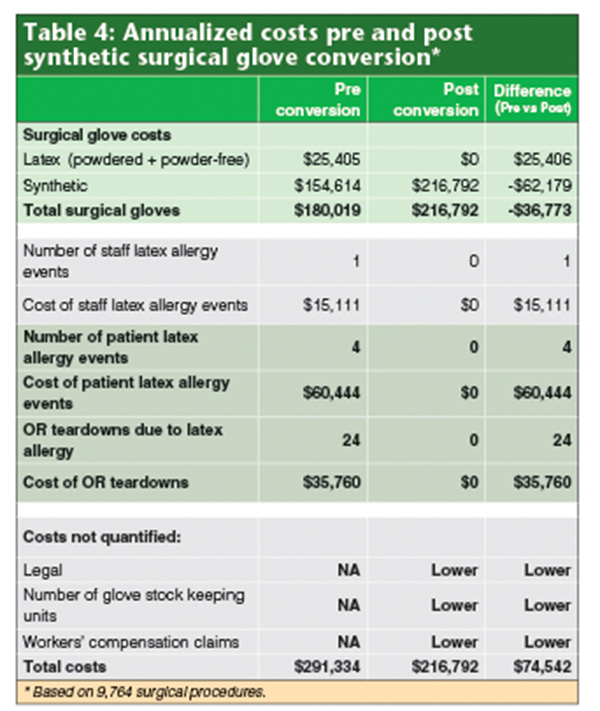
As seen in Table 4, the pre-conversion cost of $291,334 drops to $216,792 post conversion to synthetic surgical gloves. Although surgical glove costs increased by $36,773, overall costs decreased $74,542. The elimination of costs associated with latex allergies and OR teardowns contributed significant savings exceeding the increase in surgical glove costs.
Anecdotally, Alta Bates OR staff members were impressed by the synthetic surgical glove quality, equating the fit, feel, and comfort with NRL surgical gloves. All of the synthetic surgical gloves procured by Alta Bates were manufactured using Kraton’s Cariflex® Polyisoprene Latex raw material. The high level of synthetic surgical glove performance experienced by OR staff members buttressed their commitment to improve safety for patients and staff.
Alta Bates Medical Center’s decision to convert their surgical gloves 100% to synthetic has significantly reduced overall costs, eliminated Type 1 NRL allergy events for both patients and staff, stopped NRL-related OR teardowns, and improved patient and staff safety.
Converting an OR department to synthetic surgical gloves reduces overall operating costs. This case study has proven Alta Bates Medical Center significantly reduced overall OR operating costs by $74,542 (25%) after converting fully to synthetic surgical gloves. ✥


Kurt R. Wharton, MD, is an OB-GYN physician in Lafayette, California. Jerry Thomas is administrative director, perioperative services, at Alta Bates Medical Center, Berkeley, California. Philippe Henderson is global market development director, Kraton Polymers, Mont St. Guibert, Belgium. Lundy Fields is CEO, Fields Consulting, LLC, Vero Beach, Florida.
Bollinger M E, Mudd K, Keible L A. A hospital-based screening program for natural rubber latex allergy. Ann Allergy Asthma Immunol. 2002;6:560-567.
Dimitrios K, Georgopoulos M, Georgopoulos K. Reducing the cost of laparoscopy: Reusable versus disposable laparoscopic instruments. Min Invas Surg. Published online July 22, 2014. http://www.hindawi.com/journals/mis/2014/408171/.
Elder J. Latex gloves: Time for a change. J Urol. 2006;175:1193-1194.
Gibilisco P. Clinical perils: Latex allergy. White paper. http://www.icumed.com/media/84928/M1-1252%20Clinical%20Perils%20of%20Latex%20Rev.03PQ.pdf.
Herman B. 11 Ways hospitals and health systems can increase profitability. Beckers Hospital Review. Published online November 26, 2012. http://www.beckershospitalreview.com/finance/11-ways-hospitals-and-health-systems-can-increase-profitability-in-2013.html.
http://www.lek.com/sites/default/files/2013_L.E.K._Hospital_Priorities_Study.pdf.
http://www.mayoclinic.org/ diseases-conditions/anaphylaxis/basics/definition/con-20014324?p=1.
Lopez J. Beware: Malpractice, legal risks on the rise for hospitals. Healthcare Business & Technology. Published online April 17, 2014. http://www.healthcarebusinesstech.com/malpractice-legal-risks-hospitals/.
Mustafa S S. Anaphylaxis. Medscape. 2014. http://emedicine.medscape.com/article/135065-treatment.
Rodak S. 6 Ways hospitals can survive the onslaught of Medicare cuts. Beckers Hospital Review. Published online September 1, 2011. http://www.beckershospitalreview.com/finance/6-ways-hospitals-can-survive-the-onslaught-of-medicare-cuts.html.
Smock D. Hospitals are using more disposable devices to cut costs. Plastics Today. Published online March 2, 2012. http://www.plasticstoday.com/hospitals-are-using-more-disposable-devices-cut-costs/24240385517143.


