What makes an OR subject to an immediate jeopardy finding from a Medicare inspection?
Immediate jeopardy is cited when a provider’s noncompliance with one or more of the Centers for Medicare & Medicaid’s (CMS) Conditions of Participation causes or is likely to cause serious injury, harm, impairment, or death.
OR managers who are following standards of practice for infection prevention and patient safety may think immediate jeopardy can’t happen to them. However, surveys also can be generated by patient or staff complaints, and a survey in one part of the hospital can lead to one in the OR.

Catherine Pusey, MBA, RN
If immediate jeopardy is found, the hospital is placed on a timeline for termination from Medicare unless an acceptable corrective action plan is submitted, and a repeat survey validates that the deficiencies have been corrected.
“Some may think it won’t matter if they lose their Medicare funding because they have other payers, but Medicare accounts for 40% to 80% of a hospital’s revenue,” says Catherine Pusey, MBA, RN, associate director, ECRI PSO, ECRI Institute, Plymouth Meeting, Pennsylvania.
“In addition,” she says, “if your hospital loses its Medicare funding, it could jeopardize your state license, it could affect your accreditation from other agencies, and it could seriously damage your reputation.”
The most common reasons for an immediate jeopardy finding include the failure to:
• protect from abuse
• prevent neglect
• protect from psychological harm
• protect from undue adverse medication consequences and/or failure to provide medications as ordered
• follow nationally accepted standards of practice for infection prevention
• correctly identify patients
• safely administer blood or blood products
• provide safety from fire, smoke, and environmental hazards
• comply with Emergency Medical Treatment and Labor Act (EMTALA) requirements.
OR managers may look at the first two or three reasons for immediate jeopardy—abuse, neglect, and psychological harm—and think they don’t affect or happen in their ORs, says Pusey. However, she says, if they look a little farther down the list, adverse medication consequences or failure to provide medication as ordered certainly could apply to anesthesia and nursing personnel in the OR.
Infection prevention and failing to correctly identify patients apply not only to the OR but also to the pre- and postoperative care areas and sterile processing, which could all be starting points for an immediate jeopardy finding that affects the OR.
Another example is when an EMTALA violation occurs. It may not specifically apply to the OR, but a violation in another department may bring the surveyors in, and once they are there, they can go anywhere in the hospital.
“So even if the problem arose in a different area in the hospital, it can still lead the surveyors to look at processes in the OR,” says Pusey. “They can start reviewing documents and processes and putting pieces together, and suddenly you have a finding of immediate jeopardy,” she says.
CMS also can conduct a survey based on patient, family, or staff complaints. For example, a surgical patient may complain about care on a med-surg unit. The surveyors come in and look at that clinical area, but they may find something that prompts them to also look at the OR, says Pusey.
Like a stool with three legs, there are three components of immediate jeopardy—harm, immediacy, and culpability—and all three have to be in place for the immediate jeopardy to stand (sidebar, below).
• Actual: Was there actually an outcome of harm? For example, was there actually a retained surgical item?
• Potential: Is there likelihood of potential harm? Is it likely to occur in the very near future? For example, the process is so broken that at one time it really is going to break down. Does that harm meet the definition of immediate jeopardy?
• How imminent is the danger? For example, is this something that could happen tomorrow?
• What is the likelihood of it happening again?
• Does the situation need to be immediately addressed?
• Did the entity know about the situation?
• Should they have known?
• If so, when did they first become aware? This includes, but is not limited to, neglect, indifference, or disregard for patient care, comfort, or safety—otherwise known as avoidability.
“In other words,” says Pusey, “who in your organization knows that something is happening that could potentially cause serious harm for the patient? Did you know the process was broken? Did leadership know and say, ‘don’t worry about it, nobody else is going to know what’s happening?’”
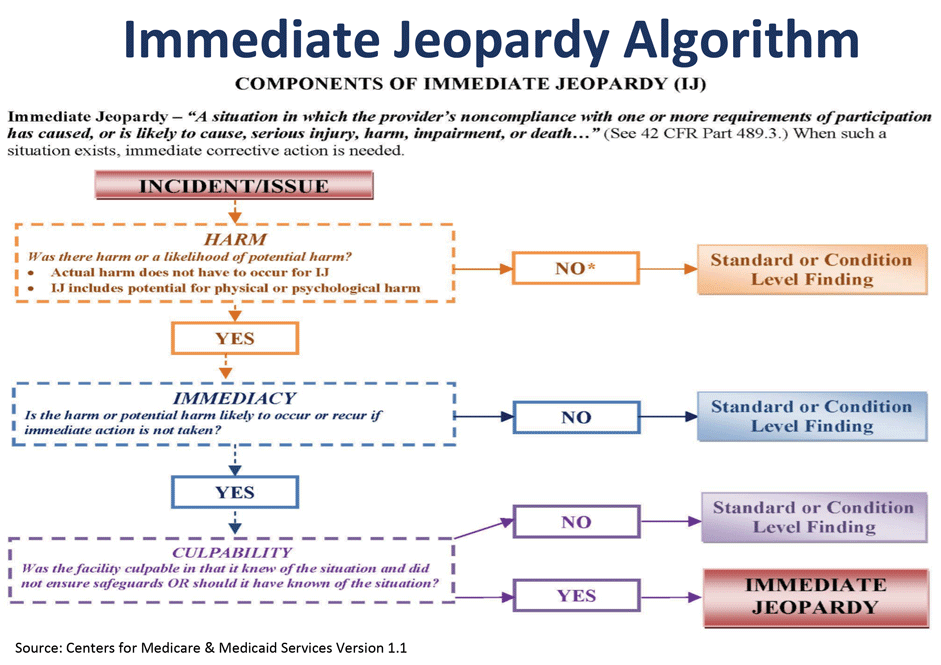
Though harm, immediacy, and culpability all have to be in place for immediate jeopardy, the surveyors may find something that isn’t going to result in true, serious harm to a patient, but they want it changed so they issue a standard- or condition-level finding that is not raised to the level of an immediate jeopardy, says Pusey.
Standard-level deficiencies involve noncompliance with a single requirement or several requirements within a particular standard in any of CMS’s 23 Conditions of Participation.
The noncompliance doesn’t substantially limit a facility’s capacity to furnish adequate care, or doesn’t jeopardize the health or safety of patients if the deficient practice recurred. Surveyors don’t view the patients as being in serious harm.
A condition-level deficiency results from noncompliance with requirements in a single standard or several standards within the condition. This represents a severe or critical health or safety breach that may rise to the level of immediate jeopardy.
The top five Conditions of Participation that have led to immediate jeopardy findings are:
• patient’s rights
• nursing services
• surgical services
• quality assurance/performance improvement (QAPI) program
• infection control.

Gail H. Horvath, MSN, RN, CNOR, CRCST
“As an OR manager, you might say, ‘I can see surgical services and infection control, but do nursing services, patient rights, and QAPI programs really apply to the OR?’ The answer is yes, and in many ways,” says Gail H. Horvath, MSN, RN, CNOR, CRCST, senior patient safety analyst and consultant IV, ECRI Institute, Plymouth Meeting, Pennsylvania.
There are multiple Conditions of Participation that apply throughout the whole continuum of care in perioperative services, she says.
For example, in sterile processing, infection control applies—as does patient rights. Patients have a right to safe care, and safe care involves clean, properly sterilized instruments.
In the preoperative holding area, patient rights apply in how an informed consent is obtained and how patient privacy is maintained.
Patient rights also apply in the postoperative area. Are patients being given discharge instructions they can understand? Are nurses ensuring patients get home safely if they are same-day surgery patients?
In the OR, surveyors assess infection prevention by counting how many minutes the surgeons and nurses scrub their hands, says Horvath. However, she asks, “Are they counting how many times a team member walks out of the OR and doesn’t wash their hands? Are they noting how many team members walk out of the OR with surgical masks hanging around their necks?”
Having worked with organizations that entered into system improvement agreements and looking at past surveys, Pusey says there are common themes and early warning signs in organizations that keep getting immediate jeopardy findings.
These include:
• multiple complaint surveys with repeated findings
• inability to implement, measure, and monitor corrective action plans
• minimal oversight by the governing board of quality of care and performance improvement
• minimal oversight by the governing board of service provider performance
• insufficient credentialing and privileging of medical staff
• unstable workforce—nursing leadership vacancies and high use of traveler and agency nurses
• preoccupied leadership (eg, by a building expansion or labor negotiation)
• compliance with the Conditions of Participation is a low management priority
• lack of frontline management knowledge of the Conditions of Participation
• decline in key leadership relationships (eg, board, medical staff, nursing, and community)
• no meaningful Code of Conduct or mechanism to report ethics violations
• lack of transparency and visibility of leadership.
In the end, OR managers must keep in mind that “sailing” through a Joint Commission accreditation survey does not necessarily translate to a problem-free CMS survey, says Pusey.
“When CMS surveyors are called to your facility, they are not going to care that the Joint Commission gave you deemed status a year ago or a few months ago. They are going to look at what’s happening now,” she says.
CMS surveyors will analyze the hospital against each Condition of Participation without regard to deemed status.
Typically, two to four state surveyors will arrive and remain on site for a period ranging from 1 day to a week. On rare occasions, survey teams have consisted of 15 surveyors and have lasted several months.
CMS surveys are unannounced. “They don’t give you a call and say, ‘we are going to come visit you next Tuesday.’ All of a sudden they are just there,” says Pusey. “Be ready.” ✥
Pusey C, Horvath G H. Conditions of Participation: Is your surgical services department at risk for immediate jeopardy? OR Manager Conference, 2016.


