Despite warnings of calamities, implementation of the International Classification of Diseases (ICD)-10 on October 1, 2015, proceeded smoothly, with minimal impact on denied claims. In the fourth quarter of 2015, the percentage of Medicare claims denied was 10%, comparable to the preimplementation figure of 9.9%. But that doesn’t mean OR leaders should forget about coding; doing so translates into lost opportunities for enhancing revenue and tapping into a rich source of data. The number of codes is now more than 141,000, and several thousand more will be added in October 2016.

Toni Wing, BSN, RN, CNOR
“This isn’t something OR leaders can ignore,” says Toni Wing, BSN, RN, CNOR, a perioperative nursing consultant with CORATEK Perioperative Consulting, LLC, in Johnson City, Tennessee. “Inaccurate coding can affect your revenues in the OR.”
For example, if the approach for a surgical procedure is not recorded properly, the wrong ICD-10 code may be assigned to the patient, leading to a MS-DRG (Medicare severity-diagnosis related group) classification with a reimbursement lower than what should have been received.
“I think OR leaders are missing the huge advantage of the data,” Wing says. “They can use that data to assess patterns of patient outcomes.”
OR leaders can take several steps to facilitate accurate coding, but first they must understand the complexity of ICD-10.
More than 100 countries around the world use ICD-10, developed by the World Health Organization (WHO). The first ICD, then known as the International List of Causes of Deaths, dates back to 1893; the WHO became responsible for ICD in 1948.
Most countries, including the US, use ICD to report mortality data, which indicates a country’s health status. ICD data are also used for reimbursement.
“About 70% of the world’s health expenditure is recorded using ICD,” says Marion McCall, BBA, RN, CNOR, CPHIM, founder and president of NurseWorks, LLC, in Hilton Head Island, South Carolina. “It has been translated into 43 languages.”
The US divides ICD-10 into two components:
• ICD-10-CM (Clinical Modification), which is used for diagnosis and is the responsibility of the National Center for Health Statistics (NCHS)
• ICD-10-PCS (Procedure Coding System), which is used only by hospitals to report procedures performed on inpatients and is the responsibility of the Centers for Medicare & Medicaid Services (CMS). (See sidebar, p 19.)
The ICD-10-CM code set can be downloaded from the NCHS (http://www.cdc.gov/nchs/icd/icd10cm.htm) or CMS (https://www.cms.gov/Medicare/Coding/ICD10/index.html) websites, and the ICD-10-PCS code set can be downloaded from the CMS website.
ICD-10 was designed to gather more specific details for purposes of reimbursement and for research. “The scope and complexity of ICD-10 compared to ICD-9 is immense,” McCall says.

Judy Bielby, MBA, RHIA, CPHQ, CCS, FAHIMA
Judy Bielby, MBA, RHIA, CPHQ, CCS, FAHIMA, a clinical assistant professor in the Health Information Management Program at the University of Kansas in Lawrence and an ICD-10 trainer, uses a simple analogy: “I would compare this to the difference between looking up a word in an abridged dictionary [ICD-9] and looking up a word in an unabridged dictionary [ICD-10].” Although the coding process is the same for both, ICD-10 has much greater specificity.
Building partnerships is key for ongoing ICD-10 success, beginning with scheduling (see sidebar, p 20). McCall suggests that OR leaders work with their schedulers to ensure they collect as much information as is needed for the ICD-10 code when the procedure is scheduled.
This information will also facilitate precertification. For example, the scheduler can enter the procedure name, such as appendectomy, but also include the surgical root operation, in this case, resection.
Other examples of root operations include bypass (eg, tracheostomy), inspection (eg, diagnostic arthroscopy), and excision (eg, laminectomy). Of course, it’s important for schedulers to understand how these are defined in ICD-10.
Coders can be hampered by a lack of clinical background. “It takes a multidisciplinary team and a steering committee to manage coding,” McCall says. “OR leaders need to work with the team to ensure accuracy.”

Marion
McCall,
BBA, RN, CNOR, CPHIM
Documentation in the OR can be particularly helpful for coders. “The accuracy of codes that are reported is completely dependent on the documentation in the patient’s record,” Bielby says. “It needs to be timely and accurate.”
OR leaders can facilitate documentation of the surgical approach, which surgeons may not report sufficiently. “If you are using an electronic health record, you can add a checkbox for the approach as part of the operative note,” Wing says.
In the nurses’ portion of documentation, more detail can be added to the device and implant section of the record. Another strategy is to develop a crosswalk tool for high-volume procedures that coders can use.
“When coders don’t have enough information in the operative note, they have to query the physician, but that takes time, and during that time the patient’s account can’t go to billing,” Wing says.
She suggests creating a resource team of OR staff whom coders can call with questions—if that team can answer some of the questions, coders can then make a more specific request to the physician and reduce delays.
Bielby recommends OR leaders have OR staff present education programs with coders to cover topics such as the definitions for different types of approaches. OR and coding staff can benefit from one another’s knowledge. For example, coders can get a better mental image of procedures, and OR staff can better understand the need to adhere to the coding definitions as opposed to terminology used in clinical practice.
“ICD-10 language doesn’t use terms such as ‘aneurysm’ or ‘hernia,’ and there are no acronyms like CABG [coronary artery bypass graft] or proper names like Nissen fundoplication,” says Toni Wing, BSN, RN, CNOR, a perioperative nursing consultant with CORATEK Perioperative Consulting, LLC, in Johnson City, Tennessee.
An ICD-10-PCS consists of seven characters (see images below). “It’s multi-axial,” says Judy Bielby, MBA, RHIA, CPHQ, CCS, FAHIMA, clinical assistant professor in the Health Information Management Program at the University of Kansas in Lawrence and an ICD-10 trainer. “Each character contains unique values that provide specific information.” Root operations such as resection replace procedure terms such as appendectomy, so an appendectomy becomes “a resection of the appendix, open approach.”
Combination procedures must be coded independently. For example, in ICD-9, a laparoscopic removal of bilateral ovaries and tubes was one code. In ICD-10, the coder must code as “resection of the bilateral ovaries, percutaneous endoscopic approach” and as “resection of bilateral fallopian tubes, percutaneous endoscopic approach.”

 1. Section: A broad procedure category
2. Body system: The general physiological system
3. Root operation: The intent or objective of the procedure
4. Body part: The specific anatomical site, including laterality
5. Approach: The technique used, such as open or percutaneous
6. Device: Device left in place at the end of the procedure, such as autologous, synthetic, or intraluminal
7. Qualifier: Additional attribute of the procedure, if applicable
Source: Marion McCall, BBA, RN, CNOR, CPHIM, and Toni Wing, BSN, RN, CNOR. All images used with permission.
It’s essential to monitor issues with claims. That’s where metrics can help. Bielby suggests hospitals monitor the following key performance indicators: case mix index, coder productivity, discharged not final billed, coding quality, days to payment, reimbursement rate, rejection rate, denials, and query rate.
CMS says comparing metrics with past calendar years by month is more accurate, and recommends considering other factors, such as staff vacations, that may influence metrics.
Wing says ICD-10 provides some advantages for OR leaders. “The granularity we can obtain with ICD-10 makes it a phenomenal tool,” she notes. “OR leaders need to start looking at the data collected in the business intelligence system and tie it into patient outcomes.”
For instance, leaders could assess how different surgical approaches affect the number of patient complications. “If five surgeons do the same procedure, but one of them uses a different approach and obtains better results, we would want to look at that,” she says.
Bielby says several organizations have implemented computer-assisted coding, which scans selected documents of a patient’s health record to identify potential diagnoses and procedures, along with the likely codes.
“A coding professional is still needed to verify the information, especially since only the electronic portion of the record is reviewed,” she points out.
In October, ICD-10 will expand to include 3,600 more codes. Setting up processes and procedures will help minimize delays and interruptions in reimbursement as more codes are rolled out.
The WHO has slated 2018 for the ICD-11 rollout. Clinicians and other stakeholders can participate through the ICD-11 online platform. For more information, see http://who.int/classifications/icd/revision/icd11faq/en/. ✥
OR leaders can take action in each area below, including identifying and removing roadblocks, to ensure accurate reimbursement.
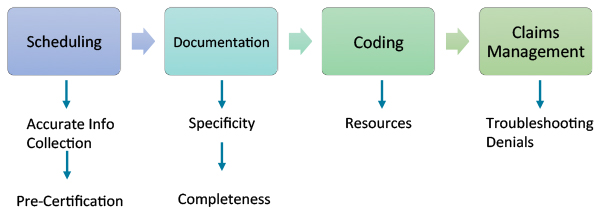
The best source for information regarding ICD-10 is https://www.cms.gov/Medicare/Coding/ICD10/index.html. Here OR leaders can access a toolkit, an infographic, and a key performance indicators fact sheet, which suggests what organizations should consider monitoring. Leaders can also sign up for ICD-10 updates at https://www.cms.gov/Medicare/Coding/ICD10/CMS_ICD-10_Industry_Email_Updates.html.
Cynthia Saver, MS, RN, is president of CLS Development, Inc, Columbia, Maryland, which provides editorial services to healthcare publications.
Bielby J A. Continuing on the intriguing ICD-10 journey. J AHIMA. 2016;87(5):50-52. http://bok.ahima.org/doc?oid=301434#.VzD4jWbD-wk.
Centers for Medicare & Medicaid Services. ICD-10 moves forward. October 10, 2015. https://www.cms.gov/Newsroom/MediaReleaseDatabase/Fact-sheets/2015-Fact-sheets-items/2015-10-29.html.
McCall M S, Wing T L. ICD-10: Meeting the perioperative challenges. AORN Surgical Congress & Expo, 2016.
Slavitt A. Lessons learned: Reflections on CMS and the successful implementation of ICD-10. The CMS Blog. Published online February 24, 2016. https://blog.cms.gov/2016/02/24/lessons-learned-reflections-on-cms-and-the-successful-implementation-of-icd-10/.
World Health Organization. International classification of diseases (ICD). http://who.int/classifications/icd/en/.


