In the past, most hospitals automatically sought accreditation from the Joint Commission, but recent years have brought new players to the field, prompting hospital administrators to rethink that strategy. One relatively new player is DNV GL-Healthcare (DNV GL). Since achieving deeming authority from the Centers for Medicare & Medicaid Services (CMS) in 2008, DNV GL has made inroads into Joint Commission territory, with some hospital leaders, including OR managers, viewing the company as more user-friendly and less punitive than the Commission.

Vivian
Ho-Nguyen
“DNV GL takes a fresh look at accreditation,” says Vivian Ho-Nguyen, director of accreditation & regulatory affairs at Harris Health System in Houston, Texas. The system, which includes three hospitals and 16 clinics, has been DNV GL accredited since July 2013.
“It’s a partnership, and it wasn’t like that with the Joint Commission,” Ho-Nguyen says. “DNV GL is a model that has transformed the mundane work of accreditation into something fresh and new, so we can deliver more efficient and better quality care to our patients.”
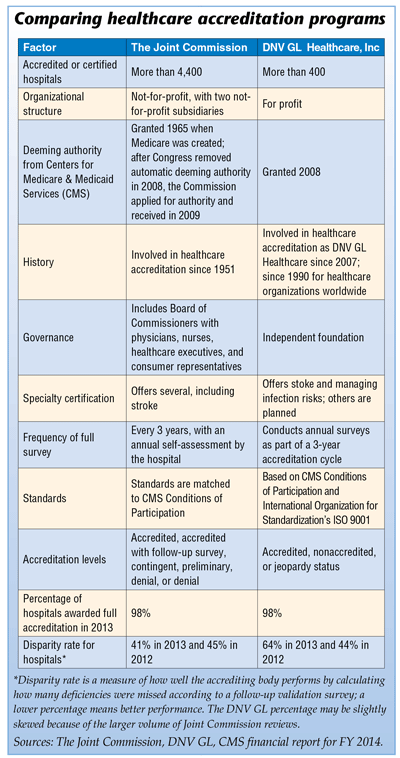
Leaders have to do their homework to determine which accreditation best fits their organization, and that includes understanding how DNV GL and the Joint Commission compare (sidebar below). Given that most OR managers are familiar with Joint Commission surveys, this article focuses on DNV GL as an alternative.
DNV GL-Healthcare’s parent company, the DNV GL Group, primarily an independent foundation, traces its origins back to Norway in 1864, when it began evaluating the seaworthiness of ships. DNV GL started US operations in 1898 and is now working in many industry sectors. In 2007, DNV GL acquired TUV Healthcare Specialists and started pursuing deeming authority from CMS.

Patrick Horine, MHA
Patrick Horine, MHA, president and chief executive officer at DNV GL-Healthcare (referred to as DNV GL in this article) has worked in accreditation for a number of years, including consulting with hospitals to help them prepare for Joint Commission accreditation. His experience led him and a partner to start an accreditation program that offered an alternative to the Joint Commission. “We saw that hospitals weren’t sustaining what they put in place,” Horine says. “We wanted to look at how we could make change more sustainable.” Ultimately, DNV GL acquired TUV Healthcare Specialists, the company that had been funding the program.

John Rosing, MHA, FACHE
Horine says one of the hallmarks of DNV GL is its approach to what he calls “changing the culture of accreditation.” The organization looks to partner with hospitals, which makes people feel less fearful of surveyors. “We are engaging and collaborative,” Horine says. “We drill down to the heart of the issue and really listen to hospitals to engage the staff.”
To become accredited through DNV GL, hospitals must:
• meet CMS Conditions of Participation (CoP), which DNV GL has built into its National Integrated Accreditation for Healthcare Organizations credential
• adhere to International Organization for Standardization (ISO) 9001.
ISO is an independent, nongovernmental membership organization that develops voluntary international standards for quality, safety, and efficiency. DNV GL uses ISO 9001, which sets out the requirements of a quality management system. This standard is under review, with the updated version expected by the end of 2015. Achieving formal certification in ISO 9001 is an option for hospitals, but is not required.
John Rosing, MHA, FACHE, vice president and principal of Patton Healthcare Consulting in Phoenix, says, “DNV GL stays more true to the requirements of CoP in part because they didn’t come at it from the perspective of already having standards, as the Joint Commission did. It’s only in the past 5 to 7 years that CMS became more assertive in requiring accrediting bodies to address each and every CoP.” (Joint Commission standards are now also compliant with CoP.) Rosing adds that CMS considers all organizations with deeming authority as essentially equal (sidebar, p 15).
Horine says ISO 9001 is a good fit for healthcare because of the complexity of its processes. “When you are talking about the OR, you are talking about very process-driven aspects that have to happen, whether it’s preoperative, intraoperative, or postoperative,” he notes. “ISO 9001 helps hospitals build consistency by helping them focus on process.”
Ho-Nguyen adds, “The standards are less prescriptive than the Joint Commission’s. Less prescriptive is better because we can do things in a way that works for our organization to achieve goals.”

Donna Willeumier, MT(ASCP), MHPE, CPHQ
Donna Willeumier, MT(ASCP), MHPE, CPHQ, administrator of quality management and regulatory compliance for Advocate Health Care in Chicago, says DNV GL is unique in that it integrates the CoPs and ISO 9001. DNV GL has accredited 10 Advocate hospitals since March 2012.
“ISO 9001 is not only an international quality standard, it’s an approach that is very process driven,” she says. “You are continually assessing your processes and improving them to meet customer needs.” This approach fosters consistency and well-designed processes, which Willeumier says are characteristics of high-reliability organizations.
“DNV GL doesn’t interfere with your day-to-day operations,” says Gabrielle White, RN, CASC, executive director for ambulatory services & network development at Hoag Orthopedic Institute in Irvine, California. “It’s up to the experts in the hospital to decide on how to accomplish the goals. The Joint Commission seems more ‘one size fits all’ in its approach, but every hospital is different. DNV GL allows hospitals to achieve quality in their own way.”
White, who helped open the Hoag Orthopedic Institute and was instrumental in bringing DNV GL to the attention of administrators, adds, “We wanted to be with an accreditor who was more collaborative.” The institute was accredited by DNV GL in November 2010, and Hoag Memorial Hospital Presbyterian was accredited in January 2013. Both are also ISO certified.

Natalie Gosselin,
MS, RN, CPHQ, CSSGB
Natalie Gosselin, MS, RN, CPHQ, CSSGB, director of quality and performance improvement at St Joseph Hospital in Nashua, New Hampshire, agrees with White that DNV GL’s approach differs from that of the Joint Commission. “DNV GL tells you what to do but not how to do it,” she says. St Joseph recently underwent its first DNV GL survey, which Gosselin says she found to be highly collaborative. She also notes that the application process was “much more streamlined” compared with that for the Commission.
Surveys are conducted annually, something hospitals embrace. “I like that they come on site every year,” Ho-Nguyen says. “It keeps you on your toes.” Different areas of the hospital are reviewed each year, so that by the end of 3 years, the entire hospital has been assessed.
By contrast, the Joint Commission conducts onsite surveys every 3 years, and through its Intracycle Monitoring Process has the following options for the years in between the triennial survey:
• A hospital can attest it has performed the required annual self-assessment (Focused Standards Assessment), but chooses not to share the data with the Joint Commission.
• A hospital can email the self-assessment to the Joint Commission and can select a conference call with the Standards Interpretation Group to discuss areas of concern or suggestions the organization might have on how to improve. There is no fee for the conference call.
• A hospital can perform the self-assessment and choose to have one or more onsite surveys (at 12 months or at 24 months). This survey is customized to focus on areas that the hospital wants to improve or for which it seeks feedback. There is a fee for this targeted survey. The customer may decide whether to receive the onsite survey feedback verbally (if there is concern about discoverability) or in written format.
Many DNV GL-accredited hospitals point to its approach to surveys as a significant advantage. “It’s a process-driven, educational approach based on continual improvement rather than simply reaching a threshold of compliance,” Willeumier says.
DNV GL sends a survey team composed of three disciplines:
• clinical—a nurse or physician who visits patient care areas
• generalist—someone with a quality management background. This surveyor’s responsibilities include review of quality management, medication management, medical staff, human resources, and support services.
• physical environment—a specialist who evaluates the environment, including adherence to the Life Safety Code.
More than one person in each discipline may be sent, depending on the size and complexity of the hospital. This team compares to the Joint Commission’s core surveyor team of a physician, nurse, and facilities engineer.
“We tell hospitals not to prepare for the survey,” Horine says. “We want to see how the hospital operates on a daily basis.” Hospitals accredited by DNV GL attest to the difference. “When the Joint Commission would come, there was a lot of ramping up time, and then when they walked out the door, everyone would relax,” says Chris Crawford, MHA, RN, CPHQ, vice president of quality at Lee Memorial in Fort Meyers, Florida, which includes four acute care hospitals and 18 off-site locations such as surgery centers. “Now it’s easier to sustain improvements because there is no relaxing; you’re maintaining perpetual compliance and continual improvement.” Lee Memorial became accredited by DNV GL in May 2010 and received ISO certification in December 2013.
Crawford says both DNV GL and Joint Commission reviews are rigorous, but has found that DNV GL provides more valuable recommendations. Hospitals receive reports in 10 days and must submit a corrective action plan, similar to Joint Commission requirements. “One of the main differences is that we have a relationship with people at DNV GL that we never had with The Joint Commission,” Crawford says.
Unlike the Joint Commission, DNV GL offers only one category for accreditation. Hospitals that don’t pass are given the opportunity to take corrective action so that they can receive accreditation. Depending on the extent of improvements, an additional survey visit may be needed before accreditation is granted.
The Joint Commission says the view that its surveyors aren’t collaborative or interested in helping hospitals improve is a misconception because the Commission has evolved over the years.

Ann Scott Blouin,
PhD, RN, FACHE
“Our board has changed the mission statement to move from people thinking of the Joint Commission as primarily an accrediting body to an organization that wants to partner with hospitals and inspire them to do better,” says Ann Scott Blouin, PhD, RN, FACHE, executive vice president for customer relations at the Joint Commission.
Surveyors learn how to hold crucial conversations, and they have become more collaborative, working to inspire people. Their wider network of hospitals comes in handy, too. “We will offer suggestions for other ways to do things based on our experiences with other hospitals,” Blouin says.
“The Joint Commission has a broader perspective on patient safety and quality than DNV GL,” says Blouin. That includes National Patient Safety Goals and standards related to labeling specimens and prevention of wrong-site surgery. “These are things that are important to OR managers,” she says, adding that Joint Commission standards are “more clinically rich” than those used by DNV GL.
“ISO 9001 standards are used in a manufacturing environment, so they don’t do well in a clinical environment,” Blouin says. “Joint Commission standards are much more relevant.”
Rosing says one of the Commission’s selling points as to why it should be the accrediting body for hospitals is its value-added offerings such as the Leading Practice Library, Targeted Solution Tool, Core Measures Solution Exchange (a database of core measure improvement success stories from hospitals), and BoosterPaks. “If you aren’t with the Joint Commission, you don’t get free access to the tools,” he says.
The Commission also offers more options for certification in disease management, such as stroke-ready care and advanced perinatal care. DNV GL is playing catch-up by rolling out certification options such as primary stroke center, soon to be followed by certifications in hip and knee surgery and heart failure.
Another advantage of the Commission is that because its history is longer than that of DNV GL, researchers have been able to study the effects of its accreditation.
For example, The Lewin Group found that compared to non-Joint Commission-accredited hospitals, Joint Commission-accredited hospitals had significantly higher operating margins, occupancy, and net income. Another study found the patients evaluated at Joint Commission-certified primary stroke centers were more likely to receive recombinant tissue plasminogen activator as treatment for ischemic stroke, leading to reduced morbidity and mortality.
Some have questioned the independence of its not-for-profit, consulting arm Joint Commission Resources (JCR). However, Blouin says, “We have a series of strict firewalls and confidentiality requirements and a separate officer who administers this. This has been examined in a federal audit, and we passed as 100% compliant.” The Joint Commission and JCR are housed in separate buildings and have separate staff and processes. DNV GL does not offer consulting services.
Setting aside the free value-added tools, the costs for the two accrediting bodies are about the same. However, Crawford says, a benefit of DNV GL is the time savings from not having to ramp up every 3 years and from achieving consistency.
“When you become more consistent, you have time for more continual improvement efforts, and that’s where you’re going to improve customer service,” she says. “Instead of chasing standards, we can focus on processes that aren’t focused on by the Joint Commission. We audit the entire system.”
Another time savings has been that DNV GL has fewer changes in requirements than the Commission, according to Crawford. “I needed to follow that [Joint Commission changes] and have a whole team involved in reviewing what the Joint Commission changed,” she says. “Now we can make our own decisions as to where we spend our time as opposed to having the Commission make the decision for us.”
Willeumier says that with DNV GL, she can now spend time on quality management system audits. Trained auditors conduct audits in departments other than their own, and the data are aggregated and shared to improve processes.
Switching to another accrediting body requires thoughtful analysis that involves key stakeholders. At Lee Memorial, Crawford facilitated a group of leaders who compared the Joint Commission and DNV GL. “We included the leaders who were the primary contacts for survey visits,” she says.
After researching the accrediting bodies and preparing a SWOT analysis (strengths, weaknesses, opportunities, and threats), the group voted to recommend DNV GL. Lee Memorial’s board then approved the recommendation. At St Joseph Hospital, Gosselin says, in addition to due diligence, the decision team also cleared the change with the legal department. “DNV GL is very similar to Lean, and our hospital has been on a Lean journey,” she adds.
“We don’t want to have accreditation for accreditation’s sake, but instead use it to continually improve,” says Willeumier, adding that DNV GL fits with that goal.
Ho-Nguyen conducted an extensive review of DNV GL and the Joint Commission and found that “DNV GL is simpler, with fewer standards. The ISO structure transforms practice by taking you back to the basics.”
Decision makers should also be aware that initially staff will need to learn about the terminology used by DNV GL, such as ISO 9001. Ho-Nguyen says education consisted of face-to-face sessions offered over a period of 3 weeks. She adds that time is needed for changing the culture, with C-suite support essential for making the change.
Reactions to DNV GL from staff have been positive. “Staff like the surveys better now,” Crawford says.
Willeumier has also found staff to be receptive, saying, “Staff have been very pleased with the move to DNV GL. They understand the benefit of ISO 9001, and the surveyors have been well received.” Having annual reviews also makes staff more accountable, she says.

Heather Long, MSN, MBA, RN, CNOR
Managers are satisfied, too. “I have much more cooperation from managers with DNV GL,” says Crawford. Heather Long, MSN, MBA, RN, CNOR, clinical director of nursing, surgical services, and endoscopy at St Joseph Hospital, is one of those satisfied managers, who says the survey was very “quality and safety focused.”
She adds, “I think it [DNV GL] will help us refocus on quality, quality measures, and process improvement and hold us all accountable.”
In choosing an accrediting body, Ho-Nguyen says, “You need to see what works for you as an organization. Rosing cautions that, “Frustrations are going to arise no matter which accrediting body you use.”
Time will tell as to whether DNV GL becomes a major player in the accreditation field, and future research will determine its effectiveness compared to the Joint Commission. For now, an important factor DNV GL brings to the table is competition.
“DNV GL is more collaborative, and that’s probably what the Joint Commission needed to make changes,” White says. “Competition is good.” ✥
The Healthcare Facilities Accreditation Program (HFAP) and the Center for Improvement in Healthcare Quality (CIHQ) also accredit hospitals and have deeming authority from the Centers for Medicare & Medicaid Services (CMS). HFAP, a not-for-profit organization, has had deeming authority for all hospitals since 1965 and accredits more than 200 hospitals. Most HFAP standards are tied to CMS Conditions of Participation, and surveys are conducted every 3 years.
CIHQ has been an accrediting organization since 2011 and accredits more than 50 hospitals. Standards are based almost exclusively (about 95%) on CMS Conditions of Participation. Surveys are conducted every 3 years, with a mid-cycle survey about 18 months into the cycle.
Center for Improvement in Healthcare Quality. FAQ. September 2013.
Centers for Medicare & Medicaid Services. Financial report. Fiscal year 2014. November 10, 2014. Publication number 95204.
Kenney L. Hospital accrediting organizations offer different approaches to the survey process. ASHE News. 2013. http://www.ashe.org/resources/ashenews/2013/hosp_ao_article_131011.html#.VVphsRcmDV0
Meldi D, Rhoades F, Gippe A. The big three: A side by side matrix comparing hospital accrediting agencies. Synergy. 2009:12-14.
Mullen M T, et al. Joint Commission Primary Stroke Centers utilize more rt-PA in the nationwide inpatient sample. J Am Heart Assoc. 2013;2(2):e000071.
The Joint Commission. Facts about the Intracycle Monitoring Process. January 13, 2015. http://www.jointcommission.org/facts_about_the_intracycle_monitoring_process/default.aspx.


