Leaders in ambulatory surgery centers (ASCs) are seeing little to no growth in salary, even through most are experiencing higher surgical volumes, according to the OR Manager 2016 Salary/Career Survey.
The average annual salary was $104,721, slightly more than the $102,051 in 2015, but the average total compensation was down slightly: $128,112 compared to $130,000 last year. More than half (56%) reported higher case volume in the past year, while only 11% reported a decrease.
The flat compensation may reflect an economy where the overall rate of growth is not strong. The Consumer Price Index for All Urban Consumers (CPI-U) increased by only 1.0% (compared to 0.1% last year) for the year ending in June 2016, according to the Bureau of Labor Statistics.
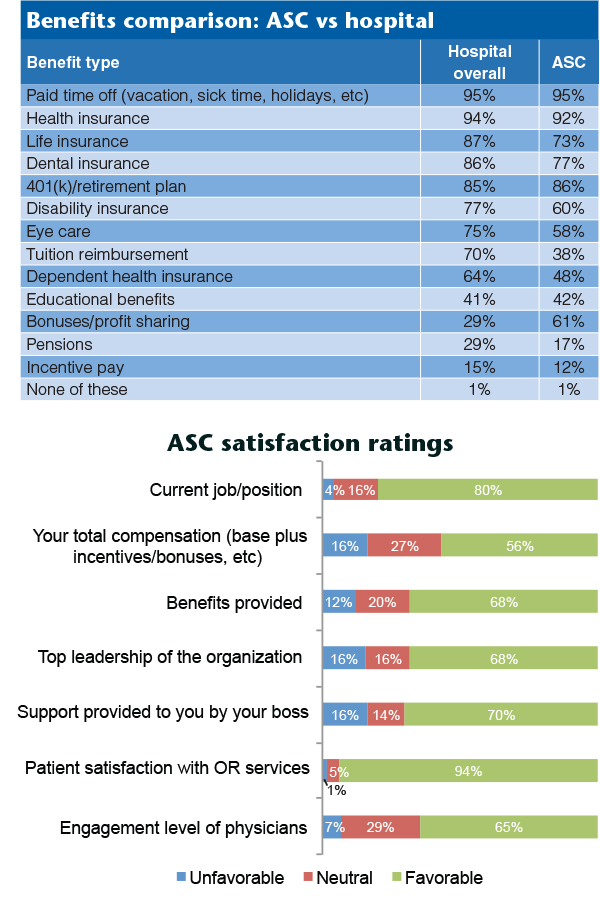
Despite the lack of growth in compensation, ASC leaders remain mostly happy with their jobs. On a scale of 1 to 10, with 1 being “not engaged at all” and 10 being “totally engaged,” ASC managers rate themselves an average of 9.36, compared to 9.24 in 2015. And, 80% rate their satisfaction with their current job as “favorable” (vs 76% in 2015).
Other key findings from this year’s survey include:
• The average raise was 3.39%, comparable to last year’s 3%.
• Most respondents (61%) plan to stay with their current employer until retirement.
• About 25% plan to retire by 2020, a mere 4 years away.

The difference between compensation of ASC and hospital managers continues to drop. This year, the average salary of ASC managers was $9,927 less than their hospital counterparts, compared to a difference of $13,935 in 2015, $16,000 in 2014, and $27,700 in 2013.
Average total compensation, including wages, bonuses, insurance, and pensions, was highest in the Midwest ($142,000), followed by the West ($138,000), Northeast ($128,000), and South ($118,000).
ASC leaders may be narrowing the salary gap with their hospital colleagues, but variances in benefits remain. For example, disability insurance is a benefit for 77% of hospital leaders compared to 60% for those in ASCs, and only 48% of ASC leaders have health insurance for dependents, vs 64% of hospital leaders.
Nearly two-thirds (61%) report a bonus or profit-sharing benefit, however, vs 29% of their hospital colleagues.


The average work week of 47.43 hours is on par with last year’s 48.2 hours. Only 20% work 40 hours or less during the week.
The breakdown in respondents’ job titles was administrator or administrative director (34%), director (31%), and nurse manager (27%). ASC leaders manage an average of 24.33 ORs, with a range of 22 to 26, and they oversee an average of 36.84 employees (mean of 30.11 clinical and 6.73 nonclinical).
With regard to annual operating budget, most respondents either did not know (29%) or did not want to share (23%) those figures. Among the rest, 12% reported a budget between $5.0 and $9.9 million. For the 4% (six respondents) who manage a budget of $15 million or more, the range was $15 to $35 million, with a mean of $20.5 million.
Only 14% of respondents plan to leave their current employer within the next 2 years. Nearly two-thirds (63%) of ASC managers report they are “totally engaged” in their current position, and 65% say they are satisfied with the engagement level of their staff.
The 80% favorable satisfaction level that ASC leaders reported for their current position is comparable to the 76% reported overall for those working in health services and healthcare. Similar results are reported for those in other professions such as financial services (76%) and insurance (75%).
Although 94% of ASC leaders view patient satisfaction with OR services as favorable, that figure drops to 68% for other benefits provided and top leadership of an organization. However, those results are similar to others working in healthcare, with 61% for benefits and 57% for top leadership.
Most leaders hold a bachelor’s degree (42%) as their highest level of education, with 27% having a master’s degree. Only one person reported a doctoral degree, and only nine had a diploma as their highest level of education. In all, 16% had an associate degree in nursing.
ASC leaders have seen little change in compensation, satisfaction, and scope of work during the past year. It remains to be seen whether this steady course will continue in the future. ✥
Data for the OR Manager Salary/Career Survey were collected from March 23 to April 30, 2016. The survey list comprised nurse managers of ASCs who were either OR Manager subscribers or part of an external list. The survey was closed with 157 usable responses. The margin of error is ±9 percentage points at the 95% confidence level.
This article features the compensation and management findings from the survey. Results of the staffing portion of the survey appeared in the September 2016 issue.
OR Manager thanks those who generously took time to complete this year’s survey. We appreciate your part in gathering this information, which will be useful to your colleagues around the country.


