In 2020, supply costs were once again reported as one of the greatest line-item expenses in a hospital, exceeding labor expenses. US hospitals have most recently reported a combined $36 billion in medical and surgical supply costs. These expenses account for more than half of a hospital’s total supply costs. And, as the pandemic continues, these costs continue to rise at unsustainable rates.
ORs continue to be a main revenue source for hospitals—and yet, ORs are one of the largest drivers of waste and cost. The OR represents approximately 60% of a hospital’s supply expenditures, with the average OR supply spend per year at nearly $1M per surgical suite, not including salaries paid for manually stocking, restocking, reshelving, and checking for expired items.
 The top sources for waste include:
• supply chain management challenges
• item preference variations
• materials management knowledge gaps
• multiple stocking locations
• inefficient communication.
Supply management efficiencies are vital, especially for those in the OR when time is precious. Nurses spend up to 50% of their time searching, moving, or sorting supplies. According to a recent Cardinal Health whitepaper, many hospitals and health systems are still manually tracking supplies and inventory—identified as one of the root causes for a “never event,” in which an expired or recalled product is used on a patient. Despite best efforts, between 7% and 10% of clinical products still expire on hospital shelves before being used. And 27% of hospital staff know of an instance in which an expired or recalled product was used on a patient.
Considering these figures, one thing is clear: real-time data and analytics that yield actionable insights are desperately needed to streamline OR operations and supply management and save costs. Automated, integrated technology that makes the OR more efficient also supports a more cost-effective, streamlined supply chain of the future—and further enhances patient care.
There is a critical need for data-driven insights and a suggested course of action that aligns the supply chain with clinical teams. A workflow solution that allows for accurate data capture and analytics enables opportunities such as supply management and optimization. This includes product linking capabilities that help ensure product availability of preferred items and provide an alternative should that item be backordered or out-of-stock. In addition, an enterprise-wide data set that combines data from multiple sources (such as electronic health records or EHR; materials management information system or MMIS; and enterprise resource planning or ERP) helps hospitals avoid being data rich but insight poor. Too many hospitals have an abundance of data but lack the systems and expertise to act on that data.
Predictive and prescriptive analytics not only predict future needs, but they also provide a course of action to manage supply-related challenges proactively. This is an area of opportunity for hospitals to dig deeper into. These analytics take historical data—what has happened in the rearview mirror—and look at what is happening now based on customer/patient insights. Data is trained on algorithms to help predict future events and help with staffing levels, which is another huge budget item for hospitals and their ORs, especially in the wake of the pandemic. An automated solution takes data like utilization rates, what products are on shelves, and expiration dates to predict what products are expiring so they can be used before time runs out. These practices help minimize wasted resources, decrease manual time spent on supply management tasks, and contribute to the overall sustainability of the supply chain.
The solution to many supply challenges an OR faces today is a single, health system wide platform that allows hospitals to streamline their OR processes and improve efficiency through real-time inventory visibility and prescriptive analytics. With up-to-the-minute insights and wrap-around logistics, hospital operations teams can rise to the level of excellence needed to support and advance their cost position and clinical ambitions.
A single platform can provide alerts for things like recalled or missing items with analytics that pull together multiple streams of supply data to ensure complete visibility, from receipt to usage to re-order. For example, a data linking feature would offer a daily data feed that enables hospitals’ business intelligence teams to develop reports and visualizations, pulling data from multiple sources into one, streamlined dashboard.
The interoperability of a single platform is key—one that seamlessly integrates between existing hospital systems, including MMIS, EHR, and ERP. Clean item master is another piece within a hospital that sets that foundation for clean, actionable data and insights downstream. Clean item master is critical for delivering higher quality and more cost-effective care. It uncovers new opportunities for savings and shows deep historical data on product usage to increase future efficiency. Not only are a clean item master and adopting global standards key foundational elements for any mature clinically integrated supply chain, but they are also crucial for delivering higher quality and more cost-effective care.
Gaining efficiencies in healthcare, given that costs continue to rise at an exponential rate, is critical, especially in the OR where staff need to spend less time on supply management. OR managers or leaders want to make sure that, from a product perspective, they have the products available when they need them to avoid canceling a procedure. An integrated supply management solution carries products through the lifecycle, identifying when something needs to be reordered based on Periodic Automatic Replenishment (PAR) levels. It allows OR staff to be aware of any challenges in terms of getting the right products while also providing key data and insights regarding cost-per-case, which is critical at the surgeon level for financial reporting. Automated technology platforms also identify opportunities to reduce product variation, consolidate stock keeping units, or SKUs, and help drive cost savings and efficiency, tying directly back to value analysis. A platform of this kind should offer demand planning, which utilizes analytics to look at case scheduling—what products are being used in surgical cases, for example—to better investigate what products and quantities are needed based on past utilization levels.
Overall, visibility to real-time product data and analytics opens opportunities for both cost savings and time savings for OR managers and supply chain leaders. For example, in a time-and-motion user study, users of an automated workflow solution saved an average of nearly seven hours weekly for staff—357 hours per year—in just the first 3 months of implementation. By enabling supply chain automation with analytics, hospitals can gain workflow efficiency, promote operational clarity, decrease time spent in the OR manually tracking inventory, and create a real financial impact.
In a peri-pandemic world, where supply chain has been put on the forefront, it is important that health system leaders employ the right strategies supported by the right technology to enable excellence in their supply chains. The right technology and automation platform can help health systems optimize their supply management analytics that yield actionable insights to drive optimal demand planning, ultimately saving time and money, as well as helping drive optimal patient outcomes. ORM

CISOM: A model to drive clinically integrated supply chain maturity. HIMSS Analytics. 2017.
Data based on WaveMark™ time and motion study led by third-party research firm. Kaleidoscope at White Memorial Hospital. Los Angeles. 2017.
Hospital Supply Chain Survey. Cardinal Health. March 2018.
Optimizing the supply chain in the wake of the pandemic. Cardinal Health Whitepaper. July 31, 2021.

When: Monday, March 16, 2026 · 1:00 p.m. Eastern Time
About
Surgery coordination can be fragmented, time-consuming, and error prone due to multiple parties needing to confirm case details through a wide variety of channels. Surgeons can spend more time than they wish outside of the of the operating room due to prolonged OR turnover times. This can be partially due processes that include excessive amounts of equipment needing to be broken down, cleaned, and set up after each case. Excessive instrumentation can lead to increased case costs.
In this webinar Dr. Robert B. (RB) Jones with Mercy Orthopedics will review how he used Advance Case Management (ACM) in his practice to:
This has enabled Dr. Jones to run a more efficient operating day. Dr. Jones currently reports over 1,300 Arthroplasty cases per year, and with utilization of Advance Case Management he aims to add to that number, and even drive efficiency and case cost reduction.

Dr. Robert B.(RB) Jones
Orthopedic Surgeon, Mercy Springfield
Dr. Jones specializes in adult reconstructive orthopedic surgery of the hip and knee. He performs routine and complex primary and revision joint replacement operations. Additionally, his focuses include direct anterior total hip arthroplasty and partial knee replacements. He considers himself very lucky to have a profession that he is passionate about and blessed to be able to help others doing what he loves.
Nate Edgington DBH, MHI, MBA
Senior Manager, Field and Customer Solutions, DepuySynthes
Nate Edgington is a seasoned leader in the MedTech industry, with over 20+ years’ experience working in the US and overseas. Nate has held various roles with DePuy Synthes as a group manager and more recently a regional manager for the Advance Case Management Platform. Nate has a doctorate in healthcare management and a master’s degree in healthcare innovation from Arizona State University and an MBA from Taylor University.
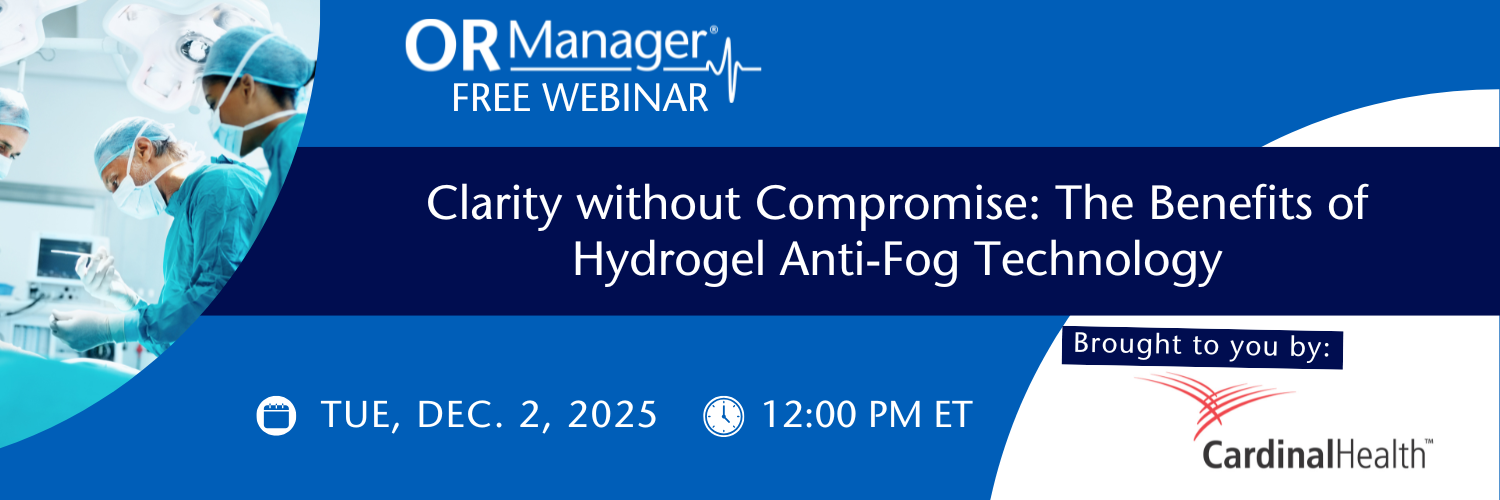
When: Tuesday, December 2, 2025 · 12:00 p.m. Eastern Time
About:
This webinar will dive into the importance of utilizing antifog surgical masks in clinical settings, examining how the risk of mask fogging can compromise the safety of healthcare providers and patients. Attendees will gain a comprehensive understanding of surgical masks, what antifog is, and what types of antifog technology are currently available in the market. The Cardinal Health hydrogel surgical mask will also be introduced, and its many features and benefits will be detailed.
Meet the Speakers:

Annie Copeland, Global Marketing Director, PPE, Cardinal Health
Annie resides in Massachusetts and has been with Cardinal Health for 8 years. With a degree in English and Marketing from Assumption University, she has held various roles across sales and marketing serving various customer segments. In her current role at Cardinal Health she leads both portfolio strategy and commercial execution for PPE. With a keen focus on clinical insight and customer needs, she aims to deliver a portfolio of PPE products known for reliable performance, designed for comfort and delivering ongoing value.
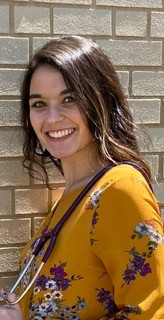
Bridget Stovall, Global Medical Advisor, Cardinal Health
Bridget currently resides in Green Bay, Wisconsin, and has worked for Cardinal Health for about a year. With a BSN from St. Ambrose University, she has a strong work history as a bedside nurse, a Clinical Nurse Leader, an Inpatient Nurse Manager, and now as a Global Medical Advisor. In her current role, she provides clinical expertise and serves as the subject matter expert to support product design, change management, and risk mitigation through product lifestyle. She serves as a clinical consultant and works to align clinical practice, product usage, and user needs.

When: Wednesday, December 3, 2025 · 1:00 PM ET
About:
This continuing education session explores the critical role of double gloving in enhancing safety for both surgical patients and healthcare workers. Participants will gain evidence-based insights into the risks associated with undetected glove perforations and the link between glove integrity and surgical site infections (SSIs). The program reviews recently published literature and consensus recommendations to highlight the benefits of double gloving with an indicator system and changing gloves at specific intervals including improved detection of glove breaches, decreased transmission of bloodborne pathogens, and reduced infection rates.
Meet the Speaker:

Carlo Butacan, BSN, RN, CNOR, Clinical Specialist, Molnlycke Health Care.
After completing his Bachelor’s in Psychology at Loyola University Chicago and obtaining a Bachelor’s in Nursing from Lewis University in Romeoville, IL, Carlo has dedicated over 17 years to his career as a registered nurse, primarily specializing in the surgical field. His extensive experience includes actively participating in various procedures, with orthopedics being his preferred focus. This hands-on involvement, both in scrubbing into surgeries and circulating, laid the groundwork for his professional growth.
Carlo transitioned into roles in Quality and Business Management for Surgery, ultimately leading him to his current position as a Clinical Nurse Specialist at Molnlycke. In this role, he is enthusiastic about applying his accumulated knowledge and, most importantly, serving as an educator. Despite his demanding career, Carlo still manages to find time to explore new restaurants in his hometown of Chicago, IL, as well as travel abroad.
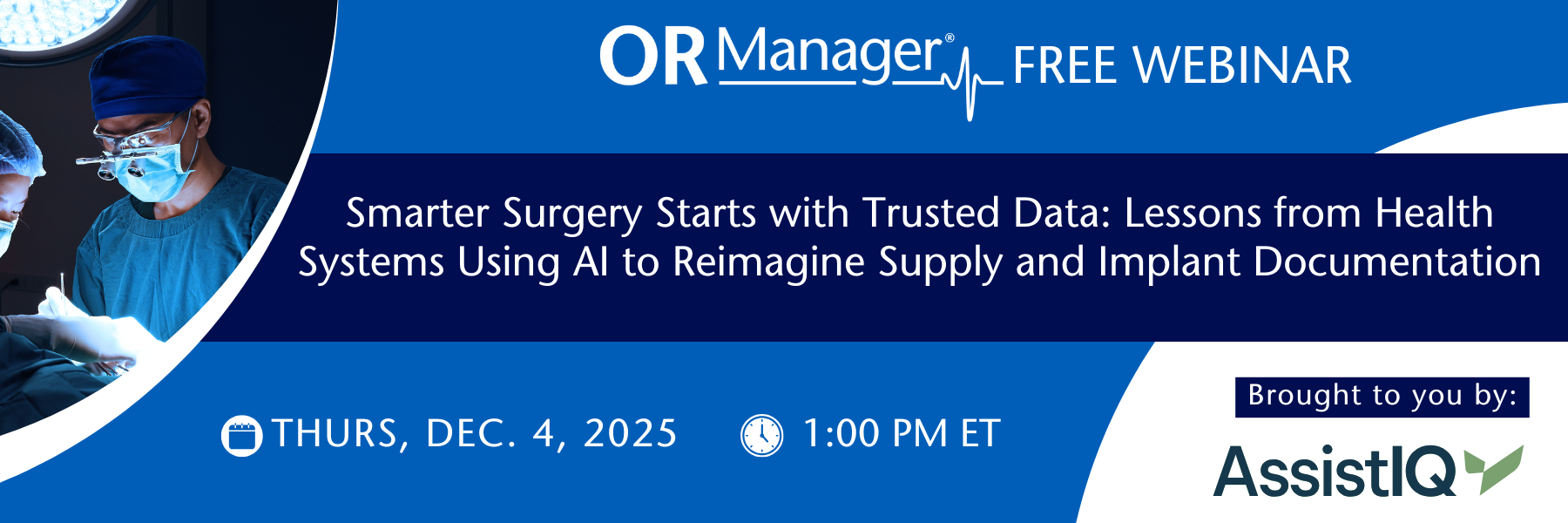
When: Thursday, December 4, 2025 · 1:00 p.m. Eastern Time
Perioperative teams are navigating tighter margins, staffing strain, and new reimbursement pressures such as OBBBA—all while relying on manual and ineffective systems that weren’t built for today’s demands.
Join AssistIQ and health system leaders for a candid roundtable on how hospitals are reimagining supply and implant documentation with AI-powered capture. Panelists will share why they adopted this approach, what implementation looked like, and the measurable impact they’ve seen so far.
“We have a financial ROI. We’ve been on it for six months, and we’ve been able to have a 12% increase in billable revenue and a 50% reduction in expired items.” -Beth Steele, Chief Operating Officer, Owensboro Health Regional Hospital
“Our care team members feel the difference right away. Instead of dealing with barcode scans that may not register or having to manually document, our teams can capture every product quickly and accurately while keeping their focus on the patient.” –Matt Pavlovec, Patient Care Manager, Allina Health
Meet the Speakers:

Amy Brown, MHA is the Director of Customer Delivery at AssistIQ, where she leads implementation and customer success. With a background in healthcare operations, Amy previously worked within Surgical Services at OhioHealth Riverside Methodist Hospital before gaining product and technology experience at a healthcare startup. She brings a deep understanding of perioperative workflows and a passion for helping health systems leverage AI to improve efficiency, accuracy, and the clinician experience.
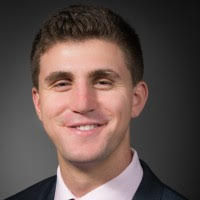
Ryan Ott, MPA oversees financial and operational performance across 36 operating rooms and 5 interventional radiology procedure rooms at North Shore University Hospital, part of Northwell Health. His work focuses on optimizing perioperative efficiency through initiatives in scheduling, charge capture, cost savings, and staffing optimization.
Ryan holds a Bachelor of Arts in Economics and Psychology from Bucknell University and a Master of Public Administration in Health Policy and Management from New York University.

Matt Pavlovec, MBA, BSN, RN brings thirty years of cardiovascular and emergency care experience across EMS and hospital settings. He has led operations spanning patient care, research, and outreach, and for the past six years has managed the Cath Lab, EP Lab, and Prep Recovery at Abbott Northwestern Hospital. Matt’s leadership focuses on operational excellence and advancing care delivery within high-acuity procedural environments.

Megan Harris, MBA is the director of Materials Management at Owensboro Health. With over 11 years of experience in healthcare supply chain, Megan specializes in strategic sourcing, process improvement, GPO product standardization, cost savings, and operational excellence; driving efficiency while fostering collaboration across clinical and operational teams.

When: Wednesday, November 5 | 1:00PM-2:00PM ET
This session introduces clinical nurses to the fundamentals of artificial intelligence in healthcare, with a focus on building AI literacy. We’ll explore essential terminology, real-world examples of generative AI, and ethical frameworks such as the HIMSS “5 Rights of AI.” Participants will gain awareness of emerging technologies, from robotics to AI prompting, and how these tools are influencing clinical workflows, communication, and decision-making.
Agenda:
Meet the speaker:

Olga Kagan, PhD, RN, FHIMSS, FAAAAI, NYAM Fellow, is a nurse scientist and educator whose work bridges informatics, innovation, and artificial intelligence in healthcare. Her research and private practice focus on food allergy management and policy through a tech-forward lens. As founder of the Food Allergy Nursing Association (FANA), she advances education and networking for nurses in this emerging subspecialty.
Dr. Kagan teaches graduate nursing informatics and leads initiatives at HIMSS, where she co-developed the “5 Rights of AI for Healthcare” and expanded the AI & Innovation Toolkit. She co-chairs the mHealth & Innovation HITE subcommittee at AAAAI and has served as HIMSS NYS Chapter board member and nursing committee chair, launching its annual Nursing Informatics Symposium in 2021. Currently President-Elect of SONSIEL, she founded its research committee and drives innovation through hackathons and pitch-a-thons globally. At NYAM, she chairs the Nursing Section, fostering interdisciplinary collaboration.
Dr. Kagan holds degrees from Hunter-Bellevue and Molloy University and has earned multiple awards for leadership, research, and mentorship. Her thought leadership has been featured on HIMSS TV, several podcasts and in print.


